Showing posts sorted by relevance for query City Housing homes. Sort by date Show all posts

Monday, January 15, 2018

Rental Warrant of Fitness for Wellington

Read article : Rental Warrant of Fitness for Wellington

Thursday 17 August

Rental Warrant of Fitness for Wellington

Wellington City Council is partnering with the University of Otago, Wellington, to launch a voluntary Rental Warrant of Fitness for minimum housing standards in Wellington, Mayor Justin Lester has announced.

“We want to lift rental standards in our city and make better accommodation available for people. Every Wellingtonian deserves a warm, dry home," says the Mayor.

“We’re pleased to announce the first Rental Warrant of Fitness in New Zealand, alongside public health experts from the University of Otago.

“We’re partnering with the University and will be launching an app that will allow tenants and landlords to check their house against minimum health standards designed by experts, and allow landlords to request a full inspection by a professional to be certified as meeting the standard.

“This will give landlords the chance to promote their house as being warm and dry, and give prospective renters an assurance the home they are looking to live in meets the standard.

“All available analysis strongly indicates that improved quality of housing leads to improving health, social and financial outcomes."

Deputy Mayor and Housing Portfolio Leader Paul Eagle says improving the quality of the housing stock was a key goal for the Council.

“This is just the start – through our Long Term Plan we will be introducing a Wellington Housing Quality Standard that will incorporate both personal health and earthquake resilience, and be tailored to Wellington’s needs. Information from this voluntary scheme will help inform the permanent standard Council introduces," he says.

Philippa Howden-Chapman, Professor of Public Health at the University of Otago, Wellington, says “The Rental Warrant of Fitness is the first scheme in the country that is taking action and helping raise the standards of our homes. It focuses on areas of the home that we know have the greatest chance of improving the occupants’ health.

“We will be launching the Rental Warrant of Fitness in Wellington on August 28, and I urge landlords to get behind this and use it as a tool to raise the level of their property to a minimum standard.”

Council will consider the partnership for approval at next week’s City Strategy Meeting on Thursday 24 August.


Q&A - Rental Warrant of Fitness (RWoF)

Who created the Rental Warrant of Fitness?

The Rental Warrant of Fitness is a University of Otago, Wellington initiative that is the result of many years research, working with industry experts and conducting practical trials. Wellington City Council and four other Councils (Auckland, Tauranga, Christchurch and Dunedin) took part in the 2014 Trial of this Rental Warrant of Fitness. Wellington City Council is supporting the Rental Warrant of Fitness as a voluntary scheme for the city.

This will help inform a Wellington Housing Standard that will take into account our city's unique layout and earthquake risks.

Who funded this scheme?

The Health Research Council of New Zealand funded the University of Otago, Wellington to develop and launch the Rental WoF, train the inspectors and evaluate its overall costs and benefits, including the impact on tenants’ health. The Hutt Mana Charitable Trust funded the monitoring of the rental housing market in the Hutt Valley, which as yet has not introduced the Rental WoF and will enable us to see the overall effect of the Rental WoF. Otherwise the scheme is self-funding. More info can be found here www.rwof.org.nz

How does the assessment work?

Landlords (or tenants with their landlord's permission) can book a Rental Warrant of Fitness inspection on Wellington City Council’s website from August 28.

We’re partnering with qualified building inspectors who will come to the house and carry out an assessment which will take around an hour to complete.

You will receive a pass or fail on the spot.

A report will be emailed to you shortly thereafter.

If the house fails the assessment you have 6 months to meet the criteria and re-book a follow up assessment for free.

The Rental Warrant of Fitness is valid for three years.

What areas of the house are assessed? How many questions are there?

The Rental Warrant inspection has 29 criteria and 63 questions.

The assessment covers insulation, heating, ventilation, structural stability, sanitation, and hazard identification.

Every question must achieve a pass for the Rental Warrant of Fitness to be achieved. (like a vehicle WOF)

A self-assessment app is available on the Wellington City Council website from 28 August. Anyone can download for free. This will give a good understanding of how close the house is to meeting the Rental Warrant of Fitness assessment standard.

How long is the RWoF valid for?

Three years.

How much does the Rental Warrant of Fitness inspection cost?

The professional inspection and assessment is $250.

If the house doesn’t pass there is a six month window to get the work done and have a re-assessment done for free.

How do I pay for the inspection?

Payment is made either through the website when requesting an inspection or on the day of the inspection.

Is it voluntary?

Yes. Right now this is something landlords can choose to take part in to demonstrate they are responsible landlords. It gives them the chance to stand out in the market and show prospective renters the home they are looking to live in meets the standard.

Can anyone choose to get a Rental Warrant of Fitness?

Yes. Although it is designed for rental properties, it does set a safe, warm, dry standard for all housing.

Is the RWoF for stand-alone houses and apartments?

It’s been designed and tested on both.

If my house doesn’t pass, can I re-book a follow up inspection for free?

Yes, you have up to six months to make the necessary changes and re-book at no cost.

Can anyone use the self-assessment app?

Yes. The self-assessment app is free and will be available from 28 August.

The self-assessment app does not give a valid pass or fail and you cannot claim to have a Rental Warrant of Fitness as a result of doing the self-assessment.

However, it will give a good indication of the state of the house.

How were the questions/criteria selected for the Rental Warrant of Fitness?

The Rental Warrant of Fitness was developed by the University of Otago, the New Zealand Green Building Council and the Accident Compensation Corporation in combination with five City Councils. The RWoF focuses on features that are supported by evidence that these changes reduce unintentional injury in the home, improve occupants’ health status, reduce school absences, and lead to greater household energy efficiency.

What’s the Wellington Housing Standard?

Wellington City Council is developing criteria that will set a standard for homes that incorporates both personal health and earthquake resilience. Wellington has some unique challenges and we want to create a standard that is designed specifically for our city.

Will the City Housing homes go through the Rental Warrant of Fitness scheme?

We're in the middle of a $400 million dollar upgrade programme to bring all of our buildings up to modern standards. Once that upgrade is completed, all of our City Housing Properties will pass the WOF.

City Housing is involved in developing our permanent Wellington Housing Standard

The 29 questions for the Rental WOF are:

Appendix A: Assessment Criteria

1. Is there a functional, safe stove-top and oven? (Yes/no)

2. Is there adequate space for food preparation and storage? (Yes/no)

3. Is there an adequate supply of hot and cold potable water? (Yes/no)

4. Is the hot-water at the tap 55C (±5C?) (Yes/no)

5. Is there a functional toilet, which does not have a cracked or broken seat, cistern or bowl? (Yes/no)

6. Is there a suitably located bath or shower in good working order? (Yes/no)

7. Are there secure or high level cupboards or shelves for storing hazardous or toxic substances out of children's reach? (Yes/no)

8. Is there a adequate form of safe and effective space heating? (Yes/no)

9. Do the bathroom, kitchen and all bedrooms have some form of ventilation to outside? (Yes/no)

10. Is the house reasonably free of visible mould, i.e. the total area of mould is less than an A4 sheet of paper? (Yes/no)

11. Are power outlets, light switches and wiring safe and in good working order? (Yes/no)

12. Is there adequate indoor lighting? (Yes/no)

13. Does the house have adequate working smoke alarms? (Yes/no)

14. Have the windows got effective latches? (Yes/no)

15. Do high level windows have security stays to prevent falls? (Yes/no)

16. Are there curtains or blinds in the bedrooms and living area? (Yes/no)

17. Do glass doors have safety visibility strips? (Yes/no)

18. Does the house have ceiling insulation to WOF standards? (Yes/no)

19. Does the house have underfloor insulation to WOF standards? (Yes/no)

20. Is a ground vapour barrier installed under the ground floor? (Yes/no)

21. Is the house weathertight with no evident leaks, or moisture stains on the walls or ceiling? (Yes/no)

22. Is the house in a reasonable state of repair? (Yes/no)

23. Is the storm and waste water drainage being adequately discharged? (Yes/no)

24. Is there any water ponding under the house? (Yes/no)

25. Is there adequate outdoor lighting near entrance ways? (Yes/no)

26. Does the house appear to be structurally sound? (Yes/no)

27. Are there handrails for all internal stairs and all outdoor steps that access the house, and do balconies/decks have balustrades to the current Building Code? (Yes/no)

28. Is the address clearly labelled and identifiable? (Yes/no)

29. Are there securely locking doors? (Yes/no)


ends

© Scoop Media

Friday, June 2, 2017

Dispossessed in the Land of Dreams

Read article : Dispossessed in the Land of Dreams


Sometime in July 2012, Suzan Russaw and her husband, James, received a letter from their landlord asking them to vacate their $800-a-month one-bedroom apartment in Palo Alto, California. He gave them 60 days to leave. The “no-fault” eviction is a common way to clear out low-paying tenants without a legal hassle and bring in people willing to pay thousands more in rent. James was 83 at the time and suffering from the constellation of illnesses that affect the old: He had high blood pressure and was undergoing dialysis for kidney failure and experiencing the early stages of dementia.

Their rent was actually a couple of hundred dollars more than James’s monthly Social Security benefits, but he made up the rest by piecing together odd jobs. They looked for a new apartment for two months and didn’t find anything close to their price range. Their landlord gave them a six-week extension, but it yielded nothing. When mid-October came, Suzan and James had no choice but to leave. With hurried help from neighbors, they packed most of their belongings into two storage units and a ramshackle 1994 Ford Explorer which they called “the van.” They didn’t know where they were going.

A majority of the homeless population in Palo Alto—93 percent—ends up sleeping outside or in their cars. In part, that’s because Palo Alto, a technology boomtown that boasts a per capita income well over twice the average for California, has almost no shelter space: For the city’s homeless population, estimated to be at least 157, there are just 15 beds that rotate among city churches through a shelter program called Hotel de Zink; a charity organizes a loose network of 130 spare rooms, regular people motivated to offer up their homes only by neighborly goodwill. The lack of shelter space in Palo Alto—and more broadly in Santa Clara and San Mateo counties, which comprise the peninsula south of San Francisco and around San Jose—is unusual for an area of its size and population. A 2013 census showed Santa Clara County having more than 7,000 homeless people, the fifth-highest homeless population per capita in the country and among the highest populations sleeping outside or in unsuitable shelters like vehicles.

San Francisco and the rest of the Bay Area are gentrifying rapidly—especially with the most recent Silicon Valley surge in social media companies, though the trend stretches back decades—leading to a cascade of displacement of the region’s poor, working class, and ethnic and racial minorities. In San Francisco itself, currently the city with the most expensive housing market in the country, rents increased 13.5 percent in 2014 from the year before, leading more people to the middle-class suburbs. As real estate prices rise in places like Palo Alto, the middle class has begun to buy homes in the exurbs of the Central Valley, displacing farmworkers there.

Suzan, who is 70, is short and slight, with her bobbed hair dyed red. The first time I met her, she wore leggings, a T-shirt, a black cardigan wrapped around her shoulders, and fuzzy black boots I later learned were slippers she’d gotten from Goodwill and sewn up to look like outside shoes. (She wore basically the same outfit, with different T-shirts, nearly every time we met, and I realized she didn’t have many clothes.) Her voice is high and singsongy and she is always polite. You can tell she tries to smooth out tensions rather than confront them. She is a font of forced sunniness and likes to punctuate a sad sentence with phrases like “I’m so blessed!” or “I’m so lucky!” She wore a small necklace and said jewelry was important to her. “I feel, to dispel the image of homelessness, it’s important to have a little bling,” she said.

In the van, Suzan was in charge of taking care of everyone and everything, organizing a life that became filled with a unique brand of busy boredom. She and James spent most of their time figuring out where to go next, how to get there, and whether they could stay once they arrived. They found a short-term unit in a local family shelter in Menlo Park that lasted for five weeks. Afterward, they stayed in a few motels, but even fleabags in the area charge upwards of $100 a night. When they couldn’t afford a room they camped out in the van, reclining the backseats and making a pallet out of blankets piled on top of their clothes and other belongings. Slowly, there were fewer nights in hotels and more in the van, until the van was where they lived.

A life of homelessness is one of logistical challenges and exhaustion. Little things, like planning a wardrobe for the week, involved coordinated trips to storage units and laundromats, and could take hours. The biggest conundrum? Where to pull over and sleep. Suzan and James learned quickly not to pull over on a residential block, because the neighbors would call the police. They tried a church or two, 24-hour businesses where they thought they could hide amidst the other cars, and even an old naval field. The places with public toilets were best because, for reasons no one can quite explain, 3 a.m. is the witching hour for needing to pee. They kept their socks and shoes on, both for staying warm on chilly Bay Area nights and also for moving quickly if someone peered into their windows, or a cop flashed his light inside, ready to rouse. Wherever they were sleeping, they couldn’t sleep there. “Sometimes, I was so tired, I would be stopped at a red light and say, ‘Don’t go to sleep. Don’t go to sleep,’” Suzan said. “And then I would fall asleep.”

A few months in, a nice man in a 7-Eleven parking lot told them about a former high school turned community center on the eastern side of town called Cubberley. He’d walked up to their van after recognizing signs of life in the car, tired faces among the junk piling up in the back. Suzan and James were familiar with the community center because they’d taken their daughter to preschool there many years before, but they hadn’t thought about sleeping there. Cubberley had a quiet back parking lot, a flat grass amphitheater with a concrete paddock for a stage, and 24-hour public bathrooms with showers in an old gym. Rumor was that the cops wouldn’t bother anyone.

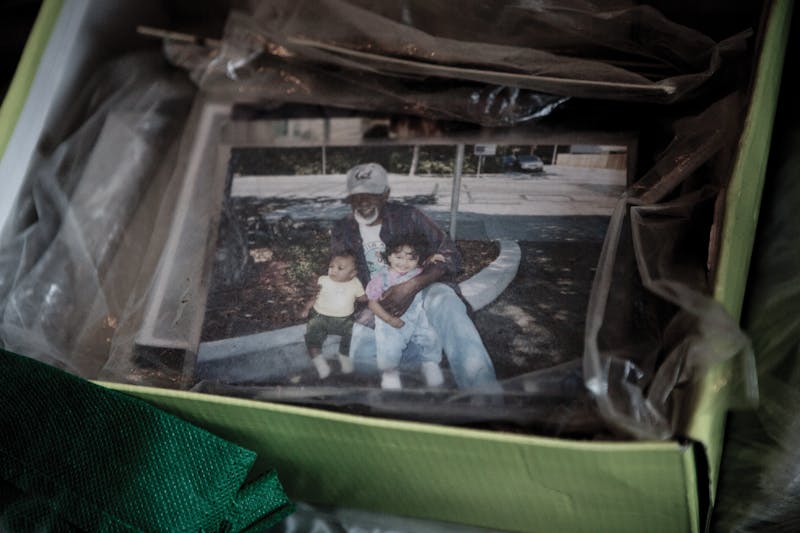
imageSuzan’s husband, James Russaw, pictured with two of their grandchildren.

Cubberley was a psychic relief because it solved so many basic needs: It had a place to bathe in the morning, a place to charge your phone. The parking lot had also formed its own etiquette and sense of community. People tended to park in the same places, a spot or two next to their neighbors, and they recognized one another and nodded at night. They weren’t exactly friends, but they were people who trusted each other, an impromptu neighborhood no one wanted to lose after losing so much. It was safe, a good place to spend the night. But it was next door to a segment of homeowners who were fighting hard to move the car dwellers out.

Normally, wealthy people who move into an area don’t see the results of their displacement because the people who lose their homes don’t stick around; they move to cheaper suburbs and work themselves into the fabric elsewhere. But the folks at Cubberley, 30 people on any given night, were the displacement made manifest. Most weren’t plagued with mental health or substance abuse problems; they simply could no longer afford rent and became homeless in the last place they lived. People will put up with a lot to stay in a place they know. “I’ve been analyzing why don’t I just get the heck on. Everybody says that, go to Wyoming, Montana, you can get a mansion,” Suzan said. “Move on, move on, always move on. And I say to myself, ‘Why should I have to move on?’”

It’s a new chapter in an old story. In his seminal 1893 lecture at the Chicago World’s Fair, Frederick Jackson Turner summarized the myth of the American frontier and the waves of settlers who created it as an early form of gentrification: First, farmers looking for land would find a remote spot of wilderness to tame; once they succeeded, more men and women would arrive to turn each new spot into a town; finally, outside investors would swoop in, pushing out the frontiersman and leaving him to pack up and start all over again. It has always been thus in America. Turner quoted from a guide published in 1837 for migrants headed for the Western frontiers of Ohio, Indiana, and Wisconsin: “Another wave rolls on. The men of capital and enterprise come. The ‘settler’ is ready to sell out and take the advantage of the rise of property, push farther into the interior, and become himself a man of capital and enterprise in turn.” This repeating cycle, Turner argued, of movement and resettlement was essential to the American character. But he foresaw a looming crisis. “The American energy will continually demand a wider field for its exercise,” he wrote. “But never again will such gifts of free land offer themselves.” In other words, we would run out of places for the displaced to go.


Suzan was born in 1945. Her father worked at what was then the Lockheed Corporation, and her mother had been raised by a wealthy family in Oak Park, Illinois. Her family called her Suzi. Though she grew up in nearby Saratoga—and spent some time in school in Switzerland—she distinctly remembers coming with her mother to visit Palo Alto, with its downtown theaters and streets named after poets. Palo Alto more than any other place formed the landscape of her childhood. “It was a little artsy-craftsy university town—you find charming towns are university towns.”

Like many women of her day, Suzan didn’t graduate from college. When she was 24, after her last stay in Switzerland, she moved to Mountain View, the town on Palo Alto’s eastern border that is now home to Google and LinkedIn. She was living off a small trust her family had set up for her when she met James at a barbecue their apartment manager threw to foster neighborliness among his tenants. James had grown up in a sharecropping family in Georgia, moved west during World War II, and was more than 17 years her senior, handsome and gentlemanly. Suzan thought: “I can learn something from him.” They were an interracial couple in the late 1960s, which was unusual, though she says her family didn’t mind. It was also an interclass marriage, and it moved Suzan down the income ladder.

For years, James and Suzan lived together, unmarried. They bought a house on University Avenue, just north of the county line and blocks from downtown Palo Alto, in 1979, and four years later had their only daughter, Nancy. It was the area’s ghetto, and the only source of affordable housing for many years. It was also the center of violence in the region, and, in 1992, was the murder capital of the country.

They never had much money. For most of their marriage, James ran a small recycling company and Suzan acted as his bookkeeper, secretary, and housewife. They refused to apply for most government assistance, even as homeless elders. “My husband and I had never been on welfare or food stamps,” she told me. “Even to this day.”

Suzan’s parents died in 2002 and 2003, and her older sister died in 2009. (“I thank God that they’re gone,” she told me. “They would die if they saw me now.”) It was a hard time for Suzan, who went to care for her dying parents and nearly left James. She felt he’d checked out of the difficulties. In retrospect, she thinks his dementia might already have been setting in; James was already in his seventies. He had taken out a second mortgage on their home, and they couldn’t pay it after he retired. They sold the house at a loss in 2005; it’s now a Century 21 office.

After they moved into the van, they settled into a routine. On the nights before James’s early-morning treatments, they slept in the dialysis center’s parking lot. Otherwise they generally stayed at Cubberley. They were still living off James’s retirement income, but most of it went to the $500 needed to rent the two storage units where their furniture remained, until they lost one for nonpayment. Finally, a few months in, Suzan was able to use a clause in a trust set up by her mother’s father to help her out in an emergency. It doubled their income—much of which was eaten up by the costs of gas, the remaining storage unit, parking tickets, and the other expenses of an unsettled life. It was a respectable income, one that technically kept them above poverty, but it still wasn’t enough for rent.

James was increasingly ill and van life was taking a toll. In addition to James’s other problems, both he and Suzan were starting to experience some of the health problems common among the homeless. The backseat of the van filled with bags of clothes, papers, fast-food detritus, pens, old parking tickets, and receipts. As the junk built up, the recline of their seats inched forever upward, until they were sitting up all the time, causing their legs to swell and nerves to become damaged, the medical consequences of not being able to raise your feet at night.


Gentrification used to be about poor neighborhoods, usually black and brown, underdeveloped and full of decrepit and neglected housing stock, run by the occasional slumlord—often described as “blighted,” though that designation has always been problematic—and how they become converted into wealthier ones, usually through the influx of richer white people and their demand for new services and new construction. It’s a negative process for the people who have to move, but there’s occasionally an element of good, because neglected neighborhoods revive. But what’s happening now in the Bay Area is that people who’ve done nothing wrong—not paid their rent late, violated their lease, or committed any other housing sin—are being forced out to make way. Displacement is reaching into unquestionably vibrant, historic, middle- and working-class neighborhoods, like The Mission in San Francisco, a former center of Chicano power. (The Mission alone has lost 8,000 Latino residents in the past ten years, according to a report from the local Council of Community Housing Organizations and the Mission Economic Development Agency.) And it’s happening to such an extent that the social workers who used to steer people to affordable apartments as far away as Santa Rosa or Sacramento, a two-hour drive, are now telling people to look even farther out. The vehicle dwellers I spoke with said they’d heard of friends living in places like Stockton, once a modest working-class city in the middle of the state, receiving notice-to-vacate letters like the one Suzan and James received.

For the most part, the traits that draw people to Palo Alto—good schools, a charming downtown, nice neighborhoods in which to raise a family, and a short commute to tech jobs—are the very same things that made the residents of Cubberley want to stay, even if it meant living in their car. The destabilizing pressure of a real estate market is also felt by the merely rich, the upper middle class, and the middle class, because the high-end demand of the global elite sets the market prices. “My block has the original owners, a retired schoolteacher and a retired postal worker,” said Hope Nakamura, a legal aid attorney who lives in Palo Alto. “They could never afford to buy anything there now.” Most people told me if they had to sell their homes today they wouldn’t be able to buy again anywhere in the area, which means many Palo Altans have all of their wealth tied up in expensive homes that they can’t access without upending their lives. It makes everyone anxious.

imageThe view inside a van parked outside a Palo Alto homeless organization.

The outcry from the neighbors over Cubberley was so fierce that it reshaped Palo Alto’s city government. The city council is nonpartisan, but a faction emerged that revived an old, slow-growth movement in town, known as the “residentialists.” Their concerns are varied (among them, the perennial suburban concerns of property values and traffic), but their influence has been to block any new development of affordable housing and shoo people like Suzan and James away from Palo Alto. An uproar scuttled an affordable-housing building for senior citizens near many public transit options that had been proposed by the city housing authority and unanimously approved by the city council. Opponents said they were worried about the effect the development would have on the surrounding community—they argued it wasn’t zoned for “density,” which is to say, small apartments—and that traffic congestion in the area would be made worse. Aparna Ananthasubramaniam, then a senior at Stanford, tried to start a women’s-only shelter in rotating churches, modeled after the Hotel de Zink. She said a woman came up to her after a community meeting where the same concerns had been raised by a real estate agent. “Her lips were quivering and she was physically shaking from how angry she was,” Ananthasubramaniam told me. “She was like, ‘You come back to me 20 years from now once you have sunk more than $1 million into an asset, like a house, and you tell me that you’re willing to take a risk like this.”

The trouble for Cubberley began when neighbors went to the police. There’d been at least one fight, and the neighbors complained about trash left around the center. At the time, Cubberley was home to a 64-year-old woman who’d found a $20-an-hour job after nine years of unemployment; a tall, lanky, panhandler from Louisiana who kept informal guard over her and other women at the center; a 63-year-old part-time school crossing guard who cared for his dying mother for 16 years, then lived off the proceeds from the sale of her house until the money ran out; two retired school teachers; a 23-year-old Palo Alto native who stayed with his mother in a rental car after his old car spontaneously combusted; and, for about six months, Suzan and James. “They didn’t fit this image that the powers that be are trying to create about homeless people. They did not fit that image at all,” Suzan told me. “We made sure the premises were respected, because it was an honor to be able to stay there.” She and others told me they cleaned up their areas at the center every morning.

“I said, ‘We have no place to go, and we’re staying right here.’ They were going to know about it.”

Pressured to find a way to move the residents out, the police department went to the city council claiming they needed a law banning vehicle habitation to address the neighbors’ concerns. Advocates for the homeless said that any problems could be solved if police would just enforce existing laws. Local attorneys warned the city council that such laws could soon be considered unconstitutional, because the Ninth Circuit Court of Appeals was hearing a challenge to a similar law in Los Angeles. Carrie LeRoy, an attorney who advocated on behalf of the unhoused, and other attorneys threatened to file a class-action lawsuit if the vehicle-habitation ban ever went into effect. The city council passed the ban anyway, in a 7-2 vote in August 2013, and the police department and other groups in the city started an outreach program to tell people about the law. “All of them had received these notices from the city,” LeRoy said, “And it was basically like, ‘Get out of our town.’”

A few weeks later, the city council also voted to close the showers at Cubberley and give it a 10:30 p.m. curfew, which made it illegal to sleep there. On their last night there, in October 2013, Suzan and James left around 8 p.m. so they wouldn’t get caught past the new curfew. They tried some old haunts and got kicked out. The stress of living in the van was hard on James. Around this time, James decided to end his dialysis. “Of course, we knew what that meant,” Suzan said.

One night, about a month after leaving Cubberley, the police pulled Suzan and James over. Their registration was expired. “This officer, he got a wild hair, and he said, ‘I’m going to impound your car,’ and called the tow truck.” Suzan told me. They got out of the car. Without pushing and demanding, she realized, she was never going to get out of the situation. She told me she said to the officer, “This is our home, and if you impound it we will not have a home.” He insisted. “I said ‘That’s fine. You do that. We will stay right here. I will put the beds out, I will put what we need here, right here on the sidewalk.” Other officers arrived and talked to them. They asked Suzan whether, surely, there was some other place they could go. “I said, ‘We have no place to go, and we’re staying right here.’ I was going to make a stink. They were going to know about it.” Suzan told me people were poking their heads out of their homes, and she realized the bigger fuss she made, the more likely officers might decide just to leave them alone.

Because James’s health had continued to worsen, he and Suzan finally qualified for motel vouchers during the cold weather. They got a room in a rundown hotel. “It had a microwave and a hot bath,” Suzan said. In his last few days, James was given a spot in a hospice in San Jose, and Suzan went with him. “It was so cut-and-dry. They said, ‘This is an end-of-life bed, period,’ ” Suzan said. “And I never said that to James.” He died on February 17, 2014, and a few weeks later a friend of theirs held a memorial service for James at her house. Suzan wore an old silk jacket of her mother’s, one that would later be ruined by moisture in the van, and a necklace Nancy had made. They ate James’s favorite foods—cornbread, shrimp, and pound cake. Suzan had a few motel vouchers left, and afterward stayed with friends and volunteers for a few weeks each, but she felt she was imposing.

That summer, she returned to her van. It was different without James; she realized she’d gotten to know him better during their van life than she ever had before. Maybe it was his dementia, but as they drove around or sat together, squished amidst their stuff, he’d started to tell her long stories, over and over, of his youth in Georgia. She’d never heard the tales before, but she’d started to be able to picture it all. On her own, without his imposing figure beside her, Suzan was scared, and more than a little lonely. Most nights, she stayed tucked away in a church parking lot, without permission from the pastor, hidden between bushes and vans. The law wasn’t being enforced, but sleeping in the lot made her a kind of a criminal. “The neighbors never gave me up,” she said.


Suzan told me she was in a fog of denial after James’s death, but it’s probably what protected her because homelessness is exhausting. “You start to lose it after a while,” she said. “You feel disenfranchised from your own society.” The Downtown Streets Team, a local homeless organization, had been helping her look for a long-term, stable housing solution. Indeed, Suzan told me that at various times, she and James had 27 applications in for affordable housing in Palo Alto. (When he died, she had to start over, submitting new applications for herself.) Her social worker at the local senior citizens center, Emily Farber, decided to also look for a temporary situation that would get Suzan under a roof for a few months, or even a few weeks. “We were dealing with very practical limitations: having a computer, having a stable phone number,” Farber said. Craigslist was only something Suzan had heard of. She’d finally gotten a cell phone through a federal program, but hadn’t quite mastered it.

For many months, Farber struck out. She didn’t think Suzan would want to live with three 25-year-old Google employees, or that they’d want her, either. She even tried Airbnb. Because Suzan didn’t have a profile, Farber used her own, and wrote to people who had rooms listed to say her 69-year-old friend needed a place to stay in the area for a couple of weeks. “We got three rejections in a row,” she said. Finally, in November, they found a room available for rent for $1,100—about 80 percent of her income from the trust and her widow’s benefits from Social Security. Suzan would have her own bedroom and bathroom in the two-bedroom apartment of a single mother. The mother crowded into the other bedroom with her 16-year-old son and seven-year-old daughter. The only downside for Suzan was that it was in Santa Clara, another charmingly bland suburban enclave in the South Bay, a half hour south of Palo Alto and a world away for Suzan. “It’s out of my comfort zone, but that’s OK!” she told me.

I met Suzan on the day she moved in, and the concept of being able to close a door was almost as unsettling to her as the concept of sleeping in the van had been. “I’m in this kind of survival mode,” she said, and had found a certain comfort in her van. “I’ve got this little cocoon I’m staying in, and everything is within arm’s reach.” She had a big blue mat in the back of the van, like a grown-up version of the kind kindergartners nap on, but soon she’d acquire a bed. She retrieved her old TV from her storage unit. She made a comfortable room, with chairs and a bed and a small table, and decided to eat her meals in there. She only signed a lease for three months, because it wasn’t really sustainable on her fixed income. She’d also applied for an affordable housing complex being built for seniors in Sunnyvale, one that would provide permanent housing for 60 senior citizens from among the 7,000 homeless people in the county at the time. She’d find out in April if she was selected in the lottery. All her hopes were pinned on it.

In the first few weeks after her move to Santa Clara, Suzan spent a healthy portion of her limited income on gas, driving the Explorer back and forth to Palo Alto. After all, her post office box was there, and so were her social workers. Her errands demanded a lot of face time, and in some ways, she still filled her days the way she had before she got her room, moving around trying to solve her problems. Her car was still packed, too, as if she hadn’t let go of the need to drive in it, to move forward, to keep her stuff around her within arm’s reach, as if she were still without a home base.

Two afternoons a week she went to a Palo Alto food closet. She usually made it right before it closed, in the early afternoons. When her number was called, she went up to the counter to watch the volunteer sort through what was left on the shelves, finding the most recently expired items—these were older goods grocery stores couldn’t keep past their sell-by dates. Suzan’s politeness was, as always, almost formal, from an earlier era, when being ladylike was a learned skill. The volunteer would ask her if she wanted milk, or peaches, or a serving-size Baggie of cereal, and she’d say, “Yes, very much so!” These days, she got to take raw eggs instead of the boiled ones, a treat reserved for those with kitchens. Her requests were glancing rather than direct. “Have you any lettuce?” and the answer was often no. I said it seemed like an efficient operation. Suzan said, “I really know the drill!”

Suzan needed to visit her social worker, Julia Lang, at the Downtown Streets Team office to get the form that allowed her to go to an even better food bank. She asked the receptionist whether her social worker was in. She wasn’t, and Suzan explained she was looking for the food bank vouchers. Then the receptionist asked for her address. That stopped Suzan. The receptionist explained that the pantry was for Palo Alto residents, and Suzan was considering, for the first time, whether that counted her. Suzan explained that she and her husband had gone to the pantry the year before, and said they should be in the system. We waited while the receptionist looked. Suzan waved at someone she’d seen around for years, from her car-dwelling days. Suzan told the receptionist, again, that they really should be in the system. But they weren’t. Suzan said that was OK, and she would come back. The receptionist said, “Are you sure? I just need your ID and your address.” Suzan demurred. She needed to talk to her social worker. This is what it meant to have to leave her hometown. She was leaving the city where she and James had known people, the city where James had died, the city where she’d grown up and near where she’d raised her own daughter. It was the city where she knew where to go, where she’d figured out how to be homeless. It was the city where she knew the drill.


That homelessness persists in Silicon Valley has puzzled me. It has an extremely wealthy population with liberal, altruistic values. Though it has a large homeless population relative to its size, in sheer numbers it’s not as large as New York City’s or L.A.’s. Some of the reasons could be found in the meeting on November 17, 2014, when the city finally overturned the car-camping ban. It had never been enforced because, as predicted, the Ninth Circuit had overturned L.A.’s ban. In the end, all but one person who’d voted for the ban the first time around voted to overturn it. The lone dissenter was councilman Larry Klein. “The social welfare agency in our area is the county, not the city,” he said. “To think we can solve the homeless problem just doesn’t make sense.”

This idea was repeated many times among city officials—that homelessness was too big an issue for the city to resolve. The city of Palo Alto itself has one full-time staff member devoted to homelessness, and it coordinates with county and nonprofit networks to counsel, house, and feed the homeless.

imageSuzan shows where she stored food in her car while homeless.

During the fight over the ban, the city tried to devise an alternative—a program that would allow car dwellers to park at churches—but then left the details up to the faith community to work out. Nick Selby, an attorney and member of the Palo Alto Friends Meeting House, said he and his fellow Quakers met with community resistance when they tried to accommodate three or four car dwellers on their tiny lot. Neighbors circulated a petition listing concerns like “the high prevalence of mental illness, drug abuse, and communicable diseases in the homeless population” and the risk of declining property values. But Selby said some of their concerns were fair. “People who objected were saying to the city, ‘What’s your program?’” Selby said. “And the city really had no answer to those questions.” Without a solid plan and logistical help from the city, other churches were reluctant to step forward. “The churches weren’t prepared to deal with this,” he said. After the church car-camping plan fell through, the city council said it had no choice but a ban.

Santa Clara County, too, struggles to address the problem. The county is participating in federal programs to build permanent supportive housing for the chronically homeless population, the population of long-term homeless who typically have interacting mental health and substance abuse problems. But land is expensive here, and the area is shortchanged by the federal formula that disperses funds. California, ever in budget-crisis mode, provides limited state funds. There isn’t a dedicated funding stream from the cities, which don’t necessarily pay a tax to the county for these projects, and local affordable housing developments are often rejected by residents as Palo Alto’s was. In September, the city of San Jose and the county announced a $13 million program to buy old hotels and renovate them as shelters, which will make 585 new beds available. While advocates credit the county’s efforts with cutting the estimated homeless population by 14 percent since 2013, the number of people like Suzan, who hide in their cars, is almost certainly underestimated. But most such efforts are centered in San Jose. Chris Richardson, a director of the Bay Area’s Downtown Streets Team, said what needs to happen is not a mystery: Other cities have to fund affordable housing, they have to fund more of it, and they have to do it in their own neighborhoods, without relying on San Francisco and San Jose to absorb all of the area’s poverty and problems. “You can’t just ship them down to the big, poor city,” he said.

When Palo Alto originally passed the car-camping ban, it also devoted $250,000 to the county’s homelessness program. When they voted to rescind the ban, council members asked for an update on what happened to the money. The city staff was not prepared to report on how it had been spent at that council meeting, more than a year into the funding. Members of the council again reiterated their desire to help the homeless. “Helping the homeless” was tabled, as a general idea, for another agenda at another meeting, as it always seems to be, or passed off to the county, or to someone else—and so helping the homeless is something nobody does.


Through the winter, Suzan remained ill; it was a bad flu season. She kept paying the rent on her room, on her storage units, on her P.O. box in Palo Alto, and she tried setting aside money she owed on parking tickets. Some months she’d run out of gas money to drive the 15 miles to Palo Alto and check her mail or visit her social workers. She was waiting to hear about the affordable apartment.

In May, she was denied. Suzan had bad credit, both because of the unpaid storage unit she and James had lost and because otherwise her credit history was so thin. Julia Lang, one of her social workers, told me she couldn’t even get a credit score for Suzan. Lang said people get denied on credit, or because they make too little for affordable housing that’s supposedly intended for extremely low-income people, all the time. “When you’re that destitute and have gone through so many complicated situations, what are the chances that your credit’s going to be good?” she said.

Suzan was livid and despondent, and she decided to appeal. “I wasn’t going to take that lying down,” Suzan told me. “I was proud of myself.” Catholic Charities helped her appeal. Suzan had to write a letter showing how she intended to repair her credit, and that she understood why it was bad in the first place. During the months of back and forth, Suzan bought a new Jeep, only one year newer than the Explorer, in case she needed to sleep in her car again. In July, she learned she’d won her appeal. She had two weeks to get her affairs in order, pay the first month’s rent and security deposit, and move in. Her social workers helped her with some of the move-in costs, and she signed a lease for a year.

I saw Suzan again in August, about three weeks after she’d moved in. Her hair was trimmed. She was wearing a brightly colored muumuu, blue and green with tropical flowers—“It’s a housedress but you can wear it out on the street!”—and a green sweater tied around her shoulders. She seemed relaxed and rested, and I told her so. Her bed was full of folded clothes, and her room was still in disarray. She was trying to cull her storage unit so that she could get a smaller one and cut down on rent. Most of the people in her complex had been in the same boat as Suzan, or had been worse off. She pays $810 a month, the amount determined to be affordable for her income. It had taken her more than three years, help from at least three social workers, and thousands of dollars, but she was finally stably housed. At least, for a year. 

Sunday, March 19, 2017

Homes For Sale | Land for Sale

Read article : Homes For Sale | Land for Sale

Homes & Land is an all-inclusive real estate web site offering thousands of luxury home listings and houses for sale in over 300 markets throughout the US and CA. Each real estate listing provides extensive information about the property for sale along with photos, virtual tours and local housing market information. The information available on www.HomesAndLand.com goes far beyond the real estate listing, you can also find real estate tips, moving guides, mortgage rates, home selling guides or you can get expert assistance from a top real estate agent.

Our goal is to make it easy to find your next new home. Simply enter a city and state, zip code or county in our search bar to see the newest homes for sale in our vast real estate listing database including the most recent MLS houses for sale. You can save your favorite search and subscribe to an email alert to receive automated real estate updates emailed to fit your specifications.

Subscribing to your favorite Homes & Land eMagazine has also never been easier! You can now subscribe to the Homes & Land magazine available in your preferred area and be the first to browse the newest issue. From within the magazine, you can also click to contact top real estate agents in the area that will answer your questions about the listings or the local housing market.

About Homes And Land: Homes & Land Magazine is the most popular and widely read real estate listings publication in the U.S. and Canada. Each magazine contains detailed listings for homes, houses, condos and land for sale, as well as new homes and apartment rentals. Each listing is also available here on our web site through our listings search. You can also order magazines for your local area to carry with you to find homes for sale.

Monday, January 22, 2018

Livable bathroom design among keys to healthy Australian homes

Read article : Livable bathroom design among keys to healthy Australian homes

When considering what to study at university, health, at present, rates far higher than architecture. But products encouraging health-related living, and design allowing our predicted long lives to be as fruitful and mobile as possible, are likely growth areas.

Design guidelines from Livable Housing Australia (LHA) were introduced in September 2012. LHA sponsors include large property development firms and building and construction associations and accessibility is on the list of what to watch out for – alongside cost, aesthetics, materials and other usual suspects.

After all, we will be generating the demand. From 2004 to 2051, the proportion of Australians over 65 years will double, while in the same period the percentage of those 85 years plus will quadruple, says Associate Professor Dr Catherine Bridge, Director of the University of New South Wales’ Home Modification Information Clearinghouse Service Program and Director of the Enabling Built Environment Research Program at the university’s CityFutures Research Centre.

The figures are not new but they hold sway alongside increases with age in chronic health conditions and activities needing assistance and the consequent rise in costs of managing care for government and individuals. With a growing number of older people living alone and aged care reform focusing on home and community care (as Australians have indicated they want as they age) independent living is the target.

Diagram of floorplan of the Livable Housing Design's Silver' level. Images: Integrated Design Group


Yet the environment of one of our most important rooms, the bathroom, may not support the functional performance of older people, Bridge says. Assistive technologies that could help bathing also are under-developed and underutilised among older people living at home, she says. “A lack of knowledge about bathing environments, uncertainty about the design preferences of older people, lack of basic human factors data, design guides and standards without an adequate validation process, and reports of design practice not based on empirical evidence are hallmarks of current bathroom design.”

UNSW’s research into “Livable bathrooms for older people - designing out dependence in activities of daily living” aims to address these deficiencies. Of the seven LHA guidelines that have to be met for homes to receive the silver rating, which LHA chair, Peter Verwer, aims to have the market adopt by 2020, three relate to bathrooms: a hobless stair free shower recess, ground (entry) level toilet and reinforced walls around toilet, shower, and/or bath to support safe installation of support rails in future.

The livable bathroom research has received $446,000 in Australian Research Council (ARC) funding spread over three years, 2012-14, Bridge says. The ARC thought it was worth funding research that will investigate the underemployment of existing assistive technologies “due to financial constraints, lack of knowledge, denial of needs and concern over stigma,” Bridge says.

“Numerous bathroom sanitaryware designs come on to the market everyday in the form of new styles, shapes, colours, and technological innovations, but little is known about their impact on livability for older people.”

Roca promotion of an anti-ageing treatment aims to change the image of the bathroom by, for instance, getting a new bathroom unit or shower or mirror. It has the slogan, “If your bathroom looks better, you feel better”.

The bathroom is commonly considered to be the most difficult domestic space to adapt, and thus barriers to bathroom-based modifications generally have to be overcome. Research topics for UNSW identified as requiring testing include: the position of the toilet and bathtub for easy approach and transfer and the height of the toilet etc. The work, in collaboration with sanitaryware supplier, GWA (and commissioned by Caroma Industries), will incorporate human factors with a co-design group of UNSW researchers and elderly people. 


Deborah Singerman is a Sydney-based journalist and editor, specialising in architecture and design, including city, community, society, economy, sustainability and culture.

Sunday, January 28, 2018

Designing Your Home Ownership to Retire Earlier

Read article : Designing Your Home Ownership to Retire Earlier

The following is a guest contribution from reader and blogging friend Chris Mamula, a pending early-retiree in his 40’s. Chris has been writing on personal finance topics for several years. His efforts first came to my attention with his insightful review of my second book. In this post, Chris explores how to craft home ownership to support an early retirement, requiring less retirement savings while improving the quality of your life….

For many years, my wife and I made two assumptions about owning our home to facilitate our early retirement:

  1. We should live in a low cost of living area, pay our home off quickly, and own it outright. We could then essentially eliminate our housing expenses during retirement.
  2. Our home would be a safe investment because it would increase in value while simultaneously providing our family shelter.

Over the past year, I began studying real estate investing as a way to diversify our current portfolio that consists primarily of paper assets. As I learned, I thought about ways to incorporate real estate investing principles to reframe how we would approach buying our next home.

First we challenged our original assumptions. Real numbers told a different story about the cost of home ownership. Then we made the conscious decision to approach our next home as an investment in the life we truly want. This allowed us to decrease retirement savings needs by six figures while simultaneously enabling the lifestyle we desire.

The True Cost of Home Ownership

One of the most important decisions we made when getting serious about planning our early retirement was tracking our expenses. We have been doing this for the past three years and the information we gleaned from this process has been eye opening.

The US Bureau of Labor Statistics reports that on average the three largest areas of spending for most households are housing, followed by transportation, and then food. We originally assumed that because our spending is drastically different than the average household, these statistics did not apply to us. Our actual numbers told a different story.

Last year our biggest expense again was food, followed by housing and then transportation. Our numbers show that we do spend far less than the average household on housing and cars, and our overall spending is also subsequently less than average. However, even with a paid off home and cars, our three biggest areas of spending are the same as most everyone else.

The other thing that we have realized by tracking and analyzing our spending is how intertwined our housing decision is with other spending and quality of life. You may have a lower initial purchase price on your home by living away from work or popular attractions. However, it is easy to then make up for that with increased time and money traveling to work and entertainment.

This was certainly our case. Our transportation costs were driven by my hour round trip daily work commute and the fact that we live at least an hour one-way from our favorite hobbies: skiing, hiking, and rock climbing. Getting to good skiing or climbing in bigger mountains has required a full day drive to New England or a cross-country flight west. We typically take 2-4 such trips each year.

Next we looked at our assumptions that our home was a safe investment.

Is Your Home An Investment?

We built our home in 2005 for approximately $250,000. Since then we have done several costly upgrades totalling over $20,000. This brings our cost to over $270,000 before accounting for routine maintenance, property taxes, mortgage interest, and other expenses associated with home ownership.

Twelve years later, comparable homes in our area are selling for $240,000-$260,000. Even without factoring in real estate commission and taxes on the sale of our house, we have virtually no chance of recouping our initial capital investment, let alone making money on the transaction.

At the same time, as compared to our diversified paper portfolio that can be sold off strategically to our benefit, our home represents a large undiversified percentage of our capital tied up in one place. Needing to sell it when we want to move adds stress when watching our local market stagnate while most of the nation’s real estate prices soar.

As we planned what we wanted our life to look like in early retirement, we realized that if we wanted our home to be a good investment, we would need to approach it as investors.

Looking At Home Ownership As An Investor

As I read about real estate investing, one principle that I found useful in my introduction was Robert Kiyosaki’s concept of assets vs. liabilities. Kiyosaki says that your home is a liability, not an asset. His definitions essentially boil down to cash-flow. He defines an asset as anything that creates a recurring cash inflow to you, while a liability is anything that creates a cash outflow.

This definition is certainly oversimplified and not comprehensive or accurate from an accounting perspective. However, it has been extremely useful to help me challenge my assumptions. This concept helped create a different framework going forward as we looked at our home as a potential investment that could change our retirement equation.

Considerations When Buying A New Home

As we began to look for a western mountain town to live in for our early retirement, we did not throw out all conventional wisdom.

On a macro level, we narrowed down our list of potential ski towns first by affordability of housing. We wanted to go somewhere that we could use the equity from our current home to purchase our new home with cash or a very small mortgage.

On a micro level, once we honed in on Ogden, UT we tried to get the best price possible on our home based on local market conditions.

However, we went a step further. Rather than making unnecessary assumptions, we paid close attention to knowing our own personal numbers regarding how our housing decision would affect our overall expenses and lifestyle.

Going back to Kiyosaki’s asset vs. liability principle, we looked at how we could limit the liability of our purchase and possibly create a cash flowing asset.

Limiting Liability

We recently purchased our new home for $240,000. It has nearly identical finished square footage and lot size to our current home in Pennsylvania. It is an older house, but has been extensively remodeled in the past ten years.

The major items (roof, windows, furnace, plumbing, electric, etc.) are the same age or newer than in our now 12-year-old “new construction.” We therefore are assured that we will not have to carry a mortgage once we sell our current home, and the carrying costs (utilities, maintenance, etc.) for the new house should be very comparable to our current home.

Property taxes in Utah are far lower than in Pennsylvania. This comparable house has annual property taxes of $1,600 compared to our current $3,300 property taxes. This means a direct $1,700 annual reduction in liability of home ownership.

Choosing to live in a mountain town will also drastically reduce our indirect expenses associated with our current residence while increasing access to our favorite activities. On a day to day basis, we will now have only a 20-30 minute drive to world-class skiing in the winter. In warmer months, local climbing, hiking and paddling days will now mean walking from our front door to the trailheads or a short 10 minute drive to water activities. This will give us increased access at decreased cost compared to our current hour plus one-way drive to resorts, trailheads, or lakes.

Our travel expenses will decrease greatly. We will also have six additional world class ski resorts in the canyons around Salt Lake City an hour south and Jackson Hole about three hours north. We can drive in our own car and total cost will be the price of a day lift ticket. Previously, we have spent $2,000-$3,000 for a long weekend to fly across country, rent a 4WD vehicle, and pay for hotel rooms before ever purchasing expensive day tickets.

Likewise in the warmer months we will be less than a day drive to many of the west’s great parks including 6 national parks in Utah and the Grand Canyon to the south, and Grand Teton and Yellowstone national parks to the north. This will eliminate the expense of long trips to get to outdoor destinations.

Lowering our property taxes and reducing our transportation and travel expenses should save us in total at least $5,000/year based on our prior years’ expenses. Using the inverse of the 4% rule, we would need to save 25 times our annual spending to support that spending with a traditional stock/bond portfolio. Therefore, reducing this liability means needing at least $125,000 less retirement savings while improving quality of life.

Creating an Asset

Originally, when thinking about moving west we were focused on controlling or even decreasing the liability of home ownership by simply buying a smaller, cheaper home than our current residence.

As we thought about what is really valuable to us, we wanted to have the space to host family and friends. In particular, we wanted to have a place for my parents, who are retired and have a close relationship with our daughter, to stay comfortably for extended periods.

Real estate investor/educator Chad Carson writes about a powerful strategy for new real estate investors that he labels “house hacking”. As he describes the strategy: “A house hack basically means that you buy a small multi-unit real estate property, live in one unit, and rent out the others.”

While we had no desire to live in a duplex or triplex and be landlords to our neighbors, we applied the lessons of house hacking to our personal situation to allow the lifestyle we desire.

We recently became regular customers and big fans of Airbnb for the comfort and value they provide when traveling with our family. We considered being Airbnb hosts.

We thought that if we could find the right property, it could provide us with a smaller, lower-cost main living space that we desired, a comfortable place for family and friends to stay with us as desired, and a potential cash flowing asset when not in use.

As stated above, our newly purchased home has roughly the same square footage as our current home. However, the layout is far different. The new home provides a much smaller primary living space. We also have a separate two-bedroom, one-bath space with a kitchen and living room with a private entry.

Using the extra space as an Airbnb, it should net a minimum of $100/night rented. If we extremely conservatively assume we could rent 50 nights/year (approximately 50% of weekends, no weeknights), we would make $5,000/year. Doubling to 100 nights/year is a reasonable estimate and would yield $10,000/year.

Returning to the inverse of the 4% rule, earning an extra $5,000-$10,000/year would be the equivalent of not having to save $125,000-$250,000 dollars for retirement.

From the standpoint of an investment, this is the equivalent of a 2-4% cash-on-cash return on our primary residence. Unlike our prior assumptions, we are not relying on any appreciation to make money. Any appreciation in home value will only enhance returns.

If we decide we hate being Airbnb hosts and never make a penny from this plan, we have controlled our downside risk by limiting our liability. We also avoided using any leverage to further limit downside risks.

A Message Bigger Than A House

This post introduced some real estate investing ideas that may be new to you. It also demonstrated the application of the concept of using personal spending to calculate retirement saving needs. However, focusing only on specific technical points would miss two much more valuable lessons.

First, to enable the life we truly want we needed to master basic simple fundamentals of personal finance. Tracking our expenses is Personal Finance 101 that “everyone knows,” yet few people actually do.

Our faulty assumptions were the result of the fact that we did not track our expenses for the first decade of our careers. Knowing our personal numbers now allows us to see how much we spend, where our money goes, and what drives our spending. This in turn enables planning in creative ways.

Second, if we want to live a life different than the standard 40-hour work week until age 60 or 70 there are multiple ways to do it. Conventional wisdom is that early retirement requires taking large risks and requires complex technical planning. You must make and then save massive amounts of money or live a life of extreme frugality.

Planning our early retirement has taught my wife and me that simply taking the time to choose what is important to our family and thinking about creative ways to get it can change that entire equation.

As this example showed, we were able to conservatively decrease the retirement saving needs for our family by $125,000 just by decreasing the liabilities associated with owning our current home. By using our new home as an income producing asset, that number very conservatively becomes greater than a quarter million dollar difference in retirement saving needs.

At the same time, this decision will enable us to live the lifestyle we desire, adds no financial risk to our current situation, and requires no sophisticated financial products or techniques. If you design your home ownership as an investor, it can turn into an asset that will help you retire earlier!

* * *


Monday, February 19, 2018

Monday Profile: Joe P. Ruthven took risks, led the way for Lakeland - News - News Chief

Read article : Monday Profile: Joe P. Ruthven took risks, led the way for Lakeland - News - News Chief

Founder of The Ruthvens warehouse business started small, building large

LAKELAND — Joe P. Ruthven had been telling his children he’d retire when he turned 90, but now he’s thinking 100 would be a better age.

At 90 years and 1 month old, he walks two to three miles several times a week with his wife, Judy, and follows her lead in eating a healthy vegetarian diet. He takes only one prescription medication; his energy is strong.

A few hours behind the wheel of his car is no problem so he can easily visit any of the 85 properties built by the warehouse development firm he founded and owns, The Ruthvens. All the properties are within 25 miles of the downtown office at 41 Lake Morton Drive.

“Joe P. Ruthven’s impact on Lakeland is huge,” said Weymon Snuggs, chief operating officer for Citizens Bank & Trust. “Through his warehouse development business, he has helped bring new companies into the area, creating jobs for our community while providing space for businesses of all sizes.”

Ruthven knows what it is like to be a struggling small businessman, to dream, take risks and put in long, hard, worrisome hours. He likes to give a boost to small tenants and is delighted when they succeed.

“I know of several situations that a business was having some challenges and he was working with them,” Snuggs said. “Joe and his family are so great in the care that they give the tenants. These are not just someone leasing their property; these are people with relationships that Joe and the other Ruthven family members have built.”

Although The Ruthvens owns 3.5 million square feet of warehouse space, the company is still growing. Showing his company’s warehousing complexes near Lakeland Linder Regional Airport, Ruthven points out acreages he’s purchased, some ready to go into development, others still lying fallow.

“Have you ever seen so many trucks?” he asks, as he pulls alongside a 100,000-square-foot building leased to Forward Air, a logistics company that distributes goods to retailers, employing 100 workers and 50 drivers.

He rattles off the variety of products distributed or manufactured under The Ruthvens-leased space: cotton balls, tomatoes, Purina foods, spice packets, caskets, rum, water, pharmaceuticals, clothes, vitamins and a wide variety of suppliers to Publix.

“Joe was ahead of the curve in warehousing, before it was in vogue, long before Amazon and O’Reilly’s came to Lakeland,” said Gene Strickland, a former Lakeland city manager who became friends with Ruthven in the late 1960s and early 1970s when Ruthven was on the City Commission.

“Many times The Ruthvens puts in a small unit, a company leases it and grows into a bigger unit,” Strickland said. “I credit Joe with not only what he did in building the warehouses but the spinoff of what he did, the ripple effect.”

Ralph Allen, a financial adviser and chairman of the family-owned firm Allen & Co, “I am sure if it was not for The Ruthven efforts, many businesses would not have started business interests in Lakeland.

"The Ruthvens were able to be a partner of the city of Lakeland, the Lakeland Economic Development Council and the Chamber of Commerce to convince outside businesses that Lakeland was business friendly, a good place to open plants and businesses," he said. "Joe has always been a super salesman for Lakeland.”

Ruthven said arrival of Amazon’s million-square-foot warehouse/fulfillment center has been a huge boon to the Lakeland economy.

“When companies in New York or California or anywhere in the country or abroad hear that Amazon came here, they know Lakeland has been checked out thoroughly and they want to come too,” Ruthven said.

Keeping The Ruthvens’ buildings in the 100,000 square-foot and under range allows the company the latitude to recover if a leasee moves out, or worse, if a tenant’s business fails, Ruthven said.

The early years

Joe Perry Ruthven was born on July 9, 1927, to Agnes and Joe Ruthven, the third of five children, on a small farm in Chesterfield County, S.C. There was no electricity, no running water; chores began at 5 a.m. and picked back up after school.

He grew up during the height of the Great Depression in one of the poorest counties in South Carolina. He recalls one sharecropper family from a nearby farm so destitute their children went naked until his mother made them clothes out of flour sacks, and later, regular clothes.

And he recalls the changes that came after President Franklin’s Roosevelt’s Work Progress Administration and other relief programs came to the area.

His family did relatively well and each year his dad tried to add 10 acres to the farm where they grew tobacco, cotton and other crops, he said.

But he realized early-on that he did not want to be a farmer, staring at the rear end of a mule, he said. Still, the work ethic of a sunrise to sunset day stuck.

“I guess I carried that over into the rest of my life,” Ruthven said.

He had graduated from high school just before his 16th birthday and spent a couple of semesters at the University of South Carolina before enlisting in the Navy at 18. He was in boot camp when the Japanese surrendered, ending World War II.

While thousands upon thousands of troops were returning from overseas, he was assigned tug boat duty at Norfolk, Va., helping pull into harbor the huge ships bringing the battle-weary men back to American soil.

They would discharge 4,000 to 5,000 men as they came off the ship, pay in hand and nowhere to go, except maybe downtown Norfolk, before heading home, Ruthven said.

"We and everyone from the area knew not to go downtown after a ship had come in; it was wild," he said.

“But I’ve often thought it would have been better for the men if they would have sent them to a base for a while; let them acclimate," he said. "But they came directly off the ships and back into civilian life.”

When Ruthven was discharged from the Navy, “I stopped by the farm only three days, long enough to get my clothes and head back to the university," he said. "I knew if I stayed longer, Dad would have me behind a mule.” 

Ruthven said, that he as walked back on campus his first day, he saw a couple of girls shooting pool and stopped to introduce himself. One of them was Jeanette "JJ" Chiles of Lakeland, who would later become his wife. The couple had two sons and a daughter. JJ died in 1982. In 1984, he remarried, to Judy Story.  

The GI bill paid his tuition and, for spending money, he took a part-time job with JC Penney.

Upon graduation with a business degree in 1948, Penney's offered him a full-time job at $200 a month which sounded OK but then BF Goodrich gave him a better offer, $250 a month, he said.

So he went into the tire business. He moved his growing family three times as he went up the management ladder over the next decade.

Coming to Lakeland

In 1957, he and friend Eugene “Blackie” Black decided to start a tire store in Lakeland. Ruthven’s father-in-law Lawton Chiles Sr., gave Jeanette a lot at 600 Memorial Blvd. for the store.

After hiring an architect to design the building and a carpenter to pull permits and supervise, the two partners supplied the labor. Five months later, they opened an OK Tires.

They had spent most of their combined $10,000 on the move and construction so struggled to stock the store, but managed to do it after securing a $1,000 loan, plus securing a supply of retreads and used tires.

That first year, he and Black did all the work: sales, changing tires, bookkeeping and keeping the place shined. At the end of the year, they had made $7,500. After that, they not only survived, they grew and started hiring employees, including Ruthven’s two brothers, Jerry and William Ruthven. Eventually, the partners opened a second OK Tires store.

In the late 1960s, the home company, OK Tires and Rubber, wanted a warehouse in Central Florida and asked Ruthven if he could find a 10,000-square-foot space near a railway. 

"I was interested in branching out into real estate," he said.

After looking at available spaces, he decided to build the warehouse and lease it back to the company. A friend, Kirk McKay, agreed to sell him 10 acres on Mine & Mill Road with only $100 down and a personal note, starting Ruthven on a new career. 

The acreage was large enough that he was able to double the square footage and quickly found a second tenant for the other 10,000 square feet.  

In those early days, Ruthven bought most of his lots with $100 down and a personal note — not something anyone could do now, he said. “A lot of the people had inherited property and were paying taxes on it so wanted to get rid of the land.”

Financing the construction was another issue, especially because he was building on speculation, something others were not doing. He would go from bank to bank trying to get loans, he said.

“I would get turned down about three times more often than I was approved,” Ruthven said.

But after the loan officers realized he was able to lease the space and he was making the mortgage payments, it became easier to get financing.

“I don’t think we have ever missed a mortgage payment,” Ruthven said, although there were times when he was worried whether he could put groceries on the table.

In 1974, after 17 years in the tire business, he and Black sold OK Tires, Black’s wife wanting to return to South Carolina and Ruthven wanting to go full time into real estate.

The office

When Jeanette Chiles and Joe P. Ruthven married on Sept. 4, 1949, his parents stayed at the Lakeshore Hotel at 41 Lake Morton Plaza. Some 25 years later, Ruthven bought the old 32-room hotel.

“I thought it would be fun to run a hotel,” but it only took a day to change his mind, he said. That first morning, a retired professor, a 97-year-old man, who rented a room came downstairs and said he was going to take a bath.

Ruthven said, OK, but then the old man said someone had to sit with him.

“I told the woman who was working the desk with me, you sit with him and I’ll stay at the front desk to answer the phone."

From there as he watched the comings and goings, he realized a staff member kept coming from the back room to get clean sheets.

“It took me until 6 o’clock that night to figure out they were running a small prostitution ring out of the back room — $10 whether they stayed an hour or all night. I fired them all.”

“It was only two blocks from City Hall and no one over there knew what was going on,” Ruthven said, still amazed more than four decades later.

Ruthven was looking for an office so decided to convert the stately hotel. It took two years to reconfigure the 1920-era building. Since then, it has been renovated twice to fit the needs of The Ruthvens.

“It is challenging” to keep up a 100-year-old building, he said, recounting a recent country-wide search for tiles when the roof leaked.

Politics

When Ruthven and Jeanette Chiles married, her younger brother, Lawton, was still a student. But Lawton Chiles later became one of Lakeland’s most famous native sons, a Democratic politician who served in the Florida House and Florida Senate through most of 1958 through 1970, the U.S. Senate from 1971 through 1989, and as governor of Florida from 1990 until his death on Dec. 12, 1998.

Even before he met his brother-in-law, Joe P. Ruthven was a confirmed Democrat.

“One day when I was about 11 or 12, I came home from school and there was a truck with lumber in it," he said. "Several young men with the Civilian Conservation Corps were there to build our family an outhouse.”

Seeing what Roosevelt and the Democrats were willing to do to help his family and his community, “I decided right then I would be a Democrat for the rest of my life.”

Ruthven said he and other family members often had helped Chiles with campaign duties so it was not much of a leap when he he decided to run for Lakeland City Commission. He served on the commission from 1969 through 1971, the last year as mayor. Schools were being integrated and racial tensions were high, Ruthven said.

A 1971 editorial in The Ledger summing up the year and Ruthven's service said, “racial problems at Lakeland High School drew the mayor into the news as an intermediary. His Youth and Adult Community Relations Committees opened unprecedented links of communications between the races in the city, the school got a new principal and the year ended on a note of optimism.”

And, the editorial continued, “long-simmering tensions in the Washington Park Homes public housing project surfaced strongly this year, leading to a barrage of charges and counter-charges among tenants and Housing Authority officials. Again the mayor became involved, this time with a bi-racial investigation committee which promised to hear all viewpoints and seek long-range ways to improve the relationship between tenants and city.”

Ruthven said Dr. John S. Jackson, an African-American physician, worked closely with him; the two attended community meetings together, bolstering one another. And at the schools, Willy Speed, a coach at Kathleen High School worked alongside him.

There was a lot of unrest and “I am glad that time is behind us,” Ruthven said.

Marilyn Meyer can be reached at marilyn.meyer@theledger.com or 863-802-7558. Follow her on Twitter @marilyn_ledger.

Friday, August 18, 2017

For sale: Mahtomedi cottage where architect Edwin Lundie lived and worked

Read article : For sale: Mahtomedi cottage where architect Edwin Lundie lived and worked

Lamese McDowell sighs as she looks around her vintage Mahtomedi cottage. With its walnut-stained hardwood floors, its Versailles-reproduction wallpaper and its antique glass windows, it almost feels as if McDowell is seated inside an exquisite jewelry box that an artisan crafted more than a century ago.

In a way, she is: This cottage, built in 1910, was the longtime residence of Edwin Lundie, the late architect whose body of work includes the lodge at Lutsen, various buildings and structures at the Minnesota Landscape Arboretum and many private homes — including 17 Scandinavian-designed timber cabins at the North Shore. Although he didn’t build this home in Mahtomedi, he modified it with his traditional finishes, flourishes and trims.

McDowell sees herself as caretaker for the place that a Minnesota great called home. So, even though there is a “for sale” sign in the front yard, the idea of actually letting go is difficult for this widow.

“I really don’t want to sell it,” said McDowell, “but I feel like it’s time.”

But time is passing as she waits for a buyer. The two-bedroom, two-bath house, currently priced at $399,000, has been on the market for more than two months.

“I want to find someone who is going to love it,” McDowell says. “To me, it’s a very special and unique and unusual home. I picture someone buying it who appreciates architecture and history, who appreciates something unique that is handmade.”

EDWIN LUNDIE’S LIFE

Peter O’Toole is someone who “appreciates something unique and handmade” — he lives in a Lundie house in St. Paul and is the author of the sumptuous art and history book “Edwin H. Lundie — Five Decades — A Journey of Art & Architecture” (Artist Book Press, 2016).

“It’s a gem,” O’Toole says of the Mahtomedi cottage, which is featured in his book.

While researching Lundie, O’Toole spent many hours at the Northwest Architectural Archives at the University of Minnesota, the keeper of Lundie’s papers, including his drawings and blueprints and other materials from his life’s work. It was there that O’Toole began mapping out the story of Lundie’s life.

Lundie was born in 1886: It was the year that Cocoa Cola was introduced to the world. It was the year that the Statue of Liberty, finally assembled, was dedicated. Grover Cleveland was president; Emily Dickinson died; it was the debut of the St. Paul Winter Carnival.

Edwin Lundie, architect who worked under Cass Gilbert, circa 1931.Edwin Lundie, architect who worked under Cass Gilbert, circa 1931.

Although Lundie was a native of Cedar Rapids, Iowa, his family later moved to Salem, S.D., where he attended high school. He didn’t stay.

“He was a teenager when he left Salem, setting out to St. Paul to be an architect,” O’Toole says.

Back then — believed to be 1904 — there was not yet a formal school of architecture in Minnesota for this artistic young man to attend, but it didn’t matter. Lundie received a superior education in the Endicott building in downtown St. Paul, where he settled in as a student draftsman in the St. Paul office of Cass Gilbert. Gilbert was America’s first “celebrity” architect, designer of buildings like the Minnesota state Capitol in St. Paul, the U.S. Supreme Court in Washington, D.C., and the Woolworth Building in New York (the tallest building in the world when it was completed in 1912).

Several years later, after Gilbert closed his St. Paul office to focus exclusively on his New York base, Lundie began working for Gilbert’s colleague, architect Thomas Holyoke: “I was there for eight years,” Lundie told the Pioneer Press in a 1969 interview, “but I would not yet have called myself an architect.”

Lundie’s extensive study and training continued when he was invited to work for yet another celebrity architect in the Endicott building: Emmanuel L. Masqueray, the French architect behind both the St. Paul Cathedral and the Basilica of St. Mary — as well as many other places.

“Emmanuel Masqueray ran a very busy office with a very heavy workload,” O’Toole says.

It was good fit for Lundie, who was a bit of a workaholic.

“He kept a drafting table in his bedroom,” O’Toole says.

The studio at architect Ewin Lundie's former home at 1823 Mahtomedi Ave., Mahtomedi, which is for sale. (Courtesy of Keller Williams Realty)The studio at architect Ewin Lundie’s former home at 1823 Mahtomedi Ave., Mahtomedi, which is for sale. (Courtesy of Planomatic)

Eventually, Lundie “graduated” into his own practice, which included many well-to-do clients in and around St. Paul. This was after the Summit Avenue housing boom, however, and it might be one reason why Lundie’s name is not as familiar.

“Lundie came along the generation after the lumber barons’ homes were built,” O’Toole says. “It was post-World War I; people were more interested in smaller homes — it was the birth of the Arts and Crafts era. People were interested in homes with an intimate scale and craftmanship.”

Perhaps this is why Lundie’s work speaks to today’s generation: One could see Lundie feeling at home with the tiny house movement, with his attention to every detail; his use of natural and locally sourced materials; his collaboration with local artisans and designers.

“Because of his efficient floor plans, he was a precursor to Sarah Susanka’s idea of the ‘Not-So-Big House,’ ” O’Toole says.

In 1969, while Modernist architect Ralph Rapson was heading up the University of Minnesota School of Architecture, Lundie talked to the Pioneer Press about his quieter, more traditional style, a style reminiscent of European cottages and country houses, as well as strong Scandinavian influences.

The living room at architect Ewin Lundie's former home at 1823 Mahtomedi Ave., Mahtomedi, which is for sale. (Courtesy of Keller Williams Realty)The living room at architect Ewin Lundie’s former home at 1823 Mahtomedi Ave., Mahtomedi, which is for sale. (Courtesy of Planomatic)
“In his office today,” the Pioneer Press wrote, “he has a huge carved wooden chest which was given him by Masqueray. His office, hung with the renderings of his houses, is pure Lundie. There are samples of Dutch blue tile on his table-desk and a mantel piece carved in wood on the wall behind his chair.

“The workroom is the second one of the suite,” the story continues. “There, Lundie takes off his coat, rolls up his sleeves and goes to work with a pencil he sharpens with sandpaper rather than a mechanical sharpener. The pencil drawings in such fine detail that they might have been done under a magnifying glass. But that is not the case. It is the way Lundie works. The beautiful drawings of his houses — complete with stables, guest houses and gate houses — are a record of the joys of his life.”

EDWIN LUNDIE’S HOME

“The joys of his life” included his own home and hearth in Mahtomedi.

“The house was apparently purchased as a wedding gift for Lundie and his wife by his in-laws,” says Gayle Meador, a Keller Williams agent who is co-listing the property with her colleague, Sally Bradford, who has a personal connection with the Lundies.

“I was a neighbor of theirs,” Bradford says. “I lived there when they did. It was so cute, when Mr. Lundie was on his way home from work, Mrs. Lundie would come down to the garage ahead of time and open the door and wait for him, so he could just pull in with his Ford Thunderbird.”

Although the house is not a Lundie original, the garage is.

The garage at architect Ewin Lundie's former home at 1823 Mahtomedi Ave., Mahtomedi, which is for sale. (Courtesy of Keller Williams Realty)The garage at architect Ewin Lundie’s former home at 1823 Mahtomedi Ave., Mahtomedi, which is for sale. (Courtesy of Planomatic)

“He designed and built the garage,” O’Toole says.

The single-stall garage, covered in wood siding painted red and white to match the house, is accessed via a set of elegant carriage doors. It looks more like an upscale shed or perhaps an artist’s studio — it is only missing the cupola that Lundie originally designed to adorn its roof. For Lundie, this garage was an important form of shelter.

“Some people say his only luxury was his 1958 Ford Thunderbird,” O’Toole says.

It’s unclear how many luxuries Lundie could afford. He was a working architect who coveted the respect of his peers, but he was not a celebrity like Cass Gilbert or Frank Lloyd Wright. His star has been rising posthumously, though, especially after another Minnesota architect — “cabinologist” Dale Mulfinger of SALA Architects —  wrote a book, “The Architecture of Edwin Lundie” (Minnesota Historical Society Press, 1995), that explored and celebrated Lundie’s legacy, something that Lundie never really did for himself.

“He didn’t seem to seek fame,” Mulfinger says.

Instead, Lundie’s world seemed to revolve around work and his family (especially work). The Lundies, who were married in 1917, had one child, Ellen, born in 1920.

When Lundie wasn’t meeting with clients at his house — he had more than 30 commissions in the area for remodels as well as new builds — the family’s home life was full of simple pleasures: a porch, two wood-burning fireplaces, a charming garden, a swim at the lake across the way. When they wanted to get away, the Lundies headed to their cabin on the North Shore of Lake Superior — the only place that Lundie ever designed and built for himself and his own family (and not his Thunderbird).

EDWIN LUNDIE’S LEGACY 

Grace Lundie died in 1968 at the age of 76. After her death, Lundie sold their home and moved back to the city, to the St. Paul Athletic Club. He passed away a few years later, in 1972. He was 85.

The couple who bought the home from Lundie didn’t live there long: Instead, they sold it in 1971 to Fred McDowell, an artist.

“He loved it from the minute he saw it,” Lamese says. “Both of us did; neither of us would have lived anywhere else.”

Lamese, who is also an artist, moved into the home after she and Fred were married in 1977.

Together, the couple spent a lifetime asking themselves: “What would Lundie do?” before embarking on any changes or updates to the house (as well as consulting with the Lundies’ daughter, who passed away in 2000 at 79).

Mulfinger applauds the McDowells.

The fireplace in the master bedroom of architect Ewin Lundie's former home at 1823 Mahtomedi Ave., Mahtomedi, which is for sale. (Courtesy of Keller Williams Realty)The fireplace in the master bedroom of architect Ewin Lundie’s former home at 1823 Mahtomedi Ave., Mahtomedi, which is for sale. (Courtesy of Planomatic)

“Some of the items which Lundie designed — such as the fireplace in the bedroom and some of the trim characteristics — are significant,” he says, “but equally significant is how the McDowells, upon buying the house, have improved or altered it to make it feel more Lundie than when Lundie himself lived there. And I think that’s very significant — it says something about the influence of someone’s work going beyond that person’s own life. And the McDowells are extremely proud of their place — they have treasured it.

“Is it a significant house in his body of work? No, but at times there is a distinction between where someone lived and what someone did.”

Lundie lived simply, Mulfinger points out.

“I think it’s equally significant that it’s a very modest house,” Mulfinger says. “His work spans some beautiful mansions and country houses down to some intimate cabins and very small houses — and even his big houses seem like assemblages of small spaces. I think this house shows where his heart was; this was where his heart was. He was not a man who needed luxury in his life.”

Lundie might have agreed. In his research, O’Toole unearthed this quote:

“I have had a wonderful life,” Lundie said. “I have done just what I wanted to do.”

EDWIN LUNDIE’S STEWARDS 

Lamese McDowell sighs again as she sits in the parlor of the little jewel box of a house on Mahtomedi Avenue.

“If I could move this house to where I want to be, I would,” she says.

McDowell’s husband, Fred, passed away in 2014; just like Lundie, the widow wants to move closer into the city now — closer to her relatives and her church.

The shutters at architect Ewin Lundie's former home, 1823 Mahtomedi Ave., Mahtomedi, contain the finial Lundie designed. The house is for sale. (Courtesy of Keller Williams Realty)The shutters at architect Ewin Lundie’s former home, 1823 Mahtomedi Ave., Mahtomedi, contain the finial Lundie designed. The house is for sale.<br />(Courtesy of Planomatic)

On a tour of the home, she points out its details — the first-floor den with its wall of built-in cabinetry (and its exquisite hinges); the free-standing mirror that Lundie left behind; a custom door. She sounds like a docent at a museum. She kind of is, says her real-estate agent.

“Lamese and Fred have been wonderful stewards of this house — they only brought in the best people to do any type of work, and even some people who worked with Lundie,” Meador says. “What we are looking for is really another steward for this house.”

1823 Mahtomedi Ave., Mahtomedi

This Mahtomedi cottage was the personal residence of Edwin Lundie (1886-1972), a St. Paul architect who got his start as a student draftsman in architect Cass Gilbert’s St. Paul office and whose own notable work includes the main lodge at Lusten, 17 cabins on the North Shore of Lake Superior and many remodels and construction of private residences of the well-to-do, with last names like Dayton, MacMillan, Weyerhaeuser and Griggs. Although Lundie did not design this house, he did work on it through the years — including adding a fireplace in his bedroom and (probably) the exterior shutters and garden gate, as well as building a garage in the back (his blueprints have survived). The home is on a terraced and wooded lot that shares access to White Bear Lake across the street.

  • Price: $399,000
  • Year built: 1910
  • Square feet: 1,392
  • Bedrooms: Two (plus den)
  • Bathrooms: Full (main floor); three-quarters (second floor)
  • Basement: Walkout
  • Heating: Forced air
  • Cooling: Central air
  • Garage: Detached, single stall
  • Lot size: 0.28 acres
  • Waterfront: Property includes access to White Bear Lake.