Showing posts sorted by relevance for query European high society feel. Sort by date Show all posts

Wednesday, March 7, 2018

Dubai's 10 most decadent restaurants

Read article : Dubai's 10 most decadent restaurants
(CNN) —In the glimmering Middle Eastern city of Dubai, where luxury is good and over-the-top opulence is even better, there's no shortage of fancy restaurants.

Some are more decadent than others. Here are our top 10 stops on Dubai's fine dining circuit.

Be prepared for exquisite dishes by Michelin-starred chefs, with price tags to match.

1. Billionaire Mansion Dubai

The view from a table at Billionaire Mansion Dubai, the newly opened venue owned by Italian F1 boss Flavio Briatore, is a bit like going on safari.

Long-legged women roam in packs while men peacock in name-brand clothing.

And absolutely everything -- from the white-suit-black-tie staff to the tree growing in the middle of the restaurant -- is meant to catch the eye.

Located downtown in the Taj Dubai, this swanky spot doesn't really pick up until after 9 p.m. when the brief performances -- like silk ribbon dancing or sultry jazz singing -- start.

The menu is split into Japanese and Italian. Dishes (like a tuna tartare with white truffle sauce or salt-crusted baked sea bass) are larger and less fussy than you would expect.

As the evening moves on, diners should be prepared for sparkler-equipped dancers or bull-masked hoverboard-riding staff to wind between tables.

Just like on safari, the more exotic animals come out at night.

Credit card max-out:125 grams of Beluga Volzhenka Caviar ($640).

Worth the splurge: The wasabi prawns with mango and golden passion fruit salsa. This lightly battered dish is salty, sweet, crunchy and, with five large prawns, just the right size ($40).

2. Cavalli Club Dubai

Cavilli Club Dubai: Zebra stripes and Italian food.

Chandeliers made of Swarovski crystals hang from the ceiling of this purple-lit late-night venue where a large screen projects fashion shows on the wall.

It's not subtle -- but given that it's done in collaboration with over-the-top designer Roberto Cavalli, that's no real surprise.

Even the elevators are lined with zebra print fabric walls and the gold women's bathroom is dotted with private back-lit makeup mirrors.

While Cavalli Club is definitely a party destination, it still offers a solid four-course Italian dinner.

Mains, like meaty monkfish tail poached in squid ink or Mediterranean sea bass wrapped in zucchini, are visually gorgeous if a little under-seasoned.

By 11 p.m. the DJ's music will be pumping.

Credit card max-out: 850g of Wagyu grade 9+ New York steak ($681).

Worth the splurge: A dish of red prawns carpaccio with celery, cheese and watermelon soaked with Aperol spritz ($41).

3. Social by Heinz Beck

Heinz Beck, the chef behind Rome's three-Michelin-starred restaurant La Pergola, has brought his unconventional brand of Italian cuisine to Waldorf Astoria Dubai Palm Jumeirah.

With pristine wooden floors, retro photos and glass-fronted kitchen, the decor of Social by Heinz Beck is classic luxury with a modern twist -- a mantra that also extends to the menu.

Expect to find Italian staples such as tiramisu and carbonara turned completely on their heads.

The interior goes for a European high society feel.

There's more of a typical Dubai vibe, from the terrace which offers a vista over the resort's grounds and the sci-fi Marina skyline across the water.

Credit card max-out:The indulgent five-course tasting menu paired with wines from around the world ($226 per person).

Worth the splurge:The Heinz Beck signature, Fagottelli Carbonara. Delicately soft pasta parcels filled with hot pools of buttery sauce ($23).

4. Pierchic

Pierchic: Over-water ostentation.

Corner tables on the terrace enjoy uninterrupted views of the "seven-star" sparkling Burj Al Arab Jumeirah.

The food here is fancy and elaborate -- and has the price tag to match.

Oysters, caviar and lobster, topped with flourishes like truffle and foie gras, dominate the Mediterranean menu.

Portions are pleasantly large.

A rich starter of Alaskan king crab topped with caviar and saffron-infused hollandaise could easily be a main, while an elegant main of Chilean sea bass with smoked sweet potato could serve two.

Credit card max-out:50 grams of Beluga Imperial Caviar ($776), whole line-caught sea bass ($245), or a seafood tower with oysters, lobsters, prawns, crab, salmon and more ($245).

Worth the splurge: The venue's smoky sweet potato. Served alongside a dish of Chilean sea bass, it's rich, sweet, caramelized and incredibly decadent ($68 for complete dish).

5. Nobu Dubai

Ask Dubai locals for a great Japanese restaurant, they'll mention one of the holy three: Okku, Zuma or Nobu.

All are equally impressive, but Nobu, located in Dubai's castle-shaped Atlantis hotel on the city's man-made Palm Island, wins by location alone.

This chain restaurant (one of 33 around the world) is well-established for fantastic food.

Absent are traditional sleek and minimalist Japanese-style interiors.

Everything in this popular dining spot is decorated in mesh screens and curved wooden beams, creating the feeling of being caught in a giant fishing net with a hugely sexy twist.

Food is a rich take on Japanese fusion with Arabic touches, ranging from a spicy salmon miso taco to a creamy cheesecake with yuzu sorbet.

Credit card max-out: The Grade A9 Australian Wagyu Beef ($223) is incredible. Diners can choose from a range of styles but "anticucho" is highly recommended.

Worth the splurge:Nobu is famed for its Black Cod Miso ($60); while this will never disappoint, the lighter lobster quinoa ceviche salad ($53) is fantastic.

6. At.mosphere Burj Khalifa

At.mosphere Burj Khalifa: Super slick, super views.

It's hard to miss the Burj Khalifa, the world's tallest tower, during any Dubai visit.

While most folks head up to the viewing platform (from $35) for amazing views of Dubai from the sky, a more luxurious option is to book a dinner at At.mosphere.

This fine-dining restaurant is as super slick and expensive as you might expect.

Tables by the floor-to-ceiling windows offer urban sunsets while a multi-course tasting menu lays on the decadence.

There's wasabi roots from Japan, Australian Wagyu beef, lobster and more, all offered alongside suggested wine pairings.

Credit card max-out: The seven-course experience tasting menu with wine pairing will set you back a steep $436 per person.

Worth the splurge:A hand-cut beef tartare served with caviar is deliciously rich (part of a tasting menu at $185 per person).

7. Enigma

Theatrics and incredible food star at Enigma, a newly opened venue in the luxurious Palazzo Versace Dubai which is creating a real buzz.

Chefs change every four months, bringing with them set menus that are revealed on the night.

First there was Quique Dacosta (whose Spanish restaurant has three Michelin stars) whipping up smoking truffle creations.

Until June 20, 2016 it's Bjorn Frantzen (famed for the fine-dining Restaurant Frantzen, which was awarded two Michelin stars after only two years of operation) with a 12-course Nordic-inspired tasting menu.

Dishes are elaborate, decadent and incredibly creative.

Meals can take upwards of three hours.

For extra indulgence, cocktails can be grabbed on the column-lined terrace while the sun sets over the Dubai Creek.

"It's essentially a pop-up in a five-star deluxe hotel with chefs changing four times a year," says Samantha Wood, founder of restaurant review website foodiva.net.

Credit card max-out: The "full story" 12-course tasting menu costs $231 at weekends.

Worth the splurge: The beautifully presented scallop in its own shell served with dried roe on a bed of a fir tree (not priced individually).

8. La Cantine du Faubourg

La Cantine du Faubourg: Inviting cafe vibe.

Popular with Dubai's in-the-know crowd, this French restaurant is one of those places where folks go to see and be seen.

Billowy white fabric and high ceilings create an inviting cafe vibe.

In cooler months, the venue's terrace is packed with high-heeled well-groomed fashionistas.

Dishes include smoked salmon blinis with caviar and buttery sea bass served on a bed of black quinoa.

Optional supplements of seared foie gras ($16 for 30gr), black truffle ($19 for 2gr) or caviar ($20 for 5gr) allow for customizable amounts of decadence.

Credit card max-out: Enjoy 250gr of Imperial caviar ($1,361) or order the 500gr chateaubriand steak ($133).

Worth the splurge: "Les coquilletes de mon enfance," an elaborate mac 'n' cheese dish with truffles and gruyere ($25).

9. Al Muntaha

Al Muntaha: Skyline dining.

Like the Burj Khalifa, the ostentatious "seven star" Burj Al Arab Jumeirah is one of those properties that defines the Dubai skyline.

While the reservation-only venue's launched a few new offerings lately (including an outdoor terrace beachfront restaurant and Gold on 27, an incredibly decadent bar with foie gras-infused whiskey cocktails), its staple for luxury dining is Al Muntaha.

This contemporary European venue sits 200 meters above sea level, providing amazing views of the Arabian Gulf alongside deliberately fancy food.

The atmosphere is subdued, all clinking silverware and sophisticated diners. A new summer menu, launching mid-June, features dishes like Alaskan king crab served with lemon and caviar, or roasted veal fillet with foie gras.

Credit card max-out (and worth the splurge):The menu is currently under renovation, but expect to pay several hundred dollars per person.

10. Qbara

Arabic food is given a modern twist in Dubai's homegrown Qbara restaurant.

Located beside Raffles Hotel near the Dubai Creek, this funky venue is intimate in reds and golds, draped in shadows and subtly sexy.

A cool DJ and rotating artwork projections add to the buzzing vibe enjoyed by an Emirati and expat crowd.

Food spans everything from salads to small hot dishes, but the thing uniting it all is the edgy take on traditional Middle Eastern cuisine.

There's scallops seared with sumac (a tangy lemony spice) served with pomegranate onions or lobster kibbeh (a fried wheat parcel stuffed with flavored meat) with avocado labneh (a soft cheese).

Dates, pine nuts, hummus and more dot the expansive menu.

"If you have one night only in Dubai, then this restaurant is a must -- and ultimately my favorite restaurant in this emirate," says Samantha Wood.

Credit card max-out:Out-pricing even the tasting menu ($136 per person) is the hefty mixed grill. This star of Arabic cuisine features pure-bred Angus sirloin, tiger prawns, Syrian lamb kofta, grilled lamb cutlets and more ($204).

Worth the splurge: The decadent dessert made with iced nougat, baked kunafa pastry and gently flavored orange cream (part of a tasting menu for $136 per person, or on its own for $14).

Friday, August 18, 2017

For sale: Mahtomedi cottage where architect Edwin Lundie lived and worked

Read article : For sale: Mahtomedi cottage where architect Edwin Lundie lived and worked

Lamese McDowell sighs as she looks around her vintage Mahtomedi cottage. With its walnut-stained hardwood floors, its Versailles-reproduction wallpaper and its antique glass windows, it almost feels as if McDowell is seated inside an exquisite jewelry box that an artisan crafted more than a century ago.

In a way, she is: This cottage, built in 1910, was the longtime residence of Edwin Lundie, the late architect whose body of work includes the lodge at Lutsen, various buildings and structures at the Minnesota Landscape Arboretum and many private homes — including 17 Scandinavian-designed timber cabins at the North Shore. Although he didn’t build this home in Mahtomedi, he modified it with his traditional finishes, flourishes and trims.

McDowell sees herself as caretaker for the place that a Minnesota great called home. So, even though there is a “for sale” sign in the front yard, the idea of actually letting go is difficult for this widow.

“I really don’t want to sell it,” said McDowell, “but I feel like it’s time.”

But time is passing as she waits for a buyer. The two-bedroom, two-bath house, currently priced at $399,000, has been on the market for more than two months.

“I want to find someone who is going to love it,” McDowell says. “To me, it’s a very special and unique and unusual home. I picture someone buying it who appreciates architecture and history, who appreciates something unique that is handmade.”

EDWIN LUNDIE’S LIFE

Peter O’Toole is someone who “appreciates something unique and handmade” — he lives in a Lundie house in St. Paul and is the author of the sumptuous art and history book “Edwin H. Lundie — Five Decades — A Journey of Art & Architecture” (Artist Book Press, 2016).

“It’s a gem,” O’Toole says of the Mahtomedi cottage, which is featured in his book.

While researching Lundie, O’Toole spent many hours at the Northwest Architectural Archives at the University of Minnesota, the keeper of Lundie’s papers, including his drawings and blueprints and other materials from his life’s work. It was there that O’Toole began mapping out the story of Lundie’s life.

Lundie was born in 1886: It was the year that Cocoa Cola was introduced to the world. It was the year that the Statue of Liberty, finally assembled, was dedicated. Grover Cleveland was president; Emily Dickinson died; it was the debut of the St. Paul Winter Carnival.

Edwin Lundie, architect who worked under Cass Gilbert, circa 1931.Edwin Lundie, architect who worked under Cass Gilbert, circa 1931.

Although Lundie was a native of Cedar Rapids, Iowa, his family later moved to Salem, S.D., where he attended high school. He didn’t stay.

“He was a teenager when he left Salem, setting out to St. Paul to be an architect,” O’Toole says.

Back then — believed to be 1904 — there was not yet a formal school of architecture in Minnesota for this artistic young man to attend, but it didn’t matter. Lundie received a superior education in the Endicott building in downtown St. Paul, where he settled in as a student draftsman in the St. Paul office of Cass Gilbert. Gilbert was America’s first “celebrity” architect, designer of buildings like the Minnesota state Capitol in St. Paul, the U.S. Supreme Court in Washington, D.C., and the Woolworth Building in New York (the tallest building in the world when it was completed in 1912).

Several years later, after Gilbert closed his St. Paul office to focus exclusively on his New York base, Lundie began working for Gilbert’s colleague, architect Thomas Holyoke: “I was there for eight years,” Lundie told the Pioneer Press in a 1969 interview, “but I would not yet have called myself an architect.”

Lundie’s extensive study and training continued when he was invited to work for yet another celebrity architect in the Endicott building: Emmanuel L. Masqueray, the French architect behind both the St. Paul Cathedral and the Basilica of St. Mary — as well as many other places.

“Emmanuel Masqueray ran a very busy office with a very heavy workload,” O’Toole says.

It was good fit for Lundie, who was a bit of a workaholic.

“He kept a drafting table in his bedroom,” O’Toole says.

The studio at architect Ewin Lundie's former home at 1823 Mahtomedi Ave., Mahtomedi, which is for sale. (Courtesy of Keller Williams Realty)The studio at architect Ewin Lundie’s former home at 1823 Mahtomedi Ave., Mahtomedi, which is for sale. (Courtesy of Planomatic)

Eventually, Lundie “graduated” into his own practice, which included many well-to-do clients in and around St. Paul. This was after the Summit Avenue housing boom, however, and it might be one reason why Lundie’s name is not as familiar.

“Lundie came along the generation after the lumber barons’ homes were built,” O’Toole says. “It was post-World War I; people were more interested in smaller homes — it was the birth of the Arts and Crafts era. People were interested in homes with an intimate scale and craftmanship.”

Perhaps this is why Lundie’s work speaks to today’s generation: One could see Lundie feeling at home with the tiny house movement, with his attention to every detail; his use of natural and locally sourced materials; his collaboration with local artisans and designers.

“Because of his efficient floor plans, he was a precursor to Sarah Susanka’s idea of the ‘Not-So-Big House,’ ” O’Toole says.

In 1969, while Modernist architect Ralph Rapson was heading up the University of Minnesota School of Architecture, Lundie talked to the Pioneer Press about his quieter, more traditional style, a style reminiscent of European cottages and country houses, as well as strong Scandinavian influences.

The living room at architect Ewin Lundie's former home at 1823 Mahtomedi Ave., Mahtomedi, which is for sale. (Courtesy of Keller Williams Realty)The living room at architect Ewin Lundie’s former home at 1823 Mahtomedi Ave., Mahtomedi, which is for sale. (Courtesy of Planomatic)
“In his office today,” the Pioneer Press wrote, “he has a huge carved wooden chest which was given him by Masqueray. His office, hung with the renderings of his houses, is pure Lundie. There are samples of Dutch blue tile on his table-desk and a mantel piece carved in wood on the wall behind his chair.

“The workroom is the second one of the suite,” the story continues. “There, Lundie takes off his coat, rolls up his sleeves and goes to work with a pencil he sharpens with sandpaper rather than a mechanical sharpener. The pencil drawings in such fine detail that they might have been done under a magnifying glass. But that is not the case. It is the way Lundie works. The beautiful drawings of his houses — complete with stables, guest houses and gate houses — are a record of the joys of his life.”

EDWIN LUNDIE’S HOME

“The joys of his life” included his own home and hearth in Mahtomedi.

“The house was apparently purchased as a wedding gift for Lundie and his wife by his in-laws,” says Gayle Meador, a Keller Williams agent who is co-listing the property with her colleague, Sally Bradford, who has a personal connection with the Lundies.

“I was a neighbor of theirs,” Bradford says. “I lived there when they did. It was so cute, when Mr. Lundie was on his way home from work, Mrs. Lundie would come down to the garage ahead of time and open the door and wait for him, so he could just pull in with his Ford Thunderbird.”

Although the house is not a Lundie original, the garage is.

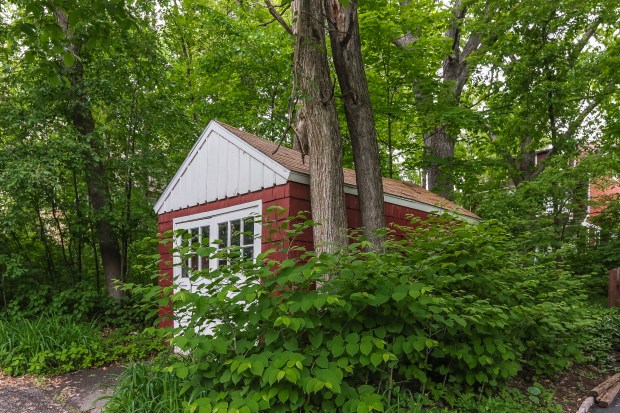
The garage at architect Ewin Lundie's former home at 1823 Mahtomedi Ave., Mahtomedi, which is for sale. (Courtesy of Keller Williams Realty)The garage at architect Ewin Lundie’s former home at 1823 Mahtomedi Ave., Mahtomedi, which is for sale. (Courtesy of Planomatic)

“He designed and built the garage,” O’Toole says.

The single-stall garage, covered in wood siding painted red and white to match the house, is accessed via a set of elegant carriage doors. It looks more like an upscale shed or perhaps an artist’s studio — it is only missing the cupola that Lundie originally designed to adorn its roof. For Lundie, this garage was an important form of shelter.

“Some people say his only luxury was his 1958 Ford Thunderbird,” O’Toole says.

It’s unclear how many luxuries Lundie could afford. He was a working architect who coveted the respect of his peers, but he was not a celebrity like Cass Gilbert or Frank Lloyd Wright. His star has been rising posthumously, though, especially after another Minnesota architect — “cabinologist” Dale Mulfinger of SALA Architects —  wrote a book, “The Architecture of Edwin Lundie” (Minnesota Historical Society Press, 1995), that explored and celebrated Lundie’s legacy, something that Lundie never really did for himself.

“He didn’t seem to seek fame,” Mulfinger says.

Instead, Lundie’s world seemed to revolve around work and his family (especially work). The Lundies, who were married in 1917, had one child, Ellen, born in 1920.

When Lundie wasn’t meeting with clients at his house — he had more than 30 commissions in the area for remodels as well as new builds — the family’s home life was full of simple pleasures: a porch, two wood-burning fireplaces, a charming garden, a swim at the lake across the way. When they wanted to get away, the Lundies headed to their cabin on the North Shore of Lake Superior — the only place that Lundie ever designed and built for himself and his own family (and not his Thunderbird).

EDWIN LUNDIE’S LEGACY 

Grace Lundie died in 1968 at the age of 76. After her death, Lundie sold their home and moved back to the city, to the St. Paul Athletic Club. He passed away a few years later, in 1972. He was 85.

The couple who bought the home from Lundie didn’t live there long: Instead, they sold it in 1971 to Fred McDowell, an artist.

“He loved it from the minute he saw it,” Lamese says. “Both of us did; neither of us would have lived anywhere else.”

Lamese, who is also an artist, moved into the home after she and Fred were married in 1977.

Together, the couple spent a lifetime asking themselves: “What would Lundie do?” before embarking on any changes or updates to the house (as well as consulting with the Lundies’ daughter, who passed away in 2000 at 79).

Mulfinger applauds the McDowells.

The fireplace in the master bedroom of architect Ewin Lundie's former home at 1823 Mahtomedi Ave., Mahtomedi, which is for sale. (Courtesy of Keller Williams Realty)The fireplace in the master bedroom of architect Ewin Lundie’s former home at 1823 Mahtomedi Ave., Mahtomedi, which is for sale. (Courtesy of Planomatic)

“Some of the items which Lundie designed — such as the fireplace in the bedroom and some of the trim characteristics — are significant,” he says, “but equally significant is how the McDowells, upon buying the house, have improved or altered it to make it feel more Lundie than when Lundie himself lived there. And I think that’s very significant — it says something about the influence of someone’s work going beyond that person’s own life. And the McDowells are extremely proud of their place — they have treasured it.

“Is it a significant house in his body of work? No, but at times there is a distinction between where someone lived and what someone did.”

Lundie lived simply, Mulfinger points out.

“I think it’s equally significant that it’s a very modest house,” Mulfinger says. “His work spans some beautiful mansions and country houses down to some intimate cabins and very small houses — and even his big houses seem like assemblages of small spaces. I think this house shows where his heart was; this was where his heart was. He was not a man who needed luxury in his life.”

Lundie might have agreed. In his research, O’Toole unearthed this quote:

“I have had a wonderful life,” Lundie said. “I have done just what I wanted to do.”

EDWIN LUNDIE’S STEWARDS 

Lamese McDowell sighs again as she sits in the parlor of the little jewel box of a house on Mahtomedi Avenue.

“If I could move this house to where I want to be, I would,” she says.

McDowell’s husband, Fred, passed away in 2014; just like Lundie, the widow wants to move closer into the city now — closer to her relatives and her church.

The shutters at architect Ewin Lundie's former home, 1823 Mahtomedi Ave., Mahtomedi, contain the finial Lundie designed. The house is for sale. (Courtesy of Keller Williams Realty)The shutters at architect Ewin Lundie’s former home, 1823 Mahtomedi Ave., Mahtomedi, contain the finial Lundie designed. The house is for sale.<br />(Courtesy of Planomatic)

On a tour of the home, she points out its details — the first-floor den with its wall of built-in cabinetry (and its exquisite hinges); the free-standing mirror that Lundie left behind; a custom door. She sounds like a docent at a museum. She kind of is, says her real-estate agent.

“Lamese and Fred have been wonderful stewards of this house — they only brought in the best people to do any type of work, and even some people who worked with Lundie,” Meador says. “What we are looking for is really another steward for this house.”

1823 Mahtomedi Ave., Mahtomedi

This Mahtomedi cottage was the personal residence of Edwin Lundie (1886-1972), a St. Paul architect who got his start as a student draftsman in architect Cass Gilbert’s St. Paul office and whose own notable work includes the main lodge at Lusten, 17 cabins on the North Shore of Lake Superior and many remodels and construction of private residences of the well-to-do, with last names like Dayton, MacMillan, Weyerhaeuser and Griggs. Although Lundie did not design this house, he did work on it through the years — including adding a fireplace in his bedroom and (probably) the exterior shutters and garden gate, as well as building a garage in the back (his blueprints have survived). The home is on a terraced and wooded lot that shares access to White Bear Lake across the street.

  • Price: $399,000
  • Year built: 1910
  • Square feet: 1,392
  • Bedrooms: Two (plus den)
  • Bathrooms: Full (main floor); three-quarters (second floor)
  • Basement: Walkout
  • Heating: Forced air
  • Cooling: Central air
  • Garage: Detached, single stall
  • Lot size: 0.28 acres
  • Waterfront: Property includes access to White Bear Lake.