Showing posts sorted by relevance for query avoid expensive demolition work. Sort by date Show all posts

Saturday, August 12, 2017

Renovate a 1950s Bathroom | Family Handyman

Read article : Renovate a 1950s Bathroom | Family Handyman
Big splash, low budget

Some say that if you wait long enough, Everything—including 1950s bathrooms— comes back in style. But “in style” doesn't necessarily mean “in perfect shape” or “in sync with today's lifestyle.” Such was the case with the bathroom shown here. Moisture problems had caused peeling paint and sticking vanity drawers, while 50 years of wear and tear had taken a toll on the grout, fixtures and hardware. However, the owners, Mary Jane and Bruce Pappas, saw too many things going for the space to completely gut it, such as unique tile work that was still in excellent shape.

“The whole point of buying this fifties house was to create our 21st century life here while honoring the original architecture and detail,” says Mary Jane, who is a professional interior designer. “Bruce and I wanted to complement and elevate what was already here and reuse as many materials as we could.” And by doing so, they were able to reach their goal of updated function on a modest budget. The couple were able to avoid expensive demolition work and get the bathroom they wanted for just under $5,000. “The results for the investment are extraordinary,” says Mary Jane Pappas.

Updated, But Still Original

This bathroom now has greater utility and a clean, contemporary look— without breaking the bank.

Updated bathroomUpdated bathroom

ReDO, reuse, recycle

Renovate a 1950s Bathroom

Vintage tile

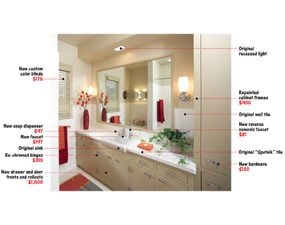
The vanity's vintage “Sputnik” tile pattern inspired the khaki color scheme of the bathroom and adjoining bedroom.

Renovate a 1950s Bathroom

New rollouts, old cabinet

The vanity cabinet is original, but for about $1,500, the new door and drawers were constructed with wipe-clean Melamine bottoms and maple sides decked out with metal slides.
Renovate a 1950s Bathroom

Updated storage closet

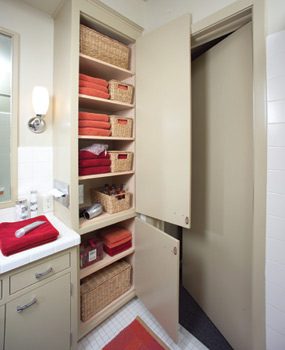
Adjustable shelving with Melamine surfaces was added along with a replacement tissue box holder. A hidden cabinet outlet keeps a hair dryer ready to roll and the electric toothbrushes charged.

After adding an exhaust fan to handle the moisture problem, they began dealing with the cosmetics, as explained by Mary Jane Pappas.

Freshening tiled surfaces
A professional tiler was brought in to repair the period tiles that had seen 53 years of bathroom life. By tuckpointing broken edges and freshening the grout, the tiler brought the surfaces up to standard. “The tile is unique to the era; we embraced the retro feel of it. It was in great shape and worth saving.”

Vanity drawers and doors
Another great example of the couple's “reuse it” philosophy lies in their treatment of the vanity. Years of water damage had made the drawers difficult to open, but instead of scrapping the entire piece, the Pappases hired Thomas J. Ross of Ross Custom Cabinetry Inc. to build new rollout drawers and cabinet doors for it and adjustable shelving for the attached linen closet. “Before, the cabinet drawers were only simple wooden boxes resting in a wooden cabinet. It was a struggle to pull 'wood-on-wood' drawers, especially when they were damp. Now that they're equipped to glide on rollers, it's like having a new piece of furniture. And when you think of the floor, tile and drywall work that we would have incurred had we demolished and installed all new cabinetry, that decision saved thousands.”

Paint, pulls and hinges
The vanity face-lift continued with several coats of an enamel paint and re-chromed hinges and the addition of contemporary drawer pulls. “We re-chromed the hinges because the plates had a unique screw pattern and I didn't want to add any additional screw holes to the vanity and risk the old holes showing.” The original mirror was saved by painting its trim the same color as the vanity.

Sink faucet
The Pappases wanted to add a soap pump and a water filter to their bath sink. By changing the old, widespread faucet for a single-lever faucet, they were able to avoid the expense of either buying a new sink or drilling new holes. The change in style left two unused holes for the new accessories.

Lighting
The old sconces were replaced with lights that better match the new drawer pulls and add a contemporary flair to the room.

Keepers! The '50s heat fan and tissue dispenser
The couple wanted to maintain the items that, like the heat fan, were still stylishly serving a useful function in the bathroom. “It's a nice amenity and it still worked, so why get rid of that?” They were even able to save the original metal tissue dispenser housed in the linen cabinet. It could no longer hold tissue boxes because the dispenser slot was vertical instead of the modern horizontal style. “But the same company, Brobick, now offers a replacement dispenser that fits tissue boxes perfectly.”

The tub
Replacing a bathtub affects the tile surrounding it, the walls above it and the plumbing below it. Keeping the existing tub saves tremendous time and money. So the tub stayed put, while some of the more easily changed elements around it were replaced. One of the first changes was to oust the shower door. “In a small bathroom, a flexible shower curtain creates a sense of spaciousness. And I use my bathtub every day, so a shower door is just not practical,” Pappas says. The original tub had a single showerhead with a bathtub faucet. Now a low-cradled hand shower, perfect for tub bathers, easily sets into an adjustable height showerhead fixture, adding to the usefulness and elegance of the bathroom.

Simple details make the difference

Renovate a 1950s Bathroom

Custom blind

Instead of settling for an off-white window blind in the bathroom, Pappas used a window blind company to create a custom window treatment to match the wall color. (Small rooms appear even smaller with a different color window treatment.) “For $175, getting an exact color match is a great deal,” says Pappas.

Renovate a 1950s Bathroom

Towels and rugs

The towels and bathroom rug proved to be a shopping challenge. “I wanted to find rich colors to work with the khaki walls and the cabinetry. I found high-quality towels I love from an online store, but searched and searched for a matching rug that would stand up to a wet environment. Finally I had a custom one handmade to match,” says Pappas.

Renovate a 1950s Bathroom

Shower curtain pull

A last little splurge of elegance lies in the Kravet silk tassel shower curtain pull ($75). Costing half as much as the Restoration Hardware shower curtain itself, the tassel adds a touch of luxury to this otherwise thrifty remodel.

Having saved a bundle by retrofitting many existing systems in the bathroom, the Pappases had some budget left to indulge in a few accessories.

Thursday, July 13, 2017

The latest dining chairs

Read article : The latest dining chairs

Save money on your bathroom renovation with these tips and advice from industry experts. Includes advice on design, planning and choosing your materials.

Scroll down to read more or jump to a topic from the list below…

‘Keep your existing layout and consider functionality’

Nick Rowland, product manager at Heritage Bathrooms says: ‘The key to a successful renovation project is planning. As soon as you start repositioning plumbing the job can become very expensive, so stick to the existing layout if possible.

‘Although installers can find great deals, do your own research as well to see what other bargains are out there. Ask yourself whether you need the installer to fit the whole bathroom. What could you do yourself? Picking up the smaller, less technical tasks, such as hanging mirrors, putting up towel rails and painting walls, can lead to considerable savings. Check whether a “good price” really is value for money – does it offer quality? Will the product stand the test of time? Is it guaranteed by the manufacturer?

‘The only area where you may want to consider cutting corners by spending less is on fittings without a working function. For example, static pieces, such as a basin and pedestal, are only required to hold water and allow it to drain away. In contrast, the WC has more moving parts and the pan and cistern need to operate properly for years to come. With this in mind, I recommend only buying a WC from a recognised manufacturer that will understand its functional needs and will carefully manage the manufacturing process to ensure that the cistern and pan do not leak.

‘A bath needs to be robust enough to hold your weight as well as the water. If you are satisfied that this basic requirement has been met then you won’t need to spend money on baths with additional reinforcement, which have little benefit for domestic use.’
?Back to top

‘Consider what you can do for yourself’

Jamey Seaman, bathroom expert at Ikea says: ‘There are many ways to make your budget go that bit further when it comes to improving your bathroom. It’s surprising just how much work you can do by yourself. Save money by purchasing ready-to-assemble basin and bathroom cabinets, and avoid paying someone else to fix units to the wall.

‘You can also make savings by buying a complete set of bathroom furniture, including a basin, cabinet and mirror, rather than individual pieces, which could cost more. You don’t have to blow your budget on bathroom storage all at once. Start by fitting storage beneath and above the sink and add more at a later date when you have the time and budget.’
?Back to top

White and grey bathroom suite; Bathroom sanitaryware
ABOVE (left-right): Venice shower-bath, (H)47x(W)85x(L)170cm, £525; basin and pedestal, (H)85x(W)60x (D)45cm, £273; close-coupled WC, (H)83x (W)36.5x(D)63cm, with cistern and soft-close seat, £432, all from the Zaar collection at Heritage Bathrooms; Godmorgon/Vitviken washstand with two drawers and porcelain basin, (H)66x(W)63x(D)49cm, £170; Dalskar chrome-plated basin mixer tap, (H)18cm, £65; Godmorgon mirror cabinet, (H)96x(W)60x(D)14cm, £180; high cabinets, (H)192x(W)40x(D)30cm, £150 each, all Ikea.

‘Mix inexpensive ceramic tiles with luxury mosaics’

Beth Boulton, head of marketing at Topps Tiles says: ‘Instead of tiling an entire room in expensive mosaics, keep down costs by using them sparingly as a feature wall or to zone a shower area.

‘With the latest advancements in the ceramic printing process, there are now ceramic tiles available featuring highly realistic interpretations of natural stone, marble and wood. By cutting sheets of tiles in half or into strips to create a vertical feature behind a basin, or a horizontal statement around a bath and corner of a shower, you can make a real impact without overspending.’
?Back to top

‘Spend wisely and look out for bargains’

Rob Whitaker, brand director at Fired Earth says: ‘In general, you will get what you pay for. While cheaper products may look very similar to more expensive equivalents, they’re unlikely to have the same quality of finish or to last as long. For example, the chrome on very inexpensive taps may start to peel, or the surface of a bath may be more likely to crack or stain, so it is worth spending as much as you can afford to save money in the long term.

‘Think about installing a shower over the bath rather than building a separate shower area. As well as saving on product and installation costs, this is a good space-saving solution, too. If you would love a classic, freestanding cast-iron bath but it is beyond your budget, a bath made from a resin and stone composite is a great, cost-effective alternative. Factory shops often have fantastic bargains, so it’s well worth paying them a visit. If you can, it’s a good idea to wait for the winter and summer sales as the discounts on large items such as baths, washstands and boxes of tiles can be considerable.’
?Back to top

Mosaic bathroom tiles; Freestanding roll-top bath; Black and white bathroom suite
ABOVE (left-right): Glossy flat ceramic wall tiles in white, (W)20x(L)25cm, £7.60 per m²; Slate square glass mosaic tiles in silver, £13.99 for a (W)30x(L)30cm sheet; large-format Crystal porcelain floor tiles in white, (W)44x (L)44cm, £49.54 per m², all Topps Tiles; Flow roll-top bath, made from resin and ground stone with chrome feet, painted in Mercury Eggshell, (H)66x (W)80x(L)175cm, £1,650; Avebury bath and shower mixer tap, (H)42x (W)18x(D)20cm, £1,125; Abbey Fountains porcelain floor tiles, (W)19.9x (L)19.9cm, £74.70 per m², all Fired Earth; Athena Black 1700 freestanding bath with chrome feet, (H)56x(W)75x(L)170cm, £349.95; Modena 60 Semi Pedestal bathroom suite with ceramic basin (H)48x(W)58.5x(D)39.5cm, and ceramic WC, (H)83.5x (W)37x(D)65cm, £179.95, all Better Bathrooms.

‘Think about selling your old suite’

Joe Cummings, product advisor at Better Bathrooms says: ‘The rising popularity of auction sites has provided a fantastic platform for selling secondhand items. Any unwanted fixtures in good condition are worth selling, from taps and basins to tiles. This is the perfect way to recoup some of the expense you have lavished on your new bathroom.

‘Labour costs are the greatest outlay in any renovation project, so try doing some of the work yourself. Demolition and debris removal, along with tiling and brassware installation are simple jobs even for the most novice of DIYers. There are installation videos on the Better Bathrooms website (betterbathrooms.com) offering step-by-step guidance on how to install a range of sanitaryware in your home yourself, including shower enclosures, basins and baths. This will help to eliminate high-cost construction bills. However, it’s not always a good idea to undertake all of the work a bathroom renovation entails yourself – this can end up costing you more rather than saving money. Large, technical jobs, including any changes in plumbing, will require experienced tradespeople, so shop around in order to find the right person for the task. You will need someone you trust who will do the job at the right price. Acquiring multiple quotes from different contractors will not only give you an estimate of the cost of the work, but will ensure the price is fair and help with your planning.’
?Back to top

‘Research affordable options for flooring’

David Snazel, buyer at Carpetright says: ‘Updating your bathroom flooring doesn’t necessarily mean you’ll have to lay out a huge amount of money. If you like the look of stone or hardwood floors, but want a more practical and affordable option, it’s certainly worth considering vinyl. Functional yet stylish, vinyl is waterproof, remarkably durable and comes in a variety of styles – from natural wood and classic tiles to modern patterned designs – making it the ideal bathroom flooring solution.’
?Back to top

‘Never cut corners when it comes to brassware’

Leanne Robey, senior designer at Ripples says: ‘There are lots of ways to save on a bathroom project, but you should always invest in quality brassware as this includes the items that are in use every day, in particular concealed valves that regulate the temperature of the water in your home.

‘Always buy a good quality showerhead, especially if you prefer to take a shower than a bath, and look for “rub clean” showerheads with easy-clean nozzles that will prevent the build-up of limescale – great if you live in a hard-water area.

‘For further savings choose an eco-friendly showerhead with a sophisticated flow restrictor, various jet options and air infusion, which all work together to cut your water consumption by up to 60 per cent. This will help keep down water costs and will also cut energy bills, as less water will need to be heated.’
?Back to top

Wood finish vinyl bathroom flooring; Shower tiles and brassware
ABOVE (left-right): Urban Planks vinyl flooring in Eden Walnut 857, £44.99 per m², from the Tegola range at Carpetright; Crema Marfil marble wall tiles, (W)30x (L)60cm, £68 per m²; Fairfield easy-clean showerhead, (dia.)20cm, and arm, (L)41cm, £433; ¾-inch concealed flow control stop valve, £292; thermostat, £675, all Ripples.

All prices and stockists correct at time of publishing