Showing posts sorted by relevance for query gas money spent. Sort by date Show all posts

Saturday, August 19, 2017

Living large in a small barn | Home and Garden

Read article : Living large in a small barn | Home and Garden

Starting out, Ryan and Kim Woodward didn't intend to live in the upstairs of a small barn.

They had purchased 17 acres of grass and trees in rural Geneseo, Ill., as a site for the building of their dream home, and the reconstruction of a small barn on the property was just intended to provide them with a storage shed.

But as the barn relocation project progressed — Ryan deconstructed the barn from the property of friends' parents in Davenport — they began talking about making it their temporary home.

Doing so would have certain advantages, they reasoned.

They could sell the Rock Island home they were living in and use the freed-up money toward their dream home.

And because Ryan was going to build as much of the new home as possible with his own two hands, living on-site would be vastly more convenient than driving back and forth to the Quad-Cities every time he wanted to work. Convenient — and with much less time and gas money spent on commuting.

So sometime in 2013, the Woodwards decided they would create a 320-square-foot living space in the second floor of the barn, complete with a living room area, a kitchen, a bathroom and a small bedroom for their son, Henry, who is now 3.

In drawing up a floor plan, there were a couple of "non-negotiables," as Kim calls them. There had to be a bathtub for Henry, and he had to have his own room, no matter how small. And Kim needed a real kitchen.

Walk into the space today and you'll see that they achieved all that and more. In fact, most people say the space is bigger than they imagined, she said.

And it's not makeshift. This is a real home, with drywall and paint, a full bath and air-conditioning.

It's just that there are no closets, which is one of the drawbacks. To compensate, the couple has been as creative as possible with storage. They've also tucked away about 85 percent of their belongings off-site.

In the living area, an Ikea daybed — a sofa by day and a bed for Ryan and Kim by night — has drawers underneath that hold Ryan's clothes.

On the opposite wall is a built-in stock storage cabinet that contains everything from socks to electronics. A flat-screen television is mounted on the front.

The kitchen contains a butcher block table/island that also serves as Kim's office and Henry's play area, with storage space below. Appliances include a microwave, refrigerator and stove. The sink is a one-well model intended for a bar, but it's sufficient. Above is shelving holding dishes, with hooks below for containers of silverware and other kitchen items.

The back area contains Henry's room — the couple thought it was more important for him to have personal space than themselves — and a bath with a tub and a shower.

The couple used recycled materials as much a possible throughout. The cherry hardwood floor, for example, came from Ryan's parents, who had taken it out in a remodeling project.

Recessed fixtures, a skylight and windows on either end provide plenty of light.

A major drawback to the small space is there's no place to "get away," Kim said. If one wants to be alone, well, that's not really possible.

But in the short-term it's very doable, and in some ways it's liberating, she said.

By paring down, they have realized what everyone in the "small house" movement understands: One needs far fewer possessions than one has. It's amazing "how few things I miss," Kim said.

Cleaning goes quickly because there's so little to clean.

"And the view is worth it all," she says, referring to the panoramic view of the countryside from their deck. 

Speaking of the deck, it nearly doubles their space in nice weather, so that helps.

And the barn's ground floor is a regular garage, with a niche for their washer and dryer as well as space for storing all the tools Ryan needs for home-building.

Ryan, 32, is a 2007 graduate of Western Illinois University and works in product development for Deere & Co. in Silvis.

Kim, 31, is a 2006 graduate of Southern Illinois University-Edwardsville and a former public relations specialist for Modern Woodmen in Rock Island. She now works as a mom, on home and garden projects, and writes a blog in addition to freelance projects.

Friday, June 2, 2017

Dispossessed in the Land of Dreams

Read article : Dispossessed in the Land of Dreams


Sometime in July 2012, Suzan Russaw and her husband, James, received a letter from their landlord asking them to vacate their $800-a-month one-bedroom apartment in Palo Alto, California. He gave them 60 days to leave. The “no-fault” eviction is a common way to clear out low-paying tenants without a legal hassle and bring in people willing to pay thousands more in rent. James was 83 at the time and suffering from the constellation of illnesses that affect the old: He had high blood pressure and was undergoing dialysis for kidney failure and experiencing the early stages of dementia.

Their rent was actually a couple of hundred dollars more than James’s monthly Social Security benefits, but he made up the rest by piecing together odd jobs. They looked for a new apartment for two months and didn’t find anything close to their price range. Their landlord gave them a six-week extension, but it yielded nothing. When mid-October came, Suzan and James had no choice but to leave. With hurried help from neighbors, they packed most of their belongings into two storage units and a ramshackle 1994 Ford Explorer which they called “the van.” They didn’t know where they were going.

A majority of the homeless population in Palo Alto—93 percent—ends up sleeping outside or in their cars. In part, that’s because Palo Alto, a technology boomtown that boasts a per capita income well over twice the average for California, has almost no shelter space: For the city’s homeless population, estimated to be at least 157, there are just 15 beds that rotate among city churches through a shelter program called Hotel de Zink; a charity organizes a loose network of 130 spare rooms, regular people motivated to offer up their homes only by neighborly goodwill. The lack of shelter space in Palo Alto—and more broadly in Santa Clara and San Mateo counties, which comprise the peninsula south of San Francisco and around San Jose—is unusual for an area of its size and population. A 2013 census showed Santa Clara County having more than 7,000 homeless people, the fifth-highest homeless population per capita in the country and among the highest populations sleeping outside or in unsuitable shelters like vehicles.

San Francisco and the rest of the Bay Area are gentrifying rapidly—especially with the most recent Silicon Valley surge in social media companies, though the trend stretches back decades—leading to a cascade of displacement of the region’s poor, working class, and ethnic and racial minorities. In San Francisco itself, currently the city with the most expensive housing market in the country, rents increased 13.5 percent in 2014 from the year before, leading more people to the middle-class suburbs. As real estate prices rise in places like Palo Alto, the middle class has begun to buy homes in the exurbs of the Central Valley, displacing farmworkers there.

Suzan, who is 70, is short and slight, with her bobbed hair dyed red. The first time I met her, she wore leggings, a T-shirt, a black cardigan wrapped around her shoulders, and fuzzy black boots I later learned were slippers she’d gotten from Goodwill and sewn up to look like outside shoes. (She wore basically the same outfit, with different T-shirts, nearly every time we met, and I realized she didn’t have many clothes.) Her voice is high and singsongy and she is always polite. You can tell she tries to smooth out tensions rather than confront them. She is a font of forced sunniness and likes to punctuate a sad sentence with phrases like “I’m so blessed!” or “I’m so lucky!” She wore a small necklace and said jewelry was important to her. “I feel, to dispel the image of homelessness, it’s important to have a little bling,” she said.

In the van, Suzan was in charge of taking care of everyone and everything, organizing a life that became filled with a unique brand of busy boredom. She and James spent most of their time figuring out where to go next, how to get there, and whether they could stay once they arrived. They found a short-term unit in a local family shelter in Menlo Park that lasted for five weeks. Afterward, they stayed in a few motels, but even fleabags in the area charge upwards of $100 a night. When they couldn’t afford a room they camped out in the van, reclining the backseats and making a pallet out of blankets piled on top of their clothes and other belongings. Slowly, there were fewer nights in hotels and more in the van, until the van was where they lived.

A life of homelessness is one of logistical challenges and exhaustion. Little things, like planning a wardrobe for the week, involved coordinated trips to storage units and laundromats, and could take hours. The biggest conundrum? Where to pull over and sleep. Suzan and James learned quickly not to pull over on a residential block, because the neighbors would call the police. They tried a church or two, 24-hour businesses where they thought they could hide amidst the other cars, and even an old naval field. The places with public toilets were best because, for reasons no one can quite explain, 3 a.m. is the witching hour for needing to pee. They kept their socks and shoes on, both for staying warm on chilly Bay Area nights and also for moving quickly if someone peered into their windows, or a cop flashed his light inside, ready to rouse. Wherever they were sleeping, they couldn’t sleep there. “Sometimes, I was so tired, I would be stopped at a red light and say, ‘Don’t go to sleep. Don’t go to sleep,’” Suzan said. “And then I would fall asleep.”

A few months in, a nice man in a 7-Eleven parking lot told them about a former high school turned community center on the eastern side of town called Cubberley. He’d walked up to their van after recognizing signs of life in the car, tired faces among the junk piling up in the back. Suzan and James were familiar with the community center because they’d taken their daughter to preschool there many years before, but they hadn’t thought about sleeping there. Cubberley had a quiet back parking lot, a flat grass amphitheater with a concrete paddock for a stage, and 24-hour public bathrooms with showers in an old gym. Rumor was that the cops wouldn’t bother anyone.

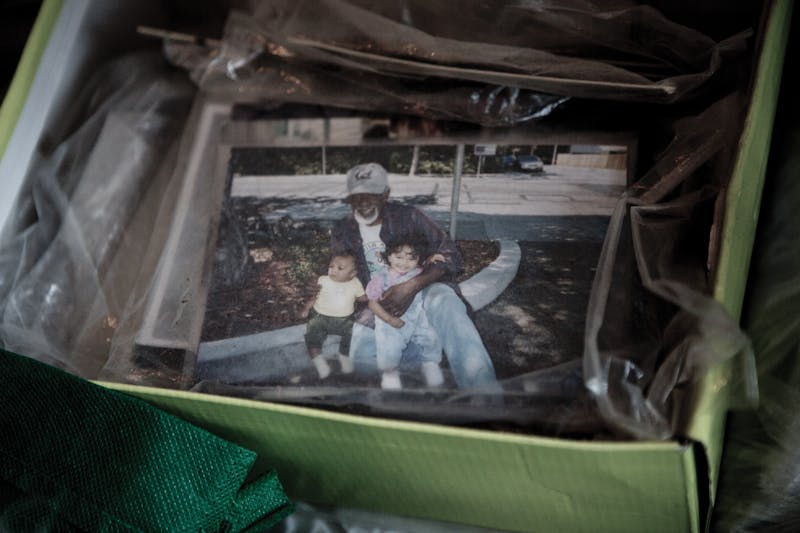
imageSuzan’s husband, James Russaw, pictured with two of their grandchildren.

Cubberley was a psychic relief because it solved so many basic needs: It had a place to bathe in the morning, a place to charge your phone. The parking lot had also formed its own etiquette and sense of community. People tended to park in the same places, a spot or two next to their neighbors, and they recognized one another and nodded at night. They weren’t exactly friends, but they were people who trusted each other, an impromptu neighborhood no one wanted to lose after losing so much. It was safe, a good place to spend the night. But it was next door to a segment of homeowners who were fighting hard to move the car dwellers out.

Normally, wealthy people who move into an area don’t see the results of their displacement because the people who lose their homes don’t stick around; they move to cheaper suburbs and work themselves into the fabric elsewhere. But the folks at Cubberley, 30 people on any given night, were the displacement made manifest. Most weren’t plagued with mental health or substance abuse problems; they simply could no longer afford rent and became homeless in the last place they lived. People will put up with a lot to stay in a place they know. “I’ve been analyzing why don’t I just get the heck on. Everybody says that, go to Wyoming, Montana, you can get a mansion,” Suzan said. “Move on, move on, always move on. And I say to myself, ‘Why should I have to move on?’”

It’s a new chapter in an old story. In his seminal 1893 lecture at the Chicago World’s Fair, Frederick Jackson Turner summarized the myth of the American frontier and the waves of settlers who created it as an early form of gentrification: First, farmers looking for land would find a remote spot of wilderness to tame; once they succeeded, more men and women would arrive to turn each new spot into a town; finally, outside investors would swoop in, pushing out the frontiersman and leaving him to pack up and start all over again. It has always been thus in America. Turner quoted from a guide published in 1837 for migrants headed for the Western frontiers of Ohio, Indiana, and Wisconsin: “Another wave rolls on. The men of capital and enterprise come. The ‘settler’ is ready to sell out and take the advantage of the rise of property, push farther into the interior, and become himself a man of capital and enterprise in turn.” This repeating cycle, Turner argued, of movement and resettlement was essential to the American character. But he foresaw a looming crisis. “The American energy will continually demand a wider field for its exercise,” he wrote. “But never again will such gifts of free land offer themselves.” In other words, we would run out of places for the displaced to go.


Suzan was born in 1945. Her father worked at what was then the Lockheed Corporation, and her mother had been raised by a wealthy family in Oak Park, Illinois. Her family called her Suzi. Though she grew up in nearby Saratogaand spent some time in school in Switzerlandshe distinctly remembers coming with her mother to visit Palo Alto, with its downtown theaters and streets named after poets. Palo Alto more than any other place formed the landscape of her childhood. “It was a little artsy-craftsy university townyou find charming towns are university towns.”

Like many women of her day, Suzan didn’t graduate from college. When she was 24, after her last stay in Switzerland, she moved to Mountain View, the town on Palo Alto’s eastern border that is now home to Google and LinkedIn. She was living off a small trust her family had set up for her when she met James at a barbecue their apartment manager threw to foster neighborliness among his tenants. James had grown up in a sharecropping family in Georgia, moved west during World War II, and was more than 17 years her senior, handsome and gentlemanly. Suzan thought: “I can learn something from him.” They were an interracial couple in the late 1960s, which was unusual, though she says her family didn’t mind. It was also an interclass marriage, and it moved Suzan down the income ladder.

For years, James and Suzan lived together, unmarried. They bought a house on University Avenue, just north of the county line and blocks from downtown Palo Alto, in 1979, and four years later had their only daughter, Nancy. It was the area’s ghetto, and the only source of affordable housing for many years. It was also the center of violence in the region, and, in 1992, was the murder capital of the country.

They never had much money. For most of their marriage, James ran a small recycling company and Suzan acted as his bookkeeper, secretary, and housewife. They refused to apply for most government assistance, even as homeless elders. “My husband and I had never been on welfare or food stamps,” she told me. “Even to this day.”

Suzan’s parents died in 2002 and 2003, and her older sister died in 2009. (“I thank God that they’re gone,” she told me. “They would die if they saw me now.”) It was a hard time for Suzan, who went to care for her dying parents and nearly left James. She felt he’d checked out of the difficulties. In retrospect, she thinks his dementia might already have been setting in; James was already in his seventies. He had taken out a second mortgage on their home, and they couldn’t pay it after he retired. They sold the house at a loss in 2005; it’s now a Century 21 office.

After they moved into the van, they settled into a routine. On the nights before James’s early-morning treatments, they slept in the dialysis center’s parking lot. Otherwise they generally stayed at Cubberley. They were still living off James’s retirement income, but most of it went to the $500 needed to rent the two storage units where their furniture remained, until they lost one for nonpayment. Finally, a few months in, Suzan was able to use a clause in a trust set up by her mother’s father to help her out in an emergency. It doubled their incomemuch of which was eaten up by the costs of gas, the remaining storage unit, parking tickets, and the other expenses of an unsettled life. It was a respectable income, one that technically kept them above poverty, but it still wasn’t enough for rent.

James was increasingly ill and van life was taking a toll. In addition to James’s other problems, both he and Suzan were starting to experience some of the health problems common among the homeless. The backseat of the van filled with bags of clothes, papers, fast-food detritus, pens, old parking tickets, and receipts. As the junk built up, the recline of their seats inched forever upward, until they were sitting up all the time, causing their legs to swell and nerves to become damaged, the medical consequences of not being able to raise your feet at night.


Gentrification used to be about poor neighborhoods, usually black and brown, underdeveloped and full of decrepit and neglected housing stock, run by the occasional slumlord—often described as “blighted,” though that designation has always been problematic—and how they become converted into wealthier ones, usually through the influx of richer white people and their demand for new services and new construction. It’s a negative process for the people who have to move, but there’s occasionally an element of good, because neglected neighborhoods revive. But what’s happening now in the Bay Area is that people who’ve done nothing wrong—not paid their rent late, violated their lease, or committed any other housing sin—are being forced out to make way. Displacement is reaching into unquestionably vibrant, historic, middle- and working-class neighborhoods, like The Mission in San Francisco, a former center of Chicano power. (The Mission alone has lost 8,000 Latino residents in the past ten years, according to a report from the local Council of Community Housing Organizations and the Mission Economic Development Agency.) And it’s happening to such an extent that the social workers who used to steer people to affordable apartments as far away as Santa Rosa or Sacramento, a two-hour drive, are now telling people to look even farther out. The vehicle dwellers I spoke with said they’d heard of friends living in places like Stockton, once a modest working-class city in the middle of the state, receiving notice-to-vacate letters like the one Suzan and James received.

For the most part, the traits that draw people to Palo Altogood schools, a charming downtown, nice neighborhoods in which to raise a family, and a short commute to tech jobsare the very same things that made the residents of Cubberley want to stay, even if it meant living in their car. The destabilizing pressure of a real estate market is also felt by the merely rich, the upper middle class, and the middle class, because the high-end demand of the global elite sets the market prices. “My block has the original owners, a retired schoolteacher and a retired postal worker,” said Hope Nakamura, a legal aid attorney who lives in Palo Alto. “They could never afford to buy anything there now.” Most people told me if they had to sell their homes today they wouldn’t be able to buy again anywhere in the area, which means many Palo Altans have all of their wealth tied up in expensive homes that they can’t access without upending their lives. It makes everyone anxious.

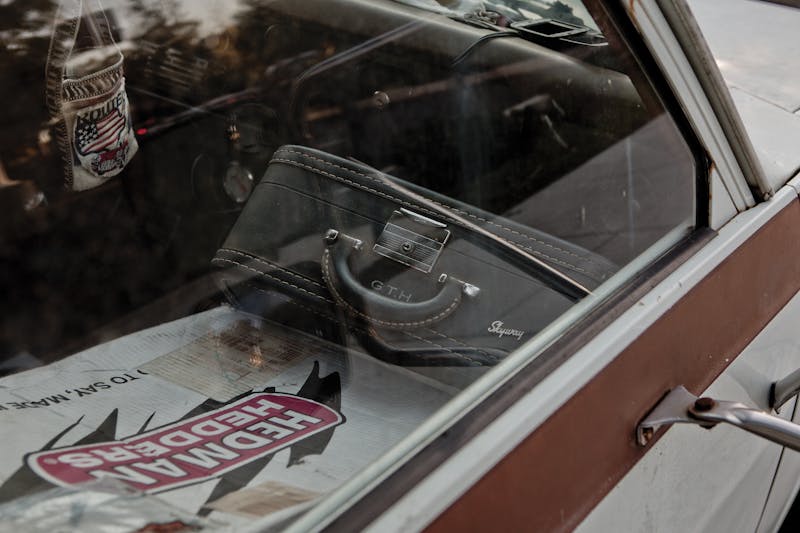
imageThe view inside a van parked outside a Palo Alto homeless organization.

The outcry from the neighbors over Cubberley was so fierce that it reshaped Palo Alto’s city government. The city council is nonpartisan, but a faction emerged that revived an old, slow-growth movement in town, known as the “residentialists.” Their concerns are varied (among them, the perennial suburban concerns of property values and traffic), but their influence has been to block any new development of affordable housing and shoo people like Suzan and James away from Palo Alto. An uproar scuttled an affordable-housing building for senior citizens near many public transit options that had been proposed by the city housing authority and unanimously approved by the city council. Opponents said they were worried about the effect the development would have on the surrounding community—they argued it wasn’t zoned for “density,” which is to say, small apartments—and that traffic congestion in the area would be made worse. Aparna Ananthasubramaniam, then a senior at Stanford, tried to start a women’s-only shelter in rotating churches, modeled after the Hotel de Zink. She said a woman came up to her after a community meeting where the same concerns had been raised by a real estate agent. “Her lips were quivering and she was physically shaking from how angry she was,” Ananthasubramaniam told me. “She was like, ‘You come back to me 20 years from now once you have sunk more than $1 million into an asset, like a house, and you tell me that you’re willing to take a risk like this.”

The trouble for Cubberley began when neighbors went to the police. There’d been at least one fight, and the neighbors complained about trash left around the center. At the time, Cubberley was home to a 64-year-old woman who’d found a $20-an-hour job after nine years of unemployment; a tall, lanky, panhandler from Louisiana who kept informal guard over her and other women at the center; a 63-year-old part-time school crossing guard who cared for his dying mother for 16 years, then lived off the proceeds from the sale of her house until the money ran out; two retired school teachers; a 23-year-old Palo Alto native who stayed with his mother in a rental car after his old car spontaneously combusted; and, for about six months, Suzan and James. “They didn’t fit this image that the powers that be are trying to create about homeless people. They did not fit that image at all,” Suzan told me. “We made sure the premises were respected, because it was an honor to be able to stay there.” She and others told me they cleaned up their areas at the center every morning.

“I said, ‘We have no place to go, and we’re staying right here.’ They were going to know about it.”

Pressured to find a way to move the residents out, the police department went to the city council claiming they needed a law banning vehicle habitation to address the neighbors’ concerns. Advocates for the homeless said that any problems could be solved if police would just enforce existing laws. Local attorneys warned the city council that such laws could soon be considered unconstitutional, because the Ninth Circuit Court of Appeals was hearing a challenge to a similar law in Los Angeles. Carrie LeRoy, an attorney who advocated on behalf of the unhoused, and other attorneys threatened to file a class-action lawsuit if the vehicle-habitation ban ever went into effect. The city council passed the ban anyway, in a 7-2 vote in August 2013, and the police department and other groups in the city started an outreach program to tell people about the law. “All of them had received these notices from the city,” LeRoy said, “And it was basically like, ‘Get out of our town.’”

A few weeks later, the city council also voted to close the showers at Cubberley and give it a 10:30 p.m. curfew, which made it illegal to sleep there. On their last night there, in October 2013, Suzan and James left around 8 p.m. so they wouldn’t get caught past the new curfew. They tried some old haunts and got kicked out. The stress of living in the van was hard on James. Around this time, James decided to end his dialysis. “Of course, we knew what that meant,” Suzan said.

One night, about a month after leaving Cubberley, the police pulled Suzan and James over. Their registration was expired. “This officer, he got a wild hair, and he said, ‘I’m going to impound your car,’ and called the tow truck.” Suzan told me. They got out of the car. Without pushing and demanding, she realized, she was never going to get out of the situation. She told me she said to the officer, “This is our home, and if you impound it we will not have a home.” He insisted. “I said ‘That’s fine. You do that. We will stay right here. I will put the beds out, I will put what we need here, right here on the sidewalk.” Other officers arrived and talked to them. They asked Suzan whether, surely, there was some other place they could go. “I said, ‘We have no place to go, and we’re staying right here.’ I was going to make a stink. They were going to know about it.” Suzan told me people were poking their heads out of their homes, and she realized the bigger fuss she made, the more likely officers might decide just to leave them alone.

Because James’s health had continued to worsen, he and Suzan finally qualified for motel vouchers during the cold weather. They got a room in a rundown hotel. “It had a microwave and a hot bath,” Suzan said. In his last few days, James was given a spot in a hospice in San Jose, and Suzan went with him. “It was so cut-and-dry. They said, ‘This is an end-of-life bed, period,’ ” Suzan said. “And I never said that to James.” He died on February 17, 2014, and a few weeks later a friend of theirs held a memorial service for James at her house. Suzan wore an old silk jacket of her mother’s, one that would later be ruined by moisture in the van, and a necklace Nancy had made. They ate James’s favorite foodscornbread, shrimp, and pound cake. Suzan had a few motel vouchers left, and afterward stayed with friends and volunteers for a few weeks each, but she felt she was imposing.

That summer, she returned to her van. It was different without James; she realized she’d gotten to know him better during their van life than she ever had before. Maybe it was his dementia, but as they drove around or sat together, squished amidst their stuff, he’d started to tell her long stories, over and over, of his youth in Georgia. She’d never heard the tales before, but she’d started to be able to picture it all. On her own, without his imposing figure beside her, Suzan was scared, and more than a little lonely. Most nights, she stayed tucked away in a church parking lot, without permission from the pastor, hidden between bushes and vans. The law wasn’t being enforced, but sleeping in the lot made her a kind of a criminal. “The neighbors never gave me up,” she said.


Suzan told me she was in a fog of denial after James’s death, but it’s probably what protected her because homelessness is exhausting. “You start to lose it after a while,” she said. “You feel disenfranchised from your own society.” The Downtown Streets Team, a local homeless organization, had been helping her look for a long-term, stable housing solution. Indeed, Suzan told me that at various times, she and James had 27 applications in for affordable housing in Palo Alto. (When he died, she had to start over, submitting new applications for herself.) Her social worker at the local senior citizens center, Emily Farber, decided to also look for a temporary situation that would get Suzan under a roof for a few months, or even a few weeks. “We were dealing with very practical limitations: having a computer, having a stable phone number,” Farber said. Craigslist was only something Suzan had heard of. She’d finally gotten a cell phone through a federal program, but hadn’t quite mastered it.

For many months, Farber struck out. She didn’t think Suzan would want to live with three 25-year-old Google employees, or that they’d want her, either. She even tried Airbnb. Because Suzan didn’t have a profile, Farber used her own, and wrote to people who had rooms listed to say her 69-year-old friend needed a place to stay in the area for a couple of weeks. “We got three rejections in a row,” she said. Finally, in November, they found a room available for rent for $1,100about 80 percent of her income from the trust and her widow’s benefits from Social Security. Suzan would have her own bedroom and bathroom in the two-bedroom apartment of a single mother. The mother crowded into the other bedroom with her 16-year-old son and seven-year-old daughter. The only downside for Suzan was that it was in Santa Clara, another charmingly bland suburban enclave in the South Bay, a half hour south of Palo Alto and a world away for Suzan. “It’s out of my comfort zone, but that’s OK!” she told me.

I met Suzan on the day she moved in, and the concept of being able to close a door was almost as unsettling to her as the concept of sleeping in the van had been. “I’m in this kind of survival mode,” she said, and had found a certain comfort in her van. “I’ve got this little cocoon I’m staying in, and everything is within arm’s reach.” She had a big blue mat in the back of the van, like a grown-up version of the kind kindergartners nap on, but soon she’d acquire a bed. She retrieved her old TV from her storage unit. She made a comfortable room, with chairs and a bed and a small table, and decided to eat her meals in there. She only signed a lease for three months, because it wasn’t really sustainable on her fixed income. She’d also applied for an affordable housing complex being built for seniors in Sunnyvale, one that would provide permanent housing for 60 senior citizens from among the 7,000 homeless people in the county at the time. She’d find out in April if she was selected in the lottery. All her hopes were pinned on it.

In the first few weeks after her move to Santa Clara, Suzan spent a healthy portion of her limited income on gas, driving the Explorer back and forth to Palo Alto. After all, her post office box was there, and so were her social workers. Her errands demanded a lot of face time, and in some ways, she still filled her days the way she had before she got her room, moving around trying to solve her problems. Her car was still packed, too, as if she hadn’t let go of the need to drive in it, to move forward, to keep her stuff around her within arm’s reach, as if she were still without a home base.

Two afternoons a week she went to a Palo Alto food closet. She usually made it right before it closed, in the early afternoons. When her number was called, she went up to the counter to watch the volunteer sort through what was left on the shelves, finding the most recently expired itemsthese were older goods grocery stores couldn’t keep past their sell-by dates. Suzan’s politeness was, as always, almost formal, from an earlier era, when being ladylike was a learned skill. The volunteer would ask her if she wanted milk, or peaches, or a serving-size Baggie of cereal, and she’d say, “Yes, very much so!” These days, she got to take raw eggs instead of the boiled ones, a treat reserved for those with kitchens. Her requests were glancing rather than direct. “Have you any lettuce?” and the answer was often no. I said it seemed like an efficient operation. Suzan said, “I really know the drill!”

Suzan needed to visit her social worker, Julia Lang, at the Downtown Streets Team office to get the form that allowed her to go to an even better food bank. She asked the receptionist whether her social worker was in. She wasn’t, and Suzan explained she was looking for the food bank vouchers. Then the receptionist asked for her address. That stopped Suzan. The receptionist explained that the pantry was for Palo Alto residents, and Suzan was considering, for the first time, whether that counted her. Suzan explained that she and her husband had gone to the pantry the year before, and said they should be in the system. We waited while the receptionist looked. Suzan waved at someone she’d seen around for years, from her car-dwelling days. Suzan told the receptionist, again, that they really should be in the system. But they weren’t. Suzan said that was OK, and she would come back. The receptionist said, “Are you sure? I just need your ID and your address.” Suzan demurred. She needed to talk to her social worker. This is what it meant to have to leave her hometown. She was leaving the city where she and James had known people, the city where James had died, the city where she’d grown up and near where she’d raised her own daughter. It was the city where she knew where to go, where she’d figured out how to be homeless. It was the city where she knew the drill.


That homelessness persists in Silicon Valley has puzzled me. It has an extremely wealthy population with liberal, altruistic values. Though it has a large homeless population relative to its size, in sheer numbers it’s not as large as New York City’s or L.A.’s. Some of the reasons could be found in the meeting on November 17, 2014, when the city finally overturned the car-camping ban. It had never been enforced because, as predicted, the Ninth Circuit had overturned L.A.’s ban. In the end, all but one person who’d voted for the ban the first time around voted to overturn it. The lone dissenter was councilman Larry Klein. “The social welfare agency in our area is the county, not the city,” he said. “To think we can solve the homeless problem just doesn’t make sense.”

This idea was repeated many times among city officials—that homelessness was too big an issue for the city to resolve. The city of Palo Alto itself has one full-time staff member devoted to homelessness, and it coordinates with county and nonprofit networks to counsel, house, and feed the homeless.

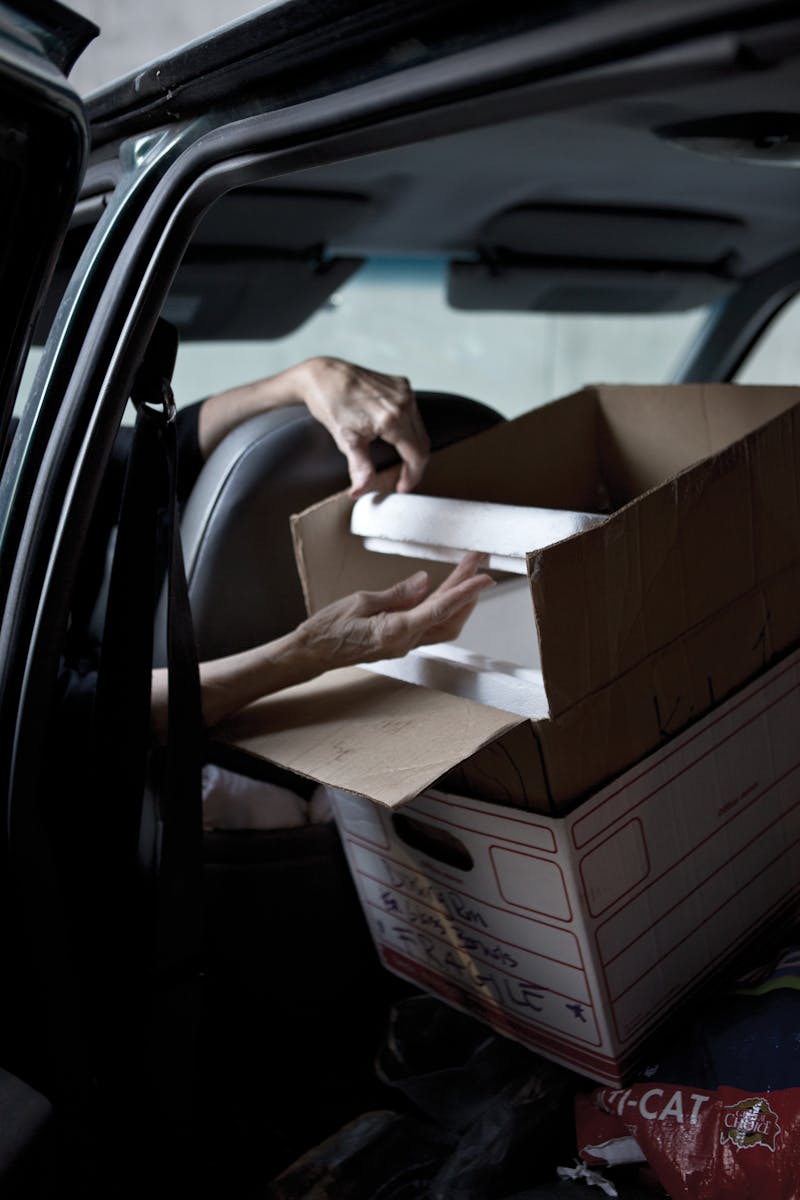
imageSuzan shows where she stored food in her car while homeless.

During the fight over the ban, the city tried to devise an alternative—a program that would allow car dwellers to park at churches—but then left the details up to the faith community to work out. Nick Selby, an attorney and member of the Palo Alto Friends Meeting House, said he and his fellow Quakers met with community resistance when they tried to accommodate three or four car dwellers on their tiny lot. Neighbors circulated a petition listing concerns like “the high prevalence of mental illness, drug abuse, and communicable diseases in the homeless population” and the risk of declining property values. But Selby said some of their concerns were fair. “People who objected were saying to the city, ‘What’s your program?’” Selby said. “And the city really had no answer to those questions.” Without a solid plan and logistical help from the city, other churches were reluctant to step forward. “The churches weren’t prepared to deal with this,” he said. After the church car-camping plan fell through, the city council said it had no choice but a ban.

Santa Clara County, too, struggles to address the problem. The county is participating in federal programs to build permanent supportive housing for the chronically homeless population, the population of long-term homeless who typically have interacting mental health and substance abuse problems. But land is expensive here, and the area is shortchanged by the federal formula that disperses funds. California, ever in budget-crisis mode, provides limited state funds. There isn’t a dedicated funding stream from the cities, which don’t necessarily pay a tax to the county for these projects, and local affordable housing developments are often rejected by residents as Palo Alto’s was. In September, the city of San Jose and the county announced a $13 million program to buy old hotels and renovate them as shelters, which will make 585 new beds available. While advocates credit the county’s efforts with cutting the estimated homeless population by 14 percent since 2013, the number of people like Suzan, who hide in their cars, is almost certainly underestimated. But most such efforts are centered in San Jose. Chris Richardson, a director of the Bay Area’s Downtown Streets Team, said what needs to happen is not a mystery: Other cities have to fund affordable housing, they have to fund more of it, and they have to do it in their own neighborhoods, without relying on San Francisco and San Jose to absorb all of the area’s poverty and problems. “You can’t just ship them down to the big, poor city,” he said.

When Palo Alto originally passed the car-camping ban, it also devoted $250,000 to the county’s homelessness program. When they voted to rescind the ban, council members asked for an update on what happened to the money. The city staff was not prepared to report on how it had been spent at that council meeting, more than a year into the funding. Members of the council again reiterated their desire to help the homeless. “Helping the homeless” was tabled, as a general idea, for another agenda at another meeting, as it always seems to be, or passed off to the county, or to someone elseand so helping the homeless is something nobody does.


Through the winter, Suzan remained ill; it was a bad flu season. She kept paying the rent on her room, on her storage units, on her P.O. box in Palo Alto, and she tried setting aside money she owed on parking tickets. Some months she’d run out of gas money to drive the 15 miles to Palo Alto and check her mail or visit her social workers. She was waiting to hear about the affordable apartment.

In May, she was denied. Suzan had bad credit, both because of the unpaid storage unit she and James had lost and because otherwise her credit history was so thin. Julia Lang, one of her social workers, told me she couldn’t even get a credit score for Suzan. Lang said people get denied on credit, or because they make too little for affordable housing that’s supposedly intended for extremely low-income people, all the time. “When you’re that destitute and have gone through so many complicated situations, what are the chances that your credit’s going to be good?” she said.

Suzan was livid and despondent, and she decided to appeal. “I wasn’t going to take that lying down,” Suzan told me. “I was proud of myself.” Catholic Charities helped her appeal. Suzan had to write a letter showing how she intended to repair her credit, and that she understood why it was bad in the first place. During the months of back and forth, Suzan bought a new Jeep, only one year newer than the Explorer, in case she needed to sleep in her car again. In July, she learned she’d won her appeal. She had two weeks to get her affairs in order, pay the first month’s rent and security deposit, and move in. Her social workers helped her with some of the move-in costs, and she signed a lease for a year.

I saw Suzan again in August, about three weeks after she’d moved in. Her hair was trimmed. She was wearing a brightly colored muumuu, blue and green with tropical flowers“It’s a housedress but you can wear it out on the street!”and a green sweater tied around her shoulders. She seemed relaxed and rested, and I told her so. Her bed was full of folded clothes, and her room was still in disarray. She was trying to cull her storage unit so that she could get a smaller one and cut down on rent. Most of the people in her complex had been in the same boat as Suzan, or had been worse off. She pays $810 a month, the amount determined to be affordable for her income. It had taken her more than three years, help from at least three social workers, and thousands of dollars, but she was finally stably housed. At least, for a year. 

Sunday, February 4, 2018

Bruce Beresford-Redman's prison diaries - CBS News

Read article : Bruce Beresford-Redman's prison diaries - CBS News

Produced by Josh Yager, Paul LaRosa and Ana Real

"48 Hours" first told the story of Bruce Beresford-Redman in 2012. His wife, Monica, was murdered in a Cancun hotel while his family was vacationing. Bruce returned to the United States to take care of his children, but when Mexico charged him with his wife's murder, he was extradited there to stand trial. Nearly three years later, he is still on trial.

Where does the case stand and how long will Monica's family have to wait for justice? "48 Hours" correspondent Troy Roberts confronts Beresford-Redman about the charges against in him in his first sit-down interview.

Video diary: "My name is Bruce Beresford-Redman ... I'm in a Mexican prison, where I've been on trial now ... for more than two years and nine months. I am accused of the murder of my wife, Monica ... for a crime I did not commit."

In a video diary he made for "48 Hours", Bruce Beresford-Redman says not a day goes by that he doesn't "miss and think about his wife."

Monica's family misses her too.

"I wish I could believe that he didn't have anything to with my sister's murder," said her sister Jeanne Burgos in a 2012 interview with Troy Roberts. "It's for the love that we have for her and all the memories that we have about her ... that we are here today demanding justice."

Bruce Beresford-Redman

Bruce Beresford-Redman

48 Hours

Recording diary entries in his cell inside Cancun's Benito Juarez Prison and elsewhere around the prison compound over a period of four months, Beresford-Redman says he wanted people to "understand what can happen, to get an idea of, what things are like here in Hell."

Video diary: "Making these video has really made me much more visible here ... which is really not a great thing for me...My existence in here has become a very basic struggle to simply survive."

"For many years I worked in reality TV and the reality of reality television, even at its best ... it's a world that is created. Being in here is real ... it is real and it sucks. .. it's noisy and it's smelly and it's sweaty and hot and cramped ... it's extremely uncomfortable.

"This is not an easy place to be I really don't have any, any what you could call real friends here ... and it's impossible for me to really have anybody in here that I can trust."

Riots there are not uncommon. In his video diary, Beresford-Redman documents the effects of being tear-gassed during an uprising.

Video diary: "It's Friday ... I've heard some pops and then I smelled the tear gas ... I'm getting kind of a choking sensation now ... and my eyes are just burning...it's just really strong ... itchy ... burning ... oh, god, it's awful."

A NEW REALITY

Living behind bars has been the reality for Beresford-Redman since "48 Hours" first met him in February 2012.

"This is not the United States. I really don't know this system. I don't know how it works," he told "48 Hours."

Back then, Beresford-Redman was housed in the high security wing of the Benito Juarez Prison -- a cell block full of drug traffickers and assassins responsible for countless murders around Mexico.

Now, he's in general population where he has more freedom. Beresford-Redman agreed to make video diaries to document his day-to-day life. It is a rare glimpse inside a Mexican prison.

Video diary: "Being incarcerated anywhere, but I think maybe especially here, time just gets warped ... it is almost impossible to live in the present because the present is just absolutely miserable."

"I don't think that I could possibly convey what it feels like to have not seen my children, not held my children, for nearly three years now."

"Everything that I worked my life to build is gone... If I'm convicted, I am facing a sentence of 30 years..."

Beresford-Redman says he spends a lot of time reliving time with his wife and kids -- "just times when I was free."

carnaval-011.jpg

Bruce and Monica Beresford-Redman

Images of Monica -- lovely, vivacious and headstrong -- haunt Beresford-Redman.

Video diary:"I've had a lotta time to think back on things and to remember things from the past..."

For more than two years, "48 Hours" tried to get permission to do a sit-down interview in the prison. That interview between correspondent Troy Roberts and Beresford-Redman took place earlier this year.

"How did you meet Monica?" Roberts asked.

"Monica owned a restaurant in and a nightclub in -- in West Los Angeles called Zabumba," Beresford-Redman replied. "I randomly went there one night for dinner. And this beautiful woman served me great food ... it was a fun place. And I ... went back to try and get her attention ... and I sorta never left. ...Monica was the most beautiful, engaging-- just-- she was great. She was so cool, and -- very quickly I found that my relationship with her was different than any relationship I'd ever had before and I was in love with her and she was in love with me and it was terrific."

Monica's sisters, Carla and Jeanne Burgos, say that when Bruce and Monica first met back in 1997, they seemed like a happy couple. The Burgos sisters spoke to "48 Hours" in 2012.

"She had life. She was very outgoing and self-confident," Jeanne said. "Bruce was a very well read person. He can be very eloquent ... but not necessarily the emotion."

After marrying in 1999, the couple had two children: Camilla, now 10, and Alec, now 7.

Monica had the restaurant and Bruce had his career, which was taking off in a hurry. He was a top producer on the CBS program "Survivor" and also worked on several hit reality shows for other networks and cable outlets.

As the money poured in, the family moved to a $2 million house in Los Angeles. With the more lavish lifestyle, came some unexpected challenges.

"Things became difficult?" Roberts asked.

"At times, sure," Beresford-Redman replied. "Both Monica and I worked a great deal. ...I worked during the day, she worked at night ... there was a period of time when we were sort of passing one another."

If that sounds like a recipe for marital discord, it was. Beresford-Redman began an affair with his longtime casting director Joy Pierce. At times, the two had trouble keeping their hands off each other, even in front of Monica's sister, Carla.

"I went with him to a party," she said. "It was a club ... we got there ... she jumped on his lap ... and I was ... you know..."

"You were stunned," Roberts noted.

"Yeah," Carla replied.

Beresford-Redman was struggling with the affair on an emotional level. He considered telling his parents, David and Juanita, and eventually confided in his mother.

Asked if she encouraged her son to break off the affair, Juanita told Roberts, "I did. I said, 'You know, that's the only smart thing to do. You will hurt yourself. You will hurt Monica.' ...I got the impression that he had really fallen in love and it was going to be very difficult for him to break it off."

After Monica angrily confronted her husband, Beresford-Redman wrote her a brutally frank e-mail. It was written on March 4, 2010 - only one month before the couple was to leave on their ill-fated Mexican vacation. In the e-mail, Beresford-Redman laid bare the painful truth, writing: "Joy and I were lovers." Monica was devastated.

"My relationship with Monica was good," said Beresford-Redman.

"You can't paint a rosy picture on this, right? Roberts asked. " I mean ... you guys had problems."

"Like any marriage, like any family, we had -- we had issues, certain issues," he replied. "But we were -- we were happily married and we were in love with each other ... We were good."

Beresford-Redman wouldn't talk to "48 Hours" about his affair, but in an e-mail written to Joy Pierce in the spring of 2010, he outlined the steps a furious Monica had taken against him: "She...denied me access to my children ... she shut me out of my home ... and liquidated all my money, " he wrote.

"It was a point where she had decided to get divorced from him," said Jeanne.

But Beresford-Redman did all he could to change Monica's mind. He promised he'd break off his affair with Joy and told Monica he would change his ways. Monica agreed to go with him for the family vacation they took every year for her upcoming birthday. This time, they traveled to the Moon Palace Resort in Cancun, Mexico.

"And how was the trip, initially?" Roberts asked Beresford-Redman.

"It was good. It was -- it was really fun, you know," he replied.

"So you and Monica got along well during this trip?" Roberts asked.

"Yeah, we had a really good time," said Bruce.

That's hardly the way Monica described the trip, according to her sister, Jeanne, who says she spoke to Monica by phone the day before she was murdered. Jeanne says Monica was upset about Bruce's cheating.

"I told her, 'Monica, don't worry. You know, come back here, just move on with your life,'" Jeanne said. "...you're just going to build up your life again and you're going to be happy again."

The next day, April 5, 2010, was to be the last day of Monica's life.

"She was gonna do some shopping-- and then she was perhaps gonna go to a spa," Beresford-Redman explained.

"And when did you grow concerned?" Roberts asked.

"Probably 10:30 or 11:00 that night," he said, sighing.

Bruce's concern was made all the worse because he says Monica had not taken her cell phone so he could not call her. Police later discovered that she did not take her passport or a room key, either.

"Was that surprising that she didn't take her phone when you were alone with kids?" Roberts asked.

"No. No, not really," Beresford-Redman replied. "When Monica was off the grid, she was off the grid."

She didn't take her cell phone? She left the kids all day with him? She never does that, ever," Jeanne told Roberts.

Video diary: "One of the things that I remember from the night that Monica was first missing was my children sleeping. I had given them baths and I had put them to bed ...and I thought, 'OK, I'm gonna go outside and I'm gonna take a look. I'm gonna see Monica walking back towards the room."

But Monica did not come back to the room -- not that night and not ever. The long, upward trajectory of Beresford-Redman's once-successful life and career was about to end abruptly.

A LOOK INSIDE PRISON LIFE

When Bruce Beresford-Redman left on his family vacation to Mexico in 2010, he probably never thought home would turn out to be Cancun's Benito Juarez prison.

The prison, where he has spent nearly three years on trial for his wife's murder, houses more than 1,800 men and women in a compound originally built for 700.

Video diary: "When I walk around the prison, no matter where I'm going or what's going on, I am constantly aware that this is just a hostile environment for me."

"I'm completely shut down. I'm simply in survival mode," Beresford-Redman told Roberts. "To make it in here, you cannot indulge in human sentiments. ... you really have to deaden part of yourself and just survive."

Video diary: "My Spanish is still not very good ... So I'm always paying attention ... and you're never really able to relax."

It's a pressure cooker of criminals and contraband that often boils over.

"You're with people who have demonstrated poor impulse control and a number of them may have mental problems,"Beresford-Redman explained. "It's not uncommon to have fist fights ... screaming matches ...it is a very dehumanizing situation."

bbrbehindbars.jpg

Bruce Beresford-Redman his cell at Cancun's Benito Juarez Prison.

48 Hours

Video diary: The cell that I'm in is a very small cell ... it's designed for three men. And there are 10 of us in here. There have been as many as 17... This is the bathroom of the cell. All of these buckets are full of water. The water here runs only for a couple hours a day."
"I come back from my workout and I take my first shower of the day ... I shower four times a day ... I wash my clothes ... I do everything I can to keep myself clean and healthy. It's a real struggle ... This place seems like a really great place to incubate a plague. Despite my best efforts I managed to get a rash that everyone else here had that just swept through this place like wildfire."

The cell is open to the elements -- rain and relentless heat. He says the smell from open sewers is blinding, adding that "the whole country -- it feels like is just steaming."

Video diary: This is my bunk where I sleep. I've awakened probably seven or eight times now with a cockroach on me someplace.

Among the personal items Beresford-Redman keeps on a shelf above his bed -- his favorite picture of his daughter and son.

Video diary: "This is breakfast this morning ... brown liquid with some beans on the bottom there I think ... I have gotten violently ill eating the prison food... I have been able to supplement my diet ... with-- food brought from outside. I befriended-- an inmate in here. He has since been released. But his family still comes to see me once a week with some home-cooked meals and some snacks and some other things, so that I don't have to rely entirely on the prison food."

To pay for his food and other expenses, Beresford-Redman's parents send him money from their retirement nest egg. Less fortunate inmates have to rely on meals in buckets served by new prisoners known as "talachos."

Video diary: "They are as close as you can come to slaves. You can buy your way out of it, or you can do your talacho work for your first year here."

"The guards basically maintain a perimeter on the outside and their concern primarily is making sure that nobody gets out... The prisoners discipline each other ... and it's much more dangerous, because there's really nobody to come to your help, to your aid, if you are in trouble in here."

Danger is all around, but he says Mexican prison also means a freedom he never had in American prison, where he spent 18 months awaiting extradition.

Video diary: "In many ways, this is like a very small village that they just threw razor wire around. There's churches in here, there's a mechanic shop in here ... guys making hammocks."

Some of the women prisoners are even allowed to have their children live with them. Three times a week it's visiting day.

Video diary: "...this place is full today of families ... on visit days. From 8:00 in the morning to 3:00 in the afternoon the prison ... fills up with families and wives and kids...

"Family is extraordinarily highly valued here and the prison administration and prisoners themselves and the gangs in here have enormous respect for the visits."

He says visit days make him sad, "a little melancholy." There are no family visits for Beresford-Redman.

Video diary: "I would not allow them. I don't want them to be confronted with how I am forced to exist in here."

So Beresford-Redman hasn't seen them in nearly three years. His lifeline is phone calls to his children, Alec and Camilla, who live with his parents in California.

Video diary: "To hear my kids' voices, to hear my parents' voices ... is the best, most human part of my day. ... I have not been able to be a father to Camilla and Alec for ... years now. It is devastating. It takes all of my energy just to keep going."

But there's no choice. Beresford-Redman, his family, and Monica's sisters are all navigating an unfamiliar landscape: justice in a foreign country.

"There's no question that the Mexican legal system is different from ours," said Sonya Tsiros, U.S. Consul General for the Cancun area.

Tsiros says she is closely following the Beresford-Redman case - and that by Mexican standards, it doesn't surprise her.

"Has Mr. Beresford-Redman complained to you about the length of this trial?" Roberts asked.

"He has raised that issue," Tsiros replied. "And we're following through on that."

"Do you have any sense of what the prison conditions are like?" Roberts asked.

"I would say that the prison conditions are not up to what we would consider standards in the United States," said Tsiros.

Beresford-Redman, at least, has a bed. "48 Hours" found another American, 38-year-old Johnny Mintu, from Seattle, who, incredibly, sleeps on the floor under Bruce's bunk. It's not uncommon in this prison.

Video diary: "From time to time ... when I just really need some privacy and a little bit of quiet and just a little more space than I can get in my cell or in the rest of the prison ... I book a conjugal room."

Most inmates rent the room for sex. Beresford-Redman says he rents it for peace and quiet.

Video diary: "You're not supposed to be in here by yourself. But I just put down the name Jane Doe and nobody's ever checked."

Trying to recreate life outside the bars is only a temporary escape.

Video diary: "I cannot afford in here to appear on the outside as absolutely broken as I feel on the inside."

As the sun begins to set, the prisoners are locked in for the night.

Video diary: Another night here ... another night in paradise ... then I just lay down and try to go to sleep...

It's a sleep, he says, that is haunted by the memory of his murdered wife.

Video diary: "I still miss her all the time and I still think of her all the time ... I never lose sight of the fact that this is really Monica's story."

Monica's story is a murder mystery. And for Beresford-Redman, it's a real whodunit.

THE DAY MONICA DISAPPEARED

With so much time on his hands, Bruce Beresford-Redman says he thinks often of the day Monica disappeared.

"As soon as I was awake, I called the hotel desk, I guess, and I said you know, 'My wife didn't come back yesterday. Do you know where she is?'" Beresford-Redman told Troy Roberts.

Monica Beresford-Redman

Monica Beresford-Redman

After reporting that she was missing, he called Jeane Burgos, Monica's sister.

"When Bruce called you to say that Monica was missing what went through your mind?" Roberts asked.

"My sister missing? Monica? Monica's not a person that gets lost, she doesn't get lost," Jeanne replied. "She's a person that she goes anywhere and she makes friends and she knows what she's doing."

A worried Jeanne immediately flew to Cancun to help with the search, but the next day, hotel workers found Monica's body in that sewer situated near the family's hotel room.

"How could someone put a person in the sewage. Very, very, very horrible," she said.

"How did you learn that her body was discovered?" Roberts asked Beresford-Redman.

"I was at the hotel ... I was sitting there waiting ...and they brought me back to my room," he replied. "I had no idea what was going on. ...Finally someone told me that they had found Monica's body.

It would have been her 42nd birthday.

Video diary: "I could not make sense of that. It just didn't seem possible."

Bruce Beresford-Redman became a suspect almost immediately because investigators thought his story of Monica's disappearance defied logic. They didn't believe she would leave the children behind without taking her room key, her passport, or even her cell phone. What's more, Beresford-Redman had visible scratches on his body.

He says the injuries to his hand occurred after a boat ride as he tried to carry his children up a steep incline.

"It was rocky and slippery and I had to lift the kids out and then climb out myself and I scratched my hands a little bit," he explained.

As for the scratches to the back of his neck?

"We were diving ... and I surfaced and there was a nylon rope and it was just a rough nylon rope and it abraded ... the back of my head a little bit and that was it," he told Roberts.

Police also learned that two English teenagers had reported hearing screams coming from Beresford-Redman's room very early on the morning Bruce said Monica went shopping.

Jen Heger covered the story for Radar Online.

"A female screamed crying for help," Heger explained. "The next morning, the teenagers told their parents about what they had heard to the concierge. The concierge called the hotel room to see what was going on and Bruce said that Bruce and Monica were arguing about the children and that everything was fine."

Beresford-Redman maintains that he and the children were simply playing a loud, boisterous game. But now his every move was coming under scrutiny.

Asked why he had a "do not disturb" sign on the door all day, Beresford-Redman told Roberts, "Well, I was in and out all day with the kids. We were napping and doing stuff and didn't wanna be disturbed. It's as simple as that really."

"The Mexican authorities believe that Bruce wouldn't allow the maids to clean the room that day because there was a dead body inside and that dead body belonged to his wife -- Monica," said Heger.

The police theorized that Beresford-Redman had suffocated his wife and, later that night, went looking for a place to stash her body.

"We also know," Heger continued, "someone went in and out of the room nine times in the middle of the night."

Beresford-Redman says he was nervously checking to see if Monica was about to return.

"I was in and out of the room many times to take a look to see if I could see her, to walk down to where the footpath is visible and to take a look and return to the room," Beresford-Redman told Roberts.

Back in Los Angeles, Monica's sister, Carla Burgos, thought back to the last time she had seen Bruce and how agitated he seemed to her. It was just two days before the family left for Cancun.

"I've seen him before they traveled and he was totally angry and crazy. I said, 'Don't be around him ... Monica, please listen to me, get out,'" she said.

"Why do you think Monica's family is convinced that you killed her?" Roberts asked.

"I really don't know," Beresford-Redman replied. "I understand their pain. I understand their sense of loss. After my children and myself, their loss is the greatest ... however, why they wanna blame me, I don't know ... that I don't know."

Monica also had life insurance. Her husband was not the beneficiary, but the children stood to inherit $500,000 each. All in all, investigators believed they had a strong circumstantial case but there remained a huge question -- how could Beresford-Redman kill his wife, and then dump her body while taking care of two young children?

"They were in one hotel room and it was not a suite. It was one room," said Heger.

There was scant physical evidence against Beresford-Redman except for a very small amount of blood investigators found on the bedroom pillow and a balcony railing.

"When people look at you with suspicion, how do you feel?" Roberts asked.

"I've been accused of a horrible, abhorrent crime and I'm innocent," said Beresford-Redman.

"You did not kill Monica," said Roberts.

"I did not kill Monica," Bruce replied.

But the police were convinced Bruce Beresford-Redman did kill Monica and they had no other suspects. The hotel, which says it kept written logs of everyone entering or leaving the grounds, reported it had no record of Monica leaving that day. And if there are security cameras at the Moon Palace, no recordings have surfaced.

Video diary: "My best guess would be that somewhere in the course of her day, she ran into some people that she should not have run across ... I think perhaps she attracted the attention of someone who was very dangerous."

While Beresford-Redman was cooperating with police, his children were taken back to Los Angeles by a friend of Jeanne Burgos. She also arranged for her sister's body to be brought back, even though Beresford-Redman had already paid for Monica to be cremated.

"Why do you think Bruce moved to have Monica cremated?" Roberts asked Jeanne Burgos.

"I think it's pretty self-explanatory," she said.

"Why do you think?" Roberts pressed.

"To get rid of any evidence," Jeanne replied.

Beresford-Redman stayed in Mexico for about a week after Monica's body was found. Authorities took his passport and insist they ordered him to remain in the country. He says his lawyer told him he was free to return to the United States.

bbrroberts.jpg

"48 Hours" correspondent interviews Bruce Beresford-Redman

48 Hours

"This is what I find a little difficult ... is that they're investigating your wife's murder and you go home? Why wouldn't you stay here?" Roberts asked.

"Well, because I have two small children who were at my home. They just lost their mom and I believed at the time that I had done all I could do to help the police so I went home to be with my children," he replied.

Having no passport, Beresford-Redman got a ride to the Mexican border near Laredo, Texas, and simply walked across using his driver's license for identification. From there, he took a train rather than fly back to Los Angeles. His unorthodox journey raised suspicions.

"You didn't go back to the United States to escape possible arrest?" Roberts asked Beresford-Redman.

"No, I went home to be with my children. I was at my home. I was not hiding. If I'd been trying to evade I would have attempted to evade. I went back to the United States and went directly home," he explained.

Beresford-Redman cared for his children for seven months. But in November 2010, Mexico declared him a fugitive and issued a warrant for his arrest. He was taken to a federal jail in Los Angeles where he stayed for more than a year until he was finally extradited back to Cancun to stand trial for the murder of his wife.

"Bruce probably feels that he is trapped in the worst reality show he could ever imagine," said Heger.

SEEKING JUSTICE IN MEXICO

In February 2012, Bruce Beresford-Redman -- outfitted in a bulletproof vest -- was extradited back to Mexico in a scene straight out of a movie.

Video diary: "I was taken by the U.S. Marshals to the airport ... I was brought here in the middle of the night in a rainstorm..."

"I hoped that my trial would end quickly when I got here," he told Roberts.

That is not what happened. Essentially, the courts in Mexico move at their own pace. There are no juries and in many courtrooms on any given day, there's more than one trial going on at the same time.

Video diary: "The courtroom that I'm being tried in looks like a very busy shipping office above a warehouse someplace."

Criminal defense lawyer Pat Fanning lives part-time in Mexico and has experience with the country's judicial system.

"They just don't have the resources to do the things the way we do," Fanning told Roberts. "Here, it's more like a municipal office in the United States where you'd go to get your driver's license, where you'd go to pick up a birth certificate or something."

U.S. Consul General Sonya Tsiros says the differences are more than cosmetic.

"There's not a trial, per se, in that there is one period of time in which a judge hears all of the evidence. ... It's done through a series of written presentations to the judge," Tsiros explained. "It doesn't occur ... in the same fashion in the United States."

But as the trial has dragged on, what once seemed like a strong prosecution case appeared to evaporate in court. Testing revealed that the blood droplets found in the hotel room did not belong to Monica. That raised questions about where Monica had been killed because she had suffered a substantial head wound.

"Our experts ... say it is not possible to kill someone and produce that type of injuries without leaving blood," said Jaime Cancino, who is one of Beresford-Redman's lawyers in Mexico. "If that have happened there... it would produced a humungous quantity of blood."

In court, prosecutors could not even produce the Q-tips investigators used to collect the blood. Most everything else they took from the family's hotel room as potential evidence turned out to be contaminated by mold and water damage while in police custody.

And some of the physical evidence presented at trial helped Beresford-Redman. Footprints found near the crime scene were not Bruce's. It also came to light that Monica's fingernails were not tested for the presence of DNA because her body was so decomposed.

"There isn't much direct evidence and the evidence they do have has been contaminated, largely," Roberts noted to Fanning.

"Well, it has in -- in large part. But you still have, for example, that they were havin' marital troubles ... that he had a girlfriend ... the life insurance policy on her for half-a-million dollars," he replied.

But in court, even the circumstantial case against Beresford-Redman appeared weaker than advertised.

Some witnesses, like the English teenagers who reported overhearing screams coming from the Beresford-Redman room, did not appear in court. Beresford-Redman says other witnesses did not repeat the stories they had first told police.

"It's clear to me that they have no idea what happened to my wife," he told Roberts. "There was witness, who was a housekeeper, I think. And he came in ... and before anyone asked a question, he said, 'I wasn't there that day. I didn't see anything. I don't know anything and I don't know why I'm here as a witness.'"

Another person not called to the stand or even part of the case was Emily Hamilton from Baltimore. She says she was nearly raped at the Moon Palace one month after Monica was murdered. And her attacker, Hamilton says, was a hotel worker delivering food to her room.

"He threw me on the bed. ... He had his arms around me. I was trying to force him off and I remember feeling pain ... 'cause I thought I could fend for myself, but he was too strong and overbearing ... and that's when I yelled for my friend Casey and she came back in and that's when he was pulling up his pants and that's when he ran out of the room," said Hamilton.

"So you must've been frightened out of your mind," said Roberts.

"Very much so," Hamilton replied.

That worker was fired. In the United States, it's likely he'd be a suspect in Monica's murder, but that possibility was not raised in Beresford-Redman's trial. However, in 2013, an independent criminologist was appointed by the court to review all the evidence against Beresford-Redman.

"He reviewed the case, he visited the crime scene, he did all the things required to make his report," Beresford-Redman told Roberts.

After six months, the criminologist released a bombshell of a report. His conclusion: Monica was not murdered in her Moon Palace hotel room and there was no physical evidence linking Beresford-Redman to her murder.

Video diary: "I naively assumed at that point that the prosecution would drop the charges and would focus their investigative efforts elsewhere ... and nothing has happened. Charges aren't dropped. My trial continues with no end in sight. I'm still here..."

"If you're gonna convict me, convict me so I can appeal. Otherwise just give me a ruling so I can go home," said Beresford-Redman.

"Do you think you're being unfairly singled out?" Roberts asked.

"I don't know," he replied. "It feels at times to me like they don't wanna do anything with me. I'm stuck and ... in many ways I feel like I'm without a country."

Sonia Tsiros says members of the U.S. consulate have visited Beresford-Redman on 19 separate occasions.

"U.S. citizens who are arrested in a foreign country are subject to the laws of that foreign country," Tsiros explained. "We can't intervene in court cases and we can't request special treatment for U.S. citizens."

"Can you use the influence of your office to move things along?" Roberts asked.

"If there's due process violation, we can raise those. But we can't intervene in -- in a case," she said.

"I'm broken inside. I have lost my wife. I lost my children ... I've lost everything else," Beresford-Redman told Roberts. "I'm on emotional autopilot, just surviving every day in the hopes that I will finally at some point get outta here but that is a diminishing hope."

Of course, he is not the only one who's lost a loved one.

"Everybody loved her," Carla Burgos said of her sister, Monica. "She was so awesome, so full of life. She was so fun, so smart. Everything,"

Each side hopes for justice ... and that may soon be coming because after nearly three years, the last witnesses will finally testify.

A LAST HEARING

After years in a Mexican prison - and in legal limbo - Bruce Beresford-Redman's trial finally may be nearing an end.

Video diary: "It's a Thursday afternoon. Tomorrow I will be taken back to court, and I am told it will be the last hearing in my trial...

"It's very difficult for me to get my hopes up... because I'm always waiting for the other shoe to drop ... and so often it seems to drop on my head."

He says the trial so far hasn't made any sense. Lost or contaminated evidence, missing witnesses and agonizing delays. It's his first court date in about three months.

On this day, he's set to face the prosecutor's final two witnesses -- hotel employees who may have witnessed Bruce and Monica arguing the day before her murder.

"How many times have you appeared before this judge?" Roberts asked.

"If I had to guess, I would say probably, 40, maybe 45 appearances in court over two-and- a-half years. At the many of those appearances, however-- the witness doesn't show up, and we stand around for a little while and they reschedule the witness for another eight weeks or 10 weeks down the road and we all go home again," Beresford-Redman replied.

But these witnesses actually do show up. Today, it's the judge who doesn't.

Like many of the other hearings, this one goes ahead anyway with the judge's assistant presiding.

Video diary: "...the witnesses arrived ... no one including the prosecution seemed to have any idea what they were going to say..."

Incredibly, the final two prosecution witnesses sound like part of the defense team. Both tell the court they've never laid eyes on Beresford-Redman or his wife.

"We didn't hear them arguing," one of them told "48 Hours" after the hearing. "We didn't even see their faces."

With no more witnesses on either side, Mexican law requires the judge to conclude the evidence phase of the trial within about five days; but that doesn't happen.

"Why don't we have a verdict?" Roberts asked Pat Fanning.

"Because we're in Mexico," he replied. "That's how things are done here and nobody gets excited about it."

For nearly three years, "48 Hours" has asked Mexican authorities to go on the record about this case. But they refused.

Back in prison, it's hard for Beresford-Redman not to hope.

Video diary: "Yesterday was a good day...and you sort of take them as they come..."

"I am absolutely confident that if -- if there is a ruling according to the facts, that I will be exonerated," he said.

"And when will that happen?" Roberts asked.

"Well ... that I don't know. That's my problem," he replied.

But the Burgos sisters insist Bruce is right where he should be. And justice for Monica demands that he stay there.

"If he really killed my sister, which it looks like he did, I want him in jail. But it doesn't make me happy to see him in jail," said Carla Burgos.

Video diary: "I spend a lotta time in here looking over the barbed wire ... I can see birds and green trees and life outside -- oh this Hell...

"It's really time for me to go home. It's time for me to be with Camilla and Alec. It's time for me to try and put back together some kind of a life for them and for myself."

His parents, meanwhile, are trying to keep life in California as normal as possible for Alec and Camilla, but it's not easy -- they're 81 and 76.

Juanita Beresford-Redman has been keeping a video diary, too:

"It's ... about 8:30 in the morning. The children have gone off to school. It's reasonably quiet at the moment.

"Camilla's birthday is coming up ... and she asked me yesterday did I think daddy might be able to home for her birthday this year... and I told her honestly, "No honey...he's not gonna make it this year."

"Is it your fear that this may go on indefinitely?" Roberts asked Juanita.

"It is a fear," she replied. "I can't see why it's gone on this long."

Carla and Jeanne Burgos tried and failed to get custody, but they have regular visitation with the children.

"We love those kids more than anything in this world," Jeanne said. "It's not what is good, what is bad, it's what is the best for the kids."

"We are a family, but we're not their father... we're their grandparents," Juanita said. "We love them, but, it's not the same."

"I will never make my peace with being incarcerated for something I didn't do. I will never rest or stop fighting. I may lose continually, but I'm never gonna stop ... because this is crap," Beresford-Redman told Roberts.

But as memories and milestones slip past, all Bruce Beresford-Redman can do is watch, wait, and wish his children well.

Video diary: "...I love you guys, I miss you. Be strong and ... and all I want is for you guys to have the best life you can."

Prosecutors should be submitting their closing arguments in writing by the end of November.

Thursday, May 18, 2017

Shopping advice - Mirror Online

Read article : Shopping advice - Mirror Online

Need expert advice on your home? Email Zena at homes@sundaymirror.co.uk

Q - I need to create an office space in my spare room (with sofa bed), which will look like an office most of the time, but that I can easily convert back for guests. What tips do you have? I only have a budget of around £200.

Alexander, by email

A ZENA SAYS: I think the secret to success lies in wall-mounted shelving, which will release the floor space for other essentials, such as your desk and sofa bed. Look for shelving units with ends, as opposed to the open-ended shelves. Children’s furniture stores, such as Aspace and Great Little Trading Company are very good at these. A narrow-depth desk will also save space but still give you that office look.

The Loft desk is more like a console table and measures 105 (length) x 52 (width) x 90cm (height) and costs £199. Or you could even have a wall-mounted desk - a friend recently made the one in our photograph at a cost of £43! Either option could easily be cleared and the office chair removed when guests arrive.

***

I am looking for a small, ­contemporary sofa to fit into my bay window. It should be no wider than 150cm. Any suggestions?

Cliff Andrews, Edinburgh

ZENA SAYS: The Harry two-seater from House of Fraser (call 0845 602 1073) would look so cute in a bay window. It measures 132cm wide comes in a choice of lime green or the lovely aubergine fabric in our photo (right). ­Usually it would cost £849 but it’s ­currently on sale at just £499.

If you’d like to support an up-and-coming company offering designer furniture and ­accessories direct from the makers at ­discount prices, the Ritchie ­(below) is very similar. It costs £449 from www.made.com and is also available in pearl grey.

***

Q - Our electric shower is faulty and needs to be replaced. This will be the second time in five years. Would a non-electric shower have a longer life and is that an option for us, as we have all the fittings for electric? My children have just started showering so it must be safe for them too.

Zach Summers, Leeds

ZENA SAYS: There is a good chance that you live in a hard water area and the limescale build-up is affecting your shower. Mixer valve showers cope much better with hard water and will last longer than an electric shower. A qualified person can easily replace your electric shower with one. Bristan has just launched two exposed valve ar showers – Zing and Frenzy – with Cool Chrome Technology, which is ideal where youngsters are around. The shower body stays cool to the touch and because it’s thermostatically controlled the temperature stays constant. They come with a rub clean handset, which is ideal for cleaning limescale. Zing is priced at £99 and Frenzy from £119 (valve only) and £149 (with kit). Call Bristan on 0844 701 6273 for a local stockist.

***

Q - I recently spent a week on a self-catering holiday in Wales. They had a set of Brabantia Vision saucepans which I would love to buy but cannot find anywhere. Could you tell me if/where I could get them?

Janet Shields, by email

ZENA SAYS: Your encounter sounds like a bit of a holiday romance, Janet. For some strange reason you cannot buy this set of pans direct from Brabantia but Amazon sells them. Prices start at £23.01 for a 14cm stainless steel milk pan.

***

The stair carpet in the communal area of our block needs to be replaced but we freeholders don’t know where to buy a new one or what to look for. I imagine standard hall carpet will be insufficient.

Sarah Brown, Leamington Spa, Warks

ZENA SAYS: According to The Society of British Interior Design, the wear rating of the carpet should be “heavy contract”. They suggest a high-quality 80/20 wool/nylon or 100 per cent polyamide (nylon) pile fibre, as it is very tough.

If the staircases are ­concrete, then non-slip safety nosings must be fitted. Try Vorwerk, an eco-friendly brand which is allergy-free, and Weston-Hammer for a customised design.

Some domestic carpets are also rated for contract or commercial use, too. For example Lano’s Scala range has a fleck option to help hide the dirt until vacuuming. It is rubber backed which helps with spills and ­water from shoes and stops moisture getting into the underlay.

Here’s some technical info with which to baffle your fellow freeholders – Scala is made of 100 per cent solution-dyed two-ply polypropylene for maximum durability and has been solution dyed for ease of maintenance. It costs about £22 a square metre.

The fully impervious backing means that it can be used in areas prone to accidents and where day-to-day performance is of the utmost importance.

However, the SBID does not recommend polypropylene. Although hard-wearing and inexpensive, they say this fibre soils quicker than any other pile fibre, and goes very flat and untidy.

You should also avoid natural flooring such as sisal, coir and sea grass because they get slippery and stain easily.

***

Q - Do you have the web address where I can buy “tile on a roll” wallpaper?

Kate Henson, by email

ZENA SAYS: Tile-effect wallpaper has been around for decades and is a really useful and cost-effective way of covering kitchen and ­bathroom walls that are exposed to water splashes. The designs are very bright and modern and technically, they’ve been brought up to date, too. Graham and Brown’s ­Contour antibacterial range offers protection from bacteria and it’s a paste-the-wall paper, making it really easy to hang. The Keep Calm paper in our photo costs £18 per roll. Call 0800 328 8452.

***

Savvy savers

Alison Cork gets you more... for less.

Home improvement

LIDL always has great prices and now there’s also a sale on home improvement products, too. So whether you’re moving house or just moving the sofa, spare your floors with their five-piece Furniture Transport set, only £4.99. You get a robust steel lever to lift the furniture, and four transport rollers with castors to get it from place to place.

***

Asda home sale

Save on practical kitchen and home accessories during Asda Direct’s home sale, with 30 per cent off products, on now. I ­especially love these collapsible mixing bowls, reduced from £4 to £2.80. They’re perfect for saving ­precious cupboard space and they are easy to wipe clean.

***

Drying balls

Does the wet weather have you using your tumble dryer yearround? Save up to 30 per cent on drying time and energy with these Ecozone Dry Cubes from Nigel’s Eco Store. It’s £9.95 for a pack of two cubes that can be used again and again. Call 0800 288 8970.

***

Be alarmed

You can often get a discount on your home contents insurance if you have a burglar alarm and now’s the time to buy one as B&Q currently have half-price savings on security and alarms. The Standard Wireless Door and Window Contact alarm is reduced to £7.49, and the Standard Wired PIR DC7 motion detector is just £4.99.

For bed linen and other accessories, see Reader Offers.

***

Coining it

Why is it that when you need a pound coin – be it for a parking meter, shopping trolley or vending machine – you can never find one? This clever Coin Stash Waterproof Coin Capsule (£4.95) attaches to your keys, storing an emergency stash of five one pound coins for when you need them, while keeping your pockets and car free from easily misplaced loose change. Buy one for Dad at www.gadgets.co.uk

For more gift ideas for Dad, see Reader Offers.

***

Standby for action

According to British Gas, every year we waste around £30 leaving products on standby. Save dosh with an automatic standby shutdown plug, like this one from Energenie. It recognises when you’ve left an appliance or computer on standby and switches off the mains power. Get it from www.homebargains.co.uk for £3.99.

For more computing accessories, see Reader Offers.

***

Shower power

Save water, time and money with a Water Drop shower timer from Eco Savers. Just £4.99, it sticks to the wall – you set the timer and it bleeps when your time is up. It’s a great way to cut bills.

***

Website of the Week

Save on mobile, broadband and energy bills with Incahoot.com. The site uses collective buying power (think Groupon or KGB Deals) but focuses mainly on utilities and practical services. Basic membership is free.

***

For more great shopping offers, visit Reader Offers.