Showing posts sorted by relevance for query people attend church. Sort by date Show all posts

Sunday, March 4, 2018

With Bathroom Bill Dead, Houston-Founded Pastor Council Looks To Future Fights

Read article : With Bathroom Bill Dead, Houston-Founded Pastor Council Looks To Future Fights
Dave Welch speaks during a press conference in favor of a bathroom bill at the Texas Capitol near the end of the special session on August 14, 2017.

A day before the Texas Legislature ended its special session this week, a session that included a high-profile fight over a “bathroom bill” that appeared almost certainly dead, David Welch had a message for Gov. Greg Abbott: call lawmakers back to Austin. Again.

For years, Welch, executive director of the Texas Pastor Council, has worked to pass a bill that would ban local policies that ensured transgender individuals’ right to use restrooms in public schools and government buildings that match their gender identity. The summer special session, which was quickly coming to a close, had been Welch and other social conservatives’ second chance, an overtime round after the bill — denounced by critics as discriminatory and unnecessary — failed during the regular session that ended in May.  

But with the Texas House unlikely to vote on a bathroom bill, Welch gathered with some of the most conservative Republicans in that chamber to make a final plea. The bill, they argued without any evidence, would prevent men from entering bathrooms to sexually assault or harass women.

“If this does not pass during this special session, we are asking for, urgently on behalf of all these pastors across the state of Texas, that we do hold a second special session until the job is done,” Welch said at the press event, hosted by Texas Values, a socially conservative group.

 Though the group of lawmakers, religious leaders and activists were still coming to terms with their failure to get a bill to Abbott’s desk, for Welch’s Pastor Council, the years-long fight over bathroom restrictions has nonetheless been a galvanizing campaign.

The group, which Welch founded in 2003, has grown from a local organization to a burgeoning statewide apparatus with eyes on someday becoming a nationwide force, one able to mobilize conservative Christians around the country into future political battles. If Abbott doesn’t call lawmakers back for another special session to pass a bathroom bill, the group is likely to shift its attention to the 2018 elections. 

“Our role in this process shouldn’t be restricted just because people attend church,” Welch told The Texas Tribune. “Active voting, informed voting, is a legitimate ministry of the church.”

A pastor for pastors

Welch has made a career out of mixing the religious and the political. Before founding the Pastors Council, he spent time at the Christian Coalition and Vision America, a controversial national evangelical group led by Rick Scarborough, a Texas pastor. And just before he founded the Pastor Council, Welch briefly worked as the executive director of the Republican Party in Harris County, where he would get to know many of the politicians that would animate his later campaigns. Welch said he has known Lt. Gov. Dan Patrick, one of the most outspoken proponents of a bathroom bill in state government, since he was a radio host in Houston.

But it was with the Pastor Council — at first a small group of Houston pastors — that Welch would begin to make his deepest mark in Texas politics.

“We formed the Houston area pastor council in 2003 as a group of 12 pastors, across racial and denominational lines, to engage together on a variety of social moral cultural issues,” he said.


That initial group has since expanded into two additional entities, the Texas Pastor Council and the US Pastor Council, though the distinctions between the groups can be murky. Welch — who himself no longer preaches, instead referring to himself as a “pastor for pastors” — leads all three groups, and the main phone number for the US Pastor Council is a direct line to Welch.

The group, according to Welch, has taken on a range of issues, from criminal justice reform to child foster care. But over the course of his career, Welch and the group have had a decided preoccupation with attacking LGBT rights, what Welch describes as “the continued tide of the radical political LGBTQ movement trying to work to undermine traditional marriage and traditional family.” On the US Pastor Council website, the only “current issue” listed is “Woman’s Privacy Protection,” a page that features a number of talking points in favor of a bathroom bill.

“They have made anti-LGBT activism their primary focus,” said Dan Quinn, communications director for Texas Freedom Network, a liberal watchdog group. “They’ve had their most public efforts trying to defeat anything that protects equality for LGBT Texans.”

Over the course of several years as a columnist for World Net Daily, a far-right website known for hosting conspiracy theories, Welch railed against same-sex marriage and legal protections for LGBT individuals. In a 2009 post titled “When the Wicked Rule,” Welch attacked a new federal law that protected LGBT individuals from hate crimes as condoning “every possible form of sexual deviancy.” He denounced the “radical sexual-deviancy jihad” in a post called “My Gay America” in 2010.

Lesbian Mayor Annise Parker has gone above and beyond to now extend protection through executive orders to ‘gender identity’ and ‘gender expression,’” he wrote at the time. “Keep your wives and daughters out of Houston city restrooms.”

That rhetoric against Parker – the first openly gay mayor of a large American city — and legal protections for LGBT individuals in Houston would eventually become talking points against the Houston Equal Rights Ordinance, which would have made it illegal to discriminate against someone based on 15 different “protected characteristics,” including sex, race, religion, sexual orientation and gender identity.

During that fight — which concluded with Houston residents voting overwhelmingly to strike down the nondiscrimination ordinance — Welch played a leading role in both the electoral and legal campaigns against the city. Jared Woodfill, one of the lead organizers against the HERO ordinance in Houston, said that Welch and his organization were “extremely instrumental” in gathering the signatures that would ultimately prompt the lawsuit and referendum overturning the ordinance.

Indeed, organizing and mobilizing voters is a key part of the Pastor Council’s mission. Its website boasts pages titled “Every Christian Votes” and the “AMERICA plan.” Under the “AMERICA plan,” pastors are encouraged to communicate with congregants about political issues, distribute voter guides and register “every eligible adult” to vote.

In other words, Welch had already established an infrastructure for turning out voters before the HERO referendum — a battle that helped elevate his organization and its platform. Randy Wilson, national field director for Church Ministries for the Washington, D.C.-based Family Research Council, which has worked with the Pastor Council, said this is easier said than done.

“Dave has to have an established and billed credibility with the pastors, a very untrusting demographic, really,” he said.

That credibility and visibility would only grow when the city issued subpoenas for sermons and other statements Welch and other members of the Pastors Council had made in support of a 2014 failed petition drive aimed at repealing HERO. That incident drew national attention, energizing conservatives across Texas and the country and landing Welch on national media. (In response to that incident, the Texas Legislature passed a lawearlier this year shielding pastors’ sermons from government subpoena power.)

“It certainly escalated some elements of what we do to a much higher level because of the visibility of that Houston battle,” Welch said. “That achieved national attention.”

With that momentum, Welch, Woodfill and other conservative activists began to look to the the Legislature as the next battleground for the issue. Welch would begin to use tactics that had worked in Houston — hosting workshops to educate pastors, blasting out emails on the issues and hosting rallies — on a statewide level.

“The network of churches that has become involved in this issue has become very, very important,” Woodfill said.“The same model is being used across the state of Texas.”

But that model has had its limits. In the Legislature, efforts to pass a bathroom bill have failed against stiff opposition from the House, in particular that of House Speaker Joe Straus.

Despite those setbacks, the US Pastor Council itself has continued to grow, Welch said. According to tax documents on a database maintained by ProPublica, the US Pastor Council, which is registered as a 501(c)(3) nonprofit charitable organization and does not disclose its donors, saw its revenue more than double from $329,696 to $833,749 between 2014 and 2015, the last year for which data is available and the year of the HERO ordinance vote in Houston.

Welch said the group does not buy large ad campaigns, instead focusing resources on hosting workshops and organizing among pastors.

“There aren’t many religious groups that overtly have this partisan affiliation or policy preference as pronounced as the Pastors Council,” said Brandon Rottinghaus, a political science professor at the University of Houston. “That’s been a major change we’ve seen since 2013 or 2014.”

With primary season approaching, members of the Pastor Council are preparing to take their campaign to the ballot box and unseat Republicans who did not do enough to challenge Straus’ opposition to a “bathroom bill.”Steve Riggle, a pastor to a congregation of more than 20,000 at Grace Community Church in Houston and a member of the Pastor Council, said he and others are talking about “how in the world do we have 90-some Republicans [in the 150-member Texas House] who won’t stand behind what they say they believe.”

“They’re more afraid of Straus than they are of us,” he said. “It’s about time they’re more afraid of us.”

“This is not over”

In early August, in the midst of the special session, Welch and dozens of other pastors descended on Austin. Hundreds of pastors had signed a letter in support of the bathroom legislation, and before heading inside, the group that had made the trip gathered on the Capitol steps for a brief rally.

Throughout his campaign for a bathroom bill, Welch has enjoyed easy access to the state’s elected officials. He hosted a policy briefing in February that featured, among others, Patrick and Texas Attorney General Ken Paxton. The August rally, which the Texas Pastor Council had promoted as a response to “opponents of God’s created order,” was no exception.

State Rep. Ron Simmons, R-Carrollton, and state Sen. Lois Kolkhorst, R-Brenham, the authors of bathroom bills in their chambers, both spoke to the importance of the bill as Welch acted as the effective emcee of the event, leading the crowd in chants of “Let the House vote.”  

“We’re going to take this letter to the House as the voice of the state of Texas and our churches today,” Welch said.

But even as he represents pastors across the state, Welch and his work enjoy far from unanimous support from Christian and other religious leaders. During the regular session, about 50 faith leaders of various denominations lined the stairs outside the Texas House in protest of bills targeting LGBT Texans.

And just days before Welch arrived in Austin for the rally this month, dozens of religious leaders gathered in the very same spot to denounce the bill as discriminatory and hypocritical. In front of a crowd of more than one hundred supporters, an imam from Austin, as well as pastors and rabbis from across the state spoke about how their faith led them to oppose the legislation.

For Steve Wells, a self-described conservative pastor at the South Main Baptist Church in Houston, the campaign for the “bathroom bill” represents “bad theology.” He says he wishes that Welch and other like-minded pastors would focus more on the common dignity granted human beings.

“You will never in your lifetime meet someone who was not created in the image of God,” he said.

And in July, leaders of the national Episcopal Church sent a letter to Strausasking him to remain “steadfast” in his opposition to the legislation, also denouncing it as discriminatory.

Terri Burke, the executive director of the ACLU in Texas, described the “bathroom bill” as the latest frontier for far-right groups opposed to LGBT rights. Now that sexual orientation is largely protected under the law, she said, gender identity has become a target.

“I think those who want to discriminate have figured out LGB are hard to discriminate against, so they’ve pulled the T out,” she said.

To Welch and his fellow members on the Pastor Council, though, the group’s positions are is well in line with the teachings of the Bible. And even if the death of the “bathroom bill” in the special session represents the loss of a single battle, the broader war continues

“This is not over,” Riggle said.

Disclosure: The Texas Freedom Network has been a financial supporter of The Texas Tribune. A complete list of Tribune donors and sponsors is available here.

Thursday, April 13, 2017

8.15 Around Town | Community

Read article : 8.15 Around Town | Community

All Stop Car Cruise and Music Night: 6 p.m. All Stop Travel Plaza, Highway 60/I-90/94, Lodi. Featuring The Classics. Free concert and car show, food and door prizes.

Bible study and worship service: Heritage House, 2685 Airport Road, Portage. The Portage United Methodist Church holds Bible study at 10 a.m. and worship service at 11 a.m. All are welcome to attend. Call Misty McMorrow, Education Director, at 742-2107 for more information.

Free summer meals for kids up to 18 years old: Served Monday through Friday each week during the summer at four locations in Portage: 11:15 to 11:45 a.m. at the Portage Public Library, 253 W. Edgewater St.; 11:20 to 11:50 a.m. at the Goodyear Park Splash Pad/Skate Park area between DeWitt Street and MacFarlane Road; 12:15 to 12:35 p.m. at Lincoln Park on East Carroll Street; and 12:45 to 1:05 p.m. near the new soccer fields at the corner of Thompson and Michigan streets.

Friesland Band Concert and Ice Cream Social: 7:30 p.m. Downtown Friesland Band Shelter, Highway EF, Friesland. Music, pie and ice cream.

Knitting and crocheting group: 11 a.m. to 1 p.m. Portage Public Library, 253 W. Edgwater St., Portage. Bring your projects and share your progress with friends. We will also be doing “knit-alongs” where we work on a project together. A free pattern will be provided. Feel free to bring your lunch along with your knitting.

Biking: 6:30 p.m. Portage Pedalers Wednesday night ride. Wear a helmet, bring a water bottle and bikers under 18 must ride with a parent. Monthly ride leaders: August — Jon Steidinger/Gordon Dunn (meet at MacKenzie Environmental Center); September — Doug Cook (meet at 6 p.m. at Pat and Doug’s house, W7956 Douglas Center Road (East of Briggsville on Highway 23 North via 3rd Avenue).

Bingo: 5:30 p.m. Old Chicago, 147 N. Main St., Pardeeville. Bingo will be played every Wednesday, except the first one of the month.

Cambria Farmers Market: 4 to 7 p.m. Tarrant Park, East Edgewater Street, Cambria. Runs Wednesdays through October.

Clinic: 8 a.m. to noon, Columbia County Public Health Walk-In Clinic, Columbia County Division of Health, 2652 Murphy Road, Portage. Use door No. 4. Bring child’s immunization record. Visit co.columbia.wi.us for more information.

Concerts at the Portage: 6:30 p.m. VFW Hall, 215 W. Collins St., Portage. Featuring Swing Crew. Desserts and refreshments by ARC for Special Olympics.

Free blood pressure screenings: 1 to 5 p.m. Divine Savior Healthcare, 2817 New Pinery Road, Portage. No appointment necessary. Call 745-6405 for more information. Do not eat, smoke, drink caffeine or exercise for 30 minutes prior.

Free summer meals for kids up to 18 years old: Served Monday through Friday each week during the summer at four locations in Portage: 11:15 to 11:45 a.m. at the Portage Public Library, 253 W. Edgewater St.; 11:20 to 11:50 a.m. at the Goodyear Park Splash Pad/Skate Park area between DeWitt Street and MacFarlane Road; 12:15 to 12:35 p.m. at Lincoln Park on East Carroll Street; and 12:45 to 1:05 p.m. near the new soccer fields at the corner of Thompson and Michigan streets.

Gentle Yoga with Ellen Swan: 9 a.m. Portage Public Library, 253 W. Edgewater St., Portage. Runs Wednesdays and Fridays through September. Bring a yoga mat or bath towel. All ages and skill levels welcome. Yoga is a relaxing way to become healthy physically, mentally, emotionally and spiritually. Because of the support of the Friends of the Library, this course is free to the public.

Historic Indian Agency House: 10 a.m. to 4 p.m. Wednesday through Sunday, 1490 Agency House Road, Portage. Open through Oct. 15. School tours are welcome by appointment, please call 608-742-6362. For more information, visit agencyhouse.org.

Lodi Pride Concert in the Park: 6:30 p.m. Habermann Park, Lodi. Free concert. Bring lawn chairs or blankets.

Open House at Madison College: 3:30 to 6:30 p.m. Madison College-Portage campus, 330 W. Collins St., Portage. Explore the facilities and programs, participate in hands-on activities, apply for free with help from staff, and enjoy light refreshments. People interested in manufacturing, industrial maintenance and welding can visit the Portage Enterprise Center, 1800 Kutzke Road, Portage. There is no need to register, just drop in. Children are welcome. For more information, call 608-745-3100 or 800-322-6282.

Senior meal: 11:30 a.m. Portage Area Senior Citizens Group, Municipal Building, 115 W. Pleasant St., Portage. The meal will be provided by the Columbia County Nutrition Center. If you wish to have a meal, call Lois Williams at 697-5800 by noon Tuesday to register. The cost is a cash donation which will be directly put back into the nutrition program. The meeting will start at noon with cards to follow. 

St. Vincent de Paul free medical clinic: 9 a.m. to noon. Wilz Drugs lower level, 140 E. Cook St., Portage. No appointments needed. Information needed is name, date of birth and a contact number. A foot clinic is available every week. The clinic can do exams and prescribe medications. Physical therapist available. Discounted medications are available at Wilz and Walmart. Call Bonny Oestreich, RN, at 608-234-0159 for information.

Zumba: 5:30 p.m. 1208 Northport Road (the former Freedom Carpeting building). This is a $5 drop-in class. For more information, contact Deb at DJMACK00001@yahoo.com or Rena at 697-6713.

Bingo: 6:30 p.m. Endeavor Lions Club Bingo, Endeavor-Moundville Fire Department, Endeavor. 

Brats and burgers sale: 11 a.m. to 6 p.m. Elks Lodge veranda, West Conant Street, Portage. Runs every Thursday during the Portage Farmers Market.

Free summer meals for kids up to 18 years old: Served Monday through Friday each week during the summer at four locations in Portage: 11:15 to 11:45 a.m. at the Portage Public Library, 253 W. Edgewater St.; 11:20 to 11:50 a.m. at the Goodyear Park Splash Pad/Skate Park area between DeWitt Street and MacFarlane Road; 12:15 to 12:35 p.m. at Lincoln Park on East Carroll Street; and 12:45 to 1:05 p.m. near the new soccer fields at the corner of Thompson and Michigan streets.

Griefshare support group: 5 to 7 p.m. Portage United Methodist Church, 1804 New Pinery Road, Portage. For individuals suffering from the loss of loved one(s). Meetings held weekly from 5 to 7 p.m. Thursdays through Aug. 24. Call Laurie at 608-450-1081 or visit  griefshare.org  for more information. 

Making A Difference Study Group: 6 to 8 p.m. Portage Public Library, Bidwell Room, 253 W. Edgewater St. Portage. Guest speaker Marie Moe will talk about election laws, becoming a poll worker, voting equipment, voting equipment security, nursing home/community-based residential facility elections, running for office, write-in votes, absentee voting, how aldermanic district boundaries are determined, voter registration, MyVote and more.

Museum: 10 a.m. to 3 p.m. Portage World War II Museum, 119 E. Cook St., Portage. Free tours for veterans every Thursday, Friday and Saturday. The tours take 2½ hours. For information, call 608-697-3690.

Portage Farmers Market: noon to 6 p.m. Commerce Plaza, downtown Portage. The market is hosted every Thursday through October and features homegrown produce items, homemade items and handcrafted items.

Portage Lions Club "Stuff the Bus" event: 4 to 7 p.m. Walmart, New Pinery Road, Portage. All school supplies and books collected will benefit Portage Public School students

Portage Family Skate Park public meeting: 5 to 6:30 p.m. Portage Public Library, 253 W. Edgewater St., Portage. All interested people are welcome to attend. Meetings will be held on the first and third Thursdays of each month. Cancellations will be announced on our Facebook page. Call 608-742-4959 for more information.

Mandela Rock Painting Workshop: 1 to 3 p.m. Portage Public Library, 253 W. Edgewater St., Portage. Learn how to paint amazing rocks. Materials supplied, just bring your imagination. Call 742-4959 for more information.

TOPS weight loss group: 1 p.m. Grace Bible Church, county Highway CX, Portage. For information, call Patricia Figueroa at 608-742-4853.

VFW Post 1707 Social Night: Doors open at 5 p.m., meal at 6 p.m. Portage VFW Hall, 215 W. Collins St., Portage. Serving tacos. Cost is $7 per person. Cash bar. Public welcome. Please RSVP Jana Gocke at 608-617-2944. Social Nights are held on the third Thursday of each month.

Badger Steam and Gas Engine Club annual show: 7 a.m. to 5 p.m. Sand Road, off Highway 33, three miles west of Baraboo. Admission is $8 for adults, children age 12 and younger are free. Event runs through Sunday. Free parking with shuttles to grounds. Food, music, flea market, parade daily at 2 p.m., church service at 8 a.m. Sunday, pedal tractor competition at 1 p.m. Sunday, demonstrations, displays and exhibits. 

Fort BP Customer Appreciation Day: Fort BP, Highways 33 and F, east of Portage. Free lunch beginning at 11 a.m. catered by North Shore; donations accepted for CASA (Court Appointed Special Advocates). Enter to win a big-screen TV; drawing at 2 p.m. Magician Ryan Martin will perform for the kids. Rotary raffle tickets will be on sale. 

Free summer meals for kids up to 18 years old: Served Monday through Friday each week during the summer at four locations in Portage: 11:15 to 11:45 a.m. at Portage Public Library, 253 W. Edgewater St.; 11:20 to 11:50 a.m. at Goodyear Park Splash Pad/Skate Park area between DeWitt Street and MacFarlane Road; 12:15 to 12:35 p.m. at Lincoln Park on East Carroll Street; and 12:45 to 1:05 p.m. near the new soccer fields at the corner of Thompson and Michigan streets.

Gentle Yoga with Ellen Swan: 9 a.m. Portage Public Library, 253 W. Edgewater St., Portage. Runs Wednesdays and Fridays through September. Bring a yoga mat or bath towel. All ages and skill levels welcome. Yoga is a relaxing way to become healthy physically, mentally, emotionally and spiritually. Because of the support of the Friends of the Library, this course is free to the public.

Hope House support group: 1 to 2 p.m. Portage Public Library, 253 W. Edgewater St., Portage. Has domestic violence touched your life in some way? Find connections with supportive individuals who have similar life experiences as you at Hope House’s newest support group. All are welcome. Held on the first and third Friday of the month. For more information, contact Katie Fluger, outreach advocate, at 608-356-9123.

Lodi Valley Farmers Market: 2 to 6 p.m. 902 N. Main St., Lodi.

Seniors Bowling Social: 1 p.m. Fireball Lanes, 817 E. Wisconsin St., Portage. Cost is $6 and includes three games of bowling and shoe rental. 

Zona Gale Young People's Theatre presents “Junie B. Jones Is Not a Crook”: 7 p.m. Portage Center for the Arts, 301 E. Cook St., Portage. Directed by Dr. Tom McEvilly. Adults are $15, children age 12 and younger are $8 and the family rate is $35. A play by Allison Gregory, adapted from the book series by Barbara Park, produced by special arrangement with Playscripts, Inc. Theatre by children, for children, and for the young at heart.

Badger Steam and Gas Engine Club annual show: 7 a.m. to 5 p.m. Sand Road, off Highway 33, three miles west of Baraboo. Admission is $8 for adults, children age 12 and younger are free. Event runs through Sunday. Free parking with shuttles to grounds. Food, music, flea market, parade daily at 2 p.m., church service at 8 a.m. Sunday, pedal tractor competition at 1 p.m. Sunday, demonstrations, displays and exhibits. 

Briggsville American Legion Men's Over 30 Slow Pitch Softball Tournament: 9 a.m. to dusk, Legion ball field, Briggsville. Raffles, food, soda and beer available on grounds. Runs through Sunday.

Community free meal: 11:30 a.m. to 1 p.m. St. John the Baptist Episcopal Church, 207 W. Pleasant St., Portage.

Friendship Village celebrates Portage Railroad History: Remembrance program followed by Portage Railroad History, 10 a.m. Museum at the Portage, 804 MacFarlane Road. The Portage Women's Civic League, 506 W. Edgewater St., will host a Pie and Ice Cream Social from 2 to 4 p.m. on the lawn by the Wisconsin River. Freewill donations are accepted.

Ice Age Trail Alliance Lodi Valley Chapter Trail Improvement event: 9 a.m. Meet at the Fern Glen (formerly Groves/Pertzborn) trailhead on Highway J near Lovering Road. For directions visit https://goo.gl/maps/12XwYkcVgnJ2. Help out for as little or as long as you like. This event is appropriate for all ages and capabilities. All tools will be provided. Bring work gloves and water, wear hefty shoes, long sleeves and pants. For more information, contact Bill at 843-3926 or billpatti@charter.net. 

Museum at the Portage: 804 MacFarlane Road, Portage. Open from 1 to 4 p.m. Tuesday through Saturday in June, July and August. New exhibition this season is "From Head to Toe: 100 Years of Portage Fashion." Vintage clothing from our collection. Admission is free.

Music at the Depot Park: 7 to 9 p.m. Depot Shelter, corner of Rio and Lincoln streets, Rio. Featuring the Hirt Alpert Brass Band. Free concert; free-will offering will be accepted with proceeds supporting music in the park. Food and refreshments available. Rain location is Rio Middle/High School.

Portage Boat Club Steak Fry: 5 p.m. Club grounds. Bring your own drinks as the bar is not open. Steak made to order with all the fixings is $15. There are hot dogs and chips available for children for $2.  Please RSVP to Jessica Beckett at 608-617-5400.

Portage Music Fest: 5 to 11 a.m. Columbia County Fairgrounds, Superior Street, Portage. Featuring Bardog Sitters from 5 to 7:30 p.m. and Reilly, an Irish rock band, from 8:30 to 11 a.m. Tickets are $10 in advance and $15 at the door. Food and beverages available. Rain or shine. 

Poynette Area Farmers Market: 8 to 11 a.m. Pauquette Park, Main Street, Poynette.

Tyke Hike: 10 a.m. Meet at the Robertson Trailhead parking lot on Riddle Road (look for yellow Ice Age Trail event signs). The group will hike the East Lodi Marsh segment of the Ice Age Trail. This hike is organized by the Ice Age Trail Alliance Lodi Valley Chapter. No fee and no registration required. This slow-paced, approximately 1-mile walk is designed for young children (accompanied by an adult) and focuses on exploration of nature. During this hike we will be doing a nature scavenger hunt to help us notice things in nature. Contact Patti Herman for more information at 608-843-3924 or billpatti@charter.net.

Zona Gale Young People's Theatre presents “Junie B. Jones Is Not a Crook”: 7 p.m. Portage Center for the Arts, 301 E. Cook St., Portage. Directed by Dr. Tom McEvilly. Adults are $15, children age 12 and younger are $8 and the family rate is $35. A play by Allison Gregory, adapted from the book series by Barbara Park, produced by special arrangement with Playscripts, Inc. Theatre by children, for children, and for the young at heart.

Badger Steam and Gas Engine Club annual show: 7 a.m. to 5 p.m. Sand Road, off Highway 33, three miles west of Baraboo. Admission is $8 for adults, children age 12 and younger are free. Free parking with shuttles to grounds. Food, music, flea market, parade daily at 2 p.m., church service at 8 a.m., pedal tractor competition at 1 p.m., demonstrations, displays and exhibits. 

Bingo: 5 to 7 p.m. VFW Hall, 215 W. Collins St., Portage. Doors open at 4:15 p.m. Hard cards are $1 and chips are available. All are welcome. Runs the first and third Sunday of each month.

Briggsville American Legion Men's Over 30 Slow Pitch Softball Tournament: 9 a.m. to dusk, Legion ball field, Briggsville. Raffles, food, soda and beer available on grounds. 

Zona Gale Young People's Theatre presents “Junie B. Jones Is Not a Crook”: 2 p.m. Portage Center for the Arts, 301 E. Cook St., Portage. Directed by Dr. Tom McEvilly. Adults are $15, children age 12 and younger are $8 and the family rate is $35. A play by Allison Gregory, adapted from the book series by Barbara Park, produced by special arrangement with Playscripts, Inc. Theatre by children, for children, and for the young at heart.

Friday, August 18, 2017

For sale: Mahtomedi cottage where architect Edwin Lundie lived and worked

Read article : For sale: Mahtomedi cottage where architect Edwin Lundie lived and worked

Lamese McDowell sighs as she looks around her vintage Mahtomedi cottage. With its walnut-stained hardwood floors, its Versailles-reproduction wallpaper and its antique glass windows, it almost feels as if McDowell is seated inside an exquisite jewelry box that an artisan crafted more than a century ago.

In a way, she is: This cottage, built in 1910, was the longtime residence of Edwin Lundie, the late architect whose body of work includes the lodge at Lutsen, various buildings and structures at the Minnesota Landscape Arboretum and many private homes — including 17 Scandinavian-designed timber cabins at the North Shore. Although he didn’t build this home in Mahtomedi, he modified it with his traditional finishes, flourishes and trims.

McDowell sees herself as caretaker for the place that a Minnesota great called home. So, even though there is a “for sale” sign in the front yard, the idea of actually letting go is difficult for this widow.

“I really don’t want to sell it,” said McDowell, “but I feel like it’s time.”

But time is passing as she waits for a buyer. The two-bedroom, two-bath house, currently priced at $399,000, has been on the market for more than two months.

“I want to find someone who is going to love it,” McDowell says. “To me, it’s a very special and unique and unusual home. I picture someone buying it who appreciates architecture and history, who appreciates something unique that is handmade.”

EDWIN LUNDIE’S LIFE

Peter O’Toole is someone who “appreciates something unique and handmade” — he lives in a Lundie house in St. Paul and is the author of the sumptuous art and history book “Edwin H. Lundie — Five Decades — A Journey of Art & Architecture” (Artist Book Press, 2016).

“It’s a gem,” O’Toole says of the Mahtomedi cottage, which is featured in his book.

While researching Lundie, O’Toole spent many hours at the Northwest Architectural Archives at the University of Minnesota, the keeper of Lundie’s papers, including his drawings and blueprints and other materials from his life’s work. It was there that O’Toole began mapping out the story of Lundie’s life.

Lundie was born in 1886: It was the year that Cocoa Cola was introduced to the world. It was the year that the Statue of Liberty, finally assembled, was dedicated. Grover Cleveland was president; Emily Dickinson died; it was the debut of the St. Paul Winter Carnival.

Edwin Lundie, architect who worked under Cass Gilbert, circa 1931.Edwin Lundie, architect who worked under Cass Gilbert, circa 1931.

Although Lundie was a native of Cedar Rapids, Iowa, his family later moved to Salem, S.D., where he attended high school. He didn’t stay.

“He was a teenager when he left Salem, setting out to St. Paul to be an architect,” O’Toole says.

Back then — believed to be 1904 — there was not yet a formal school of architecture in Minnesota for this artistic young man to attend, but it didn’t matter. Lundie received a superior education in the Endicott building in downtown St. Paul, where he settled in as a student draftsman in the St. Paul office of Cass Gilbert. Gilbert was America’s first “celebrity” architect, designer of buildings like the Minnesota state Capitol in St. Paul, the U.S. Supreme Court in Washington, D.C., and the Woolworth Building in New York (the tallest building in the world when it was completed in 1912).

Several years later, after Gilbert closed his St. Paul office to focus exclusively on his New York base, Lundie began working for Gilbert’s colleague, architect Thomas Holyoke: “I was there for eight years,” Lundie told the Pioneer Press in a 1969 interview, “but I would not yet have called myself an architect.”

Lundie’s extensive study and training continued when he was invited to work for yet another celebrity architect in the Endicott building: Emmanuel L. Masqueray, the French architect behind both the St. Paul Cathedral and the Basilica of St. Mary — as well as many other places.

Emmanuel Masqueray ran a very busy office with a very heavy workload,” O’Toole says.

It was good fit for Lundie, who was a bit of a workaholic.

“He kept a drafting table in his bedroom,” O’Toole says.

The studio at architect Ewin Lundie's former home at 1823 Mahtomedi Ave., Mahtomedi, which is for sale. (Courtesy of Keller Williams Realty)The studio at architect Ewin Lundie’s former home at 1823 Mahtomedi Ave., Mahtomedi, which is for sale. (Courtesy of Planomatic)

Eventually, Lundie “graduated” into his own practice, which included many well-to-do clients in and around St. Paul. This was after the Summit Avenue housing boom, however, and it might be one reason why Lundie’s name is not as familiar.

“Lundie came along the generation after the lumber barons’ homes were built,” O’Toole says. “It was post-World War I; people were more interested in smaller homes — it was the birth of the Arts and Crafts era. People were interested in homes with an intimate scale and craftmanship.”

Perhaps this is why Lundie’s work speaks to today’s generation: One could see Lundie feeling at home with the tiny house movement, with his attention to every detail; his use of natural and locally sourced materials; his collaboration with local artisans and designers.

“Because of his efficient floor plans, he was a precursor to Sarah Susanka’s idea of the ‘Not-So-Big House,’ ” O’Toole says.

In 1969, while Modernist architect Ralph Rapson was heading up the University of Minnesota School of Architecture, Lundie talked to the Pioneer Press about his quieter, more traditional style, a style reminiscent of European cottages and country houses, as well as strong Scandinavian influences.

The living room at architect Ewin Lundie's former home at 1823 Mahtomedi Ave., Mahtomedi, which is for sale. (Courtesy of Keller Williams Realty)The living room at architect Ewin Lundie’s former home at 1823 Mahtomedi Ave., Mahtomedi, which is for sale. (Courtesy of Planomatic)
“In his office today,” the Pioneer Press wrote, “he has a huge carved wooden chest which was given him by Masqueray. His office, hung with the renderings of his houses, is pure Lundie. There are samples of Dutch blue tile on his table-desk and a mantel piece carved in wood on the wall behind his chair.

“The workroom is the second one of the suite,” the story continues. “There, Lundie takes off his coat, rolls up his sleeves and goes to work with a pencil he sharpens with sandpaper rather than a mechanical sharpener. The pencil drawings in such fine detail that they might have been done under a magnifying glass. But that is not the case. It is the way Lundie works. The beautiful drawings of his houses — complete with stables, guest houses and gate houses — are a record of the joys of his life.”

EDWIN LUNDIE’S HOME

“The joys of his life” included his own home and hearth in Mahtomedi.

“The house was apparently purchased as a wedding gift for Lundie and his wife by his in-laws,” says Gayle Meador, a Keller Williams agent who is co-listing the property with her colleague, Sally Bradford, who has a personal connection with the Lundies.

“I was a neighbor of theirs,” Bradford says. “I lived there when they did. It was so cute, when Mr. Lundie was on his way home from work, Mrs. Lundie would come down to the garage ahead of time and open the door and wait for him, so he could just pull in with his Ford Thunderbird.”

Although the house is not a Lundie original, the garage is.

The garage at architect Ewin Lundie's former home at 1823 Mahtomedi Ave., Mahtomedi, which is for sale. (Courtesy of Keller Williams Realty)The garage at architect Ewin Lundie’s former home at 1823 Mahtomedi Ave., Mahtomedi, which is for sale. (Courtesy of Planomatic)

“He designed and built the garage,” O’Toole says.

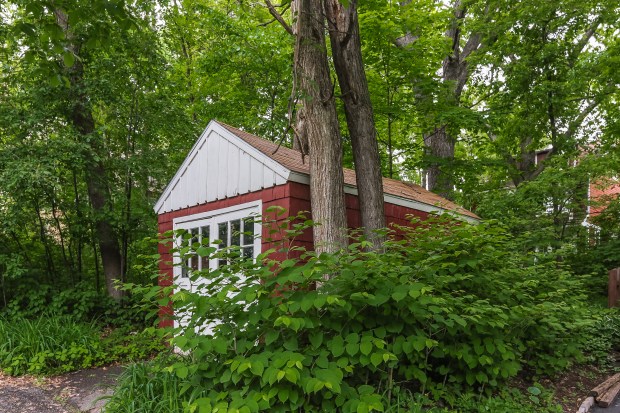
The single-stall garage, covered in wood siding painted red and white to match the house, is accessed via a set of elegant carriage doors. It looks more like an upscale shed or perhaps an artist’s studio — it is only missing the cupola that Lundie originally designed to adorn its roof. For Lundie, this garage was an important form of shelter.

“Some people say his only luxury was his 1958 Ford Thunderbird,” O’Toole says.

It’s unclear how many luxuries Lundie could afford. He was a working architect who coveted the respect of his peers, but he was not a celebrity like Cass Gilbert or Frank Lloyd Wright. His star has been rising posthumously, though, especially after another Minnesota architect — “cabinologist” Dale Mulfinger of SALA Architects —  wrote a book, “The Architecture of Edwin Lundie” (Minnesota Historical Society Press, 1995), that explored and celebrated Lundie’s legacy, something that Lundie never really did for himself.

“He didn’t seem to seek fame,” Mulfinger says.

Instead, Lundie’s world seemed to revolve around work and his family (especially work). The Lundies, who were married in 1917, had one child, Ellen, born in 1920.

When Lundie wasn’t meeting with clients at his house — he had more than 30 commissions in the area for remodels as well as new builds — the family’s home life was full of simple pleasures: a porch, two wood-burning fireplaces, a charming garden, a swim at the lake across the way. When they wanted to get away, the Lundies headed to their cabin on the North Shore of Lake Superior — the only place that Lundie ever designed and built for himself and his own family (and not his Thunderbird).

EDWIN LUNDIE’S LEGACY 

Grace Lundie died in 1968 at the age of 76. After her death, Lundie sold their home and moved back to the city, to the St. Paul Athletic Club. He passed away a few years later, in 1972. He was 85.

The couple who bought the home from Lundie didn’t live there long: Instead, they sold it in 1971 to Fred McDowell, an artist.

“He loved it from the minute he saw it,” Lamese says. “Both of us did; neither of us would have lived anywhere else.”

Lamese, who is also an artist, moved into the home after she and Fred were married in 1977.

Together, the couple spent a lifetime asking themselves: “What would Lundie do?” before embarking on any changes or updates to the house (as well as consulting with the Lundies’ daughter, who passed away in 2000 at 79).

Mulfinger applauds the McDowells.

The fireplace in the master bedroom of architect Ewin Lundie's former home at 1823 Mahtomedi Ave., Mahtomedi, which is for sale. (Courtesy of Keller Williams Realty)The fireplace in the master bedroom of architect Ewin Lundie’s former home at 1823 Mahtomedi Ave., Mahtomedi, which is for sale. (Courtesy of Planomatic)

“Some of the items which Lundie designed — such as the fireplace in the bedroom and some of the trim characteristics — are significant,” he says, “but equally significant is how the McDowells, upon buying the house, have improved or altered it to make it feel more Lundie than when Lundie himself lived there. And I think that’s very significant — it says something about the influence of someone’s work going beyond that person’s own life. And the McDowells are extremely proud of their place — they have treasured it.

“Is it a significant house in his body of work? No, but at times there is a distinction between where someone lived and what someone did.”

Lundie lived simply, Mulfinger points out.

“I think it’s equally significant that it’s a very modest house,” Mulfinger says. “His work spans some beautiful mansions and country houses down to some intimate cabins and very small houses — and even his big houses seem like assemblages of small spaces. I think this house shows where his heart was; this was where his heart was. He was not a man who needed luxury in his life.”

Lundie might have agreed. In his research, O’Toole unearthed this quote:

“I have had a wonderful life,” Lundie said. “I have done just what I wanted to do.”

EDWIN LUNDIE’S STEWARDS 

Lamese McDowell sighs again as she sits in the parlor of the little jewel box of a house on Mahtomedi Avenue.

“If I could move this house to where I want to be, I would,” she says.

McDowell’s husband, Fred, passed away in 2014; just like Lundie, the widow wants to move closer into the city now — closer to her relatives and her church.

The shutters at architect Ewin Lundie's former home, 1823 Mahtomedi Ave., Mahtomedi, contain the finial Lundie designed. The house is for sale. (Courtesy of Keller Williams Realty)The shutters at architect Ewin Lundie’s former home, 1823 Mahtomedi Ave., Mahtomedi, contain the finial Lundie designed. The house is for sale.<br />(Courtesy of Planomatic)

On a tour of the home, she points out its details — the first-floor den with its wall of built-in cabinetry (and its exquisite hinges); the free-standing mirror that Lundie left behind; a custom door. She sounds like a docent at a museum. She kind of is, says her real-estate agent.

“Lamese and Fred have been wonderful stewards of this house — they only brought in the best people to do any type of work, and even some people who worked with Lundie,” Meador says. “What we are looking for is really another steward for this house.”

1823 Mahtomedi Ave., Mahtomedi

This Mahtomedi cottage was the personal residence of Edwin Lundie (1886-1972), a St. Paul architect who got his start as a student draftsman in architect Cass Gilbert’s St. Paul office and whose own notable work includes the main lodge at Lusten, 17 cabins on the North Shore of Lake Superior and many remodels and construction of private residences of the well-to-do, with last names like Dayton, MacMillan, Weyerhaeuser and Griggs. Although Lundie did not design this house, he did work on it through the years — including adding a fireplace in his bedroom and (probably) the exterior shutters and garden gate, as well as building a garage in the back (his blueprints have survived). The home is on a terraced and wooded lot that shares access to White Bear Lake across the street.

  • Price: $399,000
  • Year built: 1910
  • Square feet: 1,392
  • Bedrooms: Two (plus den)
  • Bathrooms: Full (main floor); three-quarters (second floor)
  • Basement: Walkout
  • Heating: Forced air
  • Cooling: Central air
  • Garage: Detached, single stall
  • Lot size: 0.28 acres
  • Waterfront: Property includes access to White Bear Lake.