Showing posts sorted by relevance for query about the author. Sort by date Show all posts

Wednesday, March 14, 2018

New Clarins Treatment Essence - how to use for best effect

Read article : New Clarins Treatment Essence - how to use for best effect

Treatment essences aren’t something new to us, skincare fans, are they? But what if there was a treatment essence that helps your skin, based on age and skin concerns? Now, that might be something worth investigating. And that was what I headed to discover in Paris with skincare brand Clarins, as part of the Malaysia digital influencer team! W00t!

clarins paris headquarters office

Clarins’ office headquarters in Paris!

Paris is a beautiful city, filled with eye-popping monuments, historical artifacts, and stunning architecture that makes you want to look upwards all the time, so you don’t miss anything of the beautiful wrought iron balconies and rooftops. Paris is also home to world famous luxury fashion designer brands and international beauty brands, of which Clarins is one. I’ll take you through some highlights of my PB’s Parisian Adventure with Clarins, tell you a LOT more about these Clarins Anti-Ageing Treatment Essences (and how to score some samples) and how I was taught to use them for best effect. Settle in, it’ll be quite a ride 🙂

Learning about the Clarins Treatment Essence at the Clarins Headquarters

How often do I get the chance to visit a major brand’s headquarters and meet the owners? Never! That’s the answer! LOL! I’m a bit of a geek when it comes to skincare or brands in general, and I love meeting the people behind a brand or product. They are always so passionate about what they do, and that is very, very inspiring!

For this new Clarins Treatment Essence, we were briefed by Caroline Camuzat, Clarins’ International Scientific Manager at Clarins’ new HQ offices in the 17th arrondissement of Paris. The spanking new building is bright and shiny and eco-friendly, with a self-cooling system mimicking a beehive, that is also energy efficient, has an internal cafe and staff canteen, and pleasant gardens through which to walk. Wouldn’t I love to work there! 😀

Being the International Scientific Manager, Caroline took us through the what, how and why of the new Clarins Treatment Essence, and answered a couple of burning questions I had about which to pick, since we have 3 to choose from.

New Clarins Treatment Essence

Some of us are by now, familiar with the skin’s natural barrier that protects us against external aggressions. These Treatment Essences, which are applied immediately after cleansing, as the first step of your post-cleansing skincare routine are designed to “unlock” this skin barrier and boost skin hydration, so other products that go on, absorb more effectively into the skin. Think of it like a pre-serum, or pre-essence – something familiar in most Asian skincare lines.

I must say that when you first prep your skin using the Treatment Essence, you will find that any other products go on and absorb into skin more quickly. The logical summation is that this Treatment Essence will help boost the absorption and efficacy of other products that follow. This has been the premise of treatment essences since they appeared on the skincare scene in recent years.

<a href=clarins treatment essence" width="710" height="1024" />

Cruising down the River Seine with Clarins Treatment Essences 

However, realising that our skin ages differently and is unique, and therefore one treatment essence cannot suit every skin type, Clarins came out with not just 1, but THREE different Anti-Ageing Treatment Essences to suit 3 different age groups.

  • 25+ Multi-Active Treatment Essence Vitality Booster (pink) (RM200) – targeted at younger skin with the first signs of ageing, this essence boosts cell vitality, radiance and slows down cellulcar ageing. The result would be more supple, moisturized and revitalised skin.
  • 35+ Extra-Firming Treatment Essence Bounciness Enhancer (orange) (RM215) – targeted at skin that has noticeable signs of ageing which includes dehydrated skin, this essence helps reinforce the skin structure so skin is more bouncy, smoother and firmer. The result is better hydrated skin, reduction of fine lines and skin that is more plump.
  • 45+ Super Restorative Treatment Essence Smoothness Enhancer (red) (RM285) – targeted at much more matured skin that is dull with reduced cell turnover and lines and wrinkles, this essence helps re-energize the skin to boost skin radiance, and exfoliate the dead skin cells to help product penetrate better into the skin. The result would be softer, more supple and radiant skin.

As maybe expected, the 3 different Treatment Essences have different textures as well, ranging from the very light texture of the Multi-Active Treatment Essence, to the slightly heavier Extra-Firming Treatment Essence and to the almost emulsion feel of the Super Restorative Treatment Essence. I’ll share more about this when I post my review 😉

<a href=clarins treatment essence" width="710" height="525" />

Clarins Herbarium cart at the Jardine Palais Royal 

As Mr. Christian Coutin-Clarins, current Chairman of the Clarins Group told us when he met us, Clarins prides itself on using high quality ingredients, and to take the best from nature to create their products, while protecting bio-diversity and nature. The key ingredients in each of the Treatment Essences are from different plants and sources, to cater to different skin needs:-

How do you pick which Treatment Essence to use?

I asked Caroline how we’d pick which Treatment Essence to use. Was it based on our calendar age? Or was it something a little more technical?

clarins caroline camuzat

Answer:

You pick the Clarins Treatment Essence based on the age of your skin, which may or may not correspond to your calendar age. For those of us who take pains to care for our skin, and use sunscreen daily, you will likely find that your skin’s age is far younger than your calendar age. By way of example, I’m 42 this year and based on my age, would be a prime candidate for the Super Restorative Treatment Essence. However, Caroline assured me that the one I should use would be the Extra-Firming Treatment Essence for a while instead (whew! LOL!) as my skin did not display the concerns to be addressed by the Super Restorative Treatment Essence. By contrast, someone who doesn’t pay a lot of attention to their skin, or who displays the skin concerns that correspond to their age group might then need to pick a Treatment Essence from within their targeted age group or perhaps even the next one up. This is most likely to be true for the 20-somethings who may be living the party and late night lifestyle, and find that the Extra-Firming Treatment Essence does more for them than the Multi-Active Treatment Essence will.

GET YOUR SAMPLE! If you’d like to sample this Treatment Essence (I’m only posting my review in about 2 weeks from now so you can try it and share your experience when I share mine) CLICK HERE to get your sample (Malaysia only)!

How to apply the Clarins Treatment Essence

This is where I thoroughly enjoyed the session with Denise Bathe, Clarins’ Skincare International Training Manager, who is a wealth of information about the pressure technique recommended by Clarins and used at all Clarins Spas worldwide during their facials. She was trained by Clarins’ founder Mr. Jacques Courtin and is so passionate about what she does that I couldn’t help being caught up in the wake of her enthusiasm.

parisb denise

With Denise Bathe at Monseiur Bleu, a restaurant overlooking that iconic Tour Eiffel! She has BEAUTIFUL skin!

I also had the privilege to experience a Clarins facial at the Clarins Spa at the Hotel Molitor where we were put up, and I’m going to tell you right now that it feels EXACTLY like the Clarins facials here in KL! I used to frequent the Clarins Spa at BSC and KLCC and guys, it’s EXACTLY the same! You don’t have to go to Paris to experience it haha! 😀

I’m going to save the pressure technique for another day (or we’ll be here all day!) but what I wanted to share was how to use the Clarins Treatment Essence. Denise tells us there are 3 ways, all of which are effective.

clarins denise bathe

  • Use a cotton pad – Drop some of the treatment essence on a cotton pad to saturate it, and pat it over your skin. This takes the least amount of time and is good for those who are in a hurry.
  • Use your hands – Drop 1-2 drops of the treatment essence in your palm, warm it up between your palms, and pat it on your skin, tapping with your finger tips. This takes a little more time, and is good for your evening routine, or for those who are used to making a little more effort with their skincare routine. I use this method as I abhor wastage 😛
  • Use it as a mask – Get a paper mask capsule (you can easily get these at Daiso – Clarins will have some available, but it isn’t their mainstay right now) soak it with the treatment essence and then lay it on skin for about 10 minutes for an intensive treatment.

My personal preference is to use my hands. I do it with all essences, and I don’t see why I should stop LOL! I dislike the wastage on the cotton pad, and I find that with hands, you actually use a little less product (I usually use 1-2 drop at most) and that means your 200ml bottle can last you quite a while!

Meeting the owners of Clarins!

I don’t meet brand owners every day, and even less so when it’s an international brand of repute. Clarins is one of the few major beauty brands out there who are still owned by family of the founder. It is currently helmed by the 2 sons of founder Jacques Courtin – Dr. Olivier Courtin-Clarins and Mr. Christian Courtin-Clarins, both of whom are incredibly friendly and down-to-earth.

paris b olivier christian courtin clarins

How many Chairmans would allow a bunch of strangers into their office? Not many, I warrant, but Mr. Christian invited us in to show us where he worked, and showed us pictures of his family (all the Courtin-Clarins children are involved in the company in one way or another) without batting an eyelid. It was quite an experience!

Mr. Christian Courtin-Clarins is also very passionate about environment conservation and is personally involved in many Clarins’ CSR projects worldwide. For him, protecting nature is protecting our future for our future generation, and the Clarins group is very active in these endeavours. We are assured that they will keep innovating and developing their products to be better and kinder to the environment, as well as moving towards airless packaging and keeping prices affordable.

Dr. Olivier Courtain-Clarins has recently launched his book “Doctor, I want to be the fairest of them all”, a book containing 60 of the most asked beauty questions he receives, one for each year Clarins has been in existence (It’s in English!) It’s adorably illustrated, and proceeds will go towards arthritis research. I haven’t had any information on whether it’s available in Malaysia, but you can get it on the international Clarins websites.

parisb olivier courtin-clarins

I always end up with weird pictures of me like this all the time haha! Having my book autographed by the author himself, who looks a little perplexed!

It was a humbling experience to meet both these driving forces behind the global success of the Clarins brand, and to realise that they are unpretentious and very personable people who love what they do, who love their work, and who are passionate about their incidental pursuits and the growth of their company.

Grab your sample!

So there you have it. The highlights of the Clarins x MWS adventure with Paris in Paris haha! 😀 I had an amazing time, I learned a lot and I hope I’ve managed to share some of what I’ve learned with you, so you understand a little more about these Clarins Anti-Aging Treatment Essences and what they’re for.

pb paris

Paris dreaming of Paris while cruising down the River Seine – I loved this shot! 😀 We waited so long for the flag to unfurl properly and I swear I was almost sunburnt! 

I will be posting my review in about 2 weeks so I’d suggest you grab your sample now, give it a go and then in 2 weeks, come and share your thoughts with me.

GET YOUR SAMPLE! If you’d like to sample this Treatment Essence (I’m only posting my review in about 2 weeks from now so you can try it and share your experience when I share mine) CLICK HERE to get your sample (Malaysia only)!

Do these new treatment essences intrigue you?

They are available at counters from now, so go and have a play. Because some of you on Instagram asked, I checked with Clarins Paris and was told that the Treatment Essences are available only in Asia for now, because we are more receptive to a more complicated skincare routine. But who knows, they might expand to the rest of the world later, if people are receptive to the product! Now, go, get your sample and let me know if you enjoyed this post enough to try the product 😉

Paris B

Sunday, October 1, 2017

Word Wenches: Keeping it Clean

Read article : Word Wenches: Keeping it Clean


Joanna here, talking about Georgian and Regency bathtubs and the joys of getting clean.  The_bath-stevens C19
 
There is a general view that historical people were rather dirty, there being a dearth of historical folks getting up at six and grabbing a bar of soap and popping in to warble un bel dì vedremo in the shower.  I'm afraid we all feel rather smug about our acres of colored tile with the running hot and cold.

How clean were they?  The townsfolks as they merrily hung aristos from the lamposts, Ninon de l'Enclos, Voltaire, (Did you know Ninon left money in her will for the 9-year-old Voltaire to buy books?) Napoleon, Jane Austen, the kitchenmaid grinding coffee in the morning? How clean were they?

Degas woman washing her left leg 1883 to 6 the met This is a case where the written historical record tends to desert us, somewhat, as folks do not record in their diary, "I got up and Mary-the-perky-maid brought me six liters of water and I washed my face, hands, underarms and, last off, various parts south of the waistband." any more than we text to our BFFs to say we've had a morning shower.

So we end up making some 'best guesses' about this whole business.

You had your everyday getting clean.  You had your gDegas-edgar-the-tub-bathing-woman-1886etting wet for recreational purposes. And you had your washing the body to treat diseases.

This last one gets written about a lot in a 'I went to the baths to see if I could get rid of this nasty skin condition' or 'the physician prescribed a course of cold baths with sulfur powder in them and I feel much better now that I have stopped' sorta way.  Marat, you will recall, was in exactly such a medicinal bath when Charlotte Corday brought it, and him, to an abrupt end with a knife.

Rowlandson comforts of bath the bath Medicinal Baths and Thermal Spas.  The mineral baths at Bath and other spa towns provided an immersion intended to improve the health, not so much wash the body, though it did that too.  Some places there were separate baths for men and women.  Some places, everybody bathed together.
They went into the water dressed. Wearing their periwigs and bonnets.  I should think the fumes did neither periwigs nor bonnets much good, frankly.

Up at four o’clock, being by appointment called up to the Cross Bath . . .  very fine ladies; and the manner pretty enough, only methinks it cannot be clean to go so many bodies together in the same water. Good conversation among them that are acquainted here, and stay together. Strange to see how hot the water is; and in some places, though this is the most temperate bath, the springs so hot as the feet not able to endure. . . . Carried away, wrapped in a sheet, and in a chair, home; and there one after another thus carried, I staying above two hours in the water, home to bed, sweating for an hour.
         Pepys' Diary

Let us leave the whole subject of medicinal baths very quickly, as it is generally unpleasant, even if you're not getting stabbed.

Though I should point out that folks still do this medicinal bath bit, in the way of putting baking soda in a bath for some poor sufferer from poison ivy, and modern herb baths hold anything from lavender to chamomile and thyme.  The 'it's good for you' bath is not going to disappear anytime soon.

Beaumont 3rd quat c19 Out in the Fresh Air.  The opposite of taking a bath because it was good for you was getting wet just for the fun of it.  Any warm day would probably see the local youths sporting in the local river.  There are a good many references to folks doing exactly this -- including a Paris ordinance forbidding nude bathing in the Seine, but only near the bridges -- to avoid the scandalizing the public.


Pepys, in his diary, notes the sad death of a young boy bathing in the Thames.
and at Somerset-stairs do understand that a boy is newly drowned, washing himself there, and they cannot find his body.

Or this Englishman travelling in America.
Early the next morning, my kind, attentive host entered into my bedroom and inquired if I should like to take a bath. I replied in the affirmative, and immediately rising, was conducted to one in an adjoining field which is filled by a small brook and is therefore always fresh.
          A summary view of America, Isaac Candler  1824

Period pictures are not an entirely reliable guide to actual practice.  Showing folks bathing in pools and rivers is a great excuse to paint nekkid people, after all.  But from an extensive personal survey,it looks like bathing -- where folks actually got wet all over as opposed to wading in the water -- tended to be young people and they were segregated into women and men.  


Bathing in the sea, for fun and medical benefit, became fashionable in the Eighteenth Century, with 'bathing machines' on offer from mid century. 

The fourth is its fondness for bathing-machines,
Which it constantly carries about,
And believes that they add to the beauty of scenes-
A sentiment open to doubt.
          Lewis CarrollMermaids at brighton 1825

Bathing machines were high-wheeled wagons, with a canvas or wood structure on top, towed from the shore into the sea. 

Image to yourself a small, snug, wooden chamber, fixed upon a wheel-carriage, having a door at each  end, and on each side a little window above, a bench below – The bather, ascending into this apartment by wooden steps, shuts himself in, and begins to undress, while the attendant yokes a horse to the end next the sea, and draws theBenjamin west last quarter C18 the bathing place at Ramsgatecarriage forwards, till the surface of the water is on a level with the floor of the dressing-room, then he  moves and fixes the horse to the other end – The person within being stripped, opens the door to the sea-ward, where he finds the guide ready, and plunges headlong into the water – After having bathed, he re-ascends into the apartment, by the steps which had been shifted for that purpose, and puts on his clothes at his leisure, while the carriage is drawn back again upon the dry land; so that he has nothing further to do, but to open the door, and come down as he went up.
                                   Tobias Smollett  1771

Men plunged into the waves starkers.  Small children, of course, went into the water naked, as they do in European countries today.  Women wore a long flannel shift, sometimes with lead weights sewn into the hem to keep the skirts from floating up.

In all this bathing, women took to one end of the beach and men the other, so modesty was maintained, in any case.  Hefty and agile attendants supervised so folks didn't drown, a real possibility when wrapped in several yards of soaking flannel, I should imagine.  

But how did people wash? I hear you asking.  How did they keep clean?

Public Baths.  In France, the custom of public bath houses, cheap, respectable and widely available, Le bain economic des incroyables de la rue dela tannerie a quinze centimes never died out.  This was an amazement and joy to travelling Englishmen and women who have left us detailed records of the process since this was something they did not have at home. 

Paris baths had private rooms with hot and cold running water, big tubs, fireplaces, nicely heated robes and towels, waitresses offering coffee and drinks, and a selection of bath oils and bath herbs.  There were also bathin g pools for both men and women and, in one bath on the Seine, swimming lessons for both.
I'm surprised English folks every went home again.

Meanwhile . . . at home. In England, in this period, folks did their actual getting clean by sponging off with a pitcher of water and a little basin on their dresser, or by immersing themselves in a tub not too different from a modern bath tub, or by standing in a smallish tub on the floor and washing with a pitcher of water.

The habit of washing the body and the introduction of wash basins and portable bath tubs began to spread among wealthy households in the late 18th century.
     The Family, Sex & Marriage in England 1500-1800 
Laurence Stone


You had yer bath tubs.

I think and feel that, after a day's bard riding, there is no luxury comparable with a 'warm bath—it is so grateful and refreshing, and disputes the title of "tired nature's sweet restorer" with sleep
The Inspector, literary magazine and review, Volume 2

These were not necessarily in a 'bathroom'. 

The idea of having a room devoted to washing in a tub goes right back to the Seventeenth Century.  Pepys mentions such a bath in a private home.

Thence with Mr. Povy home to dinner; where extraordinary cheer. And after dinner up and down to see his house. . . .  his grotto and vault, with his bottles of wine, and a well therein to keep them cool; his furniture of all sorts; his bath at the top of his house, good pictures, and his manner of eating and drinking; do surpass all that ever I did see of one man in all my life.

But this would have been rare.  Rooms devoted to bathing were for palaces and the grandest mansions.

Jonghe late c19 apres_le_bain Moveable tub baths were more common.
What folks of middling means did when they wanted to take a bath was fire up the hearth in their bedroom, pull a screen round to close off the drafts, and send for a tub. 

And water.  They had 'running water' of a sort.  They sent a footman to run and get it.  It came up in biggish cans, generally one hot and one cold.  A housemaid might linger nearby and keep a kettle on the fire and add more hot water from time to time as the bath cooled.
This process was what you might call, labor intensive.  Water and bath hauling was done by footmen.

Warning:  Author anecdote time.  My father grew up in a house with exactly this kind of 'running water'.  His job was to go to the well and carry in all the water used for cooking, cleaning, bathing and washing for a household of ten people.  It will come as no surprise that he ran away to sea.

How common were these tub baths? Adam 1842 crop

Every house of every nobleman or gentleman, in every nation under the sun, excepting Britain, possesses one of these genial friends to cleanliness and comfort (bath tubs).
           The Mirror of Graces (1811) 

So the British may have been well behind their continental counterparts in the matter of home bath tubs, just as they were in matter of public baths.

And when there was a tub in the house, it's worth noting that its use involved a whole production.  Boiling water, carting it upstairs, and then carting it down again after use.  I wonder how many of the ordinary gentry folk would have seen this as a daily necessity when you could get just as clean with . . .


Basin and Pitcher.  This was the standard wash equipment all through the period.  

Basin and pit 1795 sevres metWashing with a pitcher of water would be part of the morning routine, or undertaken again after a long day of work or play.  This was what you'd expect to find waiting for you in a decent inn.  This was the normal way folks got clean. 

Pitchers held about the largest amount of water one person could easily manage to pour.  Call it one to two gallons.  (Four to eight liters.)  You wet a towel or flannel and washed yourself, using the basin to catch the used water. Or you might pour the water in and splash it on yourself.  Basin stand mid c18 VandA

The towels, by the way, weren't the fluffy terry cloth we think of today when we say towel.  That's mid-nineteenth century fabric.  Our Georgian and Regency folks used woven linen to dry off.  Cassat woman bathing

The soap would most likely have been spherical, about the size to fit in the palm of the hand, because that's how it would have been form -- piece by piece between the palms of the hand.  Your character might have called this a 'wash Silver soap ball attrib British museum ball'.  

It would be kept in a soap ball holder on the washstand. After the 1790's the soap might have been 'Pear's Soap', which was transparent and flower scented. And . . . There might be sponges. 

Your basin and pitcher might sit on a sideboard or Toulouse lautrec 1896 washing a dresser, or you might have a fancy, purpose-built washstand in the corner.  It was typically a maid who brought the pitcher of hot water up to you. The amount of water was limited by the amount you could lift and pour yourself.  That meant a maid could easily carry it. 

How clean did you get, washing this way? 

I don't see any reason to believe you couldn't keep yourself just as clean as bathing in a tub.  Even today, this is 'how it's done' for most of the world's population. 

Whether our Eighteenth and Nineteenth Century folks felt the need to wash as often as we do today or righteously refrained from washing on the grounds that it 'opened the pores' and let sickness in . . . I don't think anybody will really know.

It's not a British reference, but:

Having completed it, [my work]  I went to the stream to wash myself thoroughly, and then to the sailor's chest to change my coat, that I might make a decent appearance at breakfast, and give my sons an example of that cleanliness which their mother was at all times eager to inculcate.
                   Swiss Family Robinson 1812

And Beau Brummel advocated frequent washing. 
On the other hand, he felt he had to advocate frequent washing.

Rub a dub dub.  A couple final questions remain in my mind.


Bad-mit-schokolade c17 Why the devil did women sometimes wear their shifts in the bathtub?  And what is with putting a sheet along the bottom of the tub?

I have cogitated upon this from time to time when I am not concerned with other great issues of the day like, 'Why does the car always break down when I have to be somewhere in twenty minutes?' and 'Why are taxes so complicated?' and 'Why would anyone name his kid Cedric? Isn't it obvious he's going to be a supporting character and come to a sticky end in a graveyard?'

I won't call this the final word on sheets in bathtubs . . . But this is what I think:
There is cloth on the bottom of the tub because these tubs were either (a) wood and full of splinters or (b) metal and cold.

  So why are women wearing a shift in the water?

I think bathing in a tub was seen not so much as washing to get clean, as it was an enjoyable interlude. 

Think of modern habit of spending an hour reading in the bathtub.  If it took a couple man-hours to prepare and clear out that tub, it seems to me you wouldn't put your household to that much trouble and then not take full advantage of it. 

Washing with a basin and pitcher was solitary, but tub bathing, by its Romanet2 1774 le bain nature, was a group effort.  It seems to have been something of a social occasion for some folks.

Marie Antoinette wrote:  I dictate from my bath, into which I have just thrown myself, to support, at least, my physical strength. I can say nothing of the state of my mind;"

If Marat had not been of the opinion that receiving visitors in the bathtub was an unexceptional practice he might have lived a while longer.

So maybe -- a shift was worn for modesty when the bedroom was apt to be crisscrossed by servants running errands and you planned to be in the tub a while? 

washstand from the Victoria and Albert. Ewer and basin, soap ball, and the Degas statue of Woman Washing Her Leg are from the Metropolitan Museum. 

What do you think?  Were they clean and sweet in Regency times, or deplorably . . . uncleanly. 
(Not Mr. Darcy.  Say it ain't so.)

Thursday, October 26, 2017

Pacific Rain Shower Head – The Best Accessory For The Modern Bathroom

Read article : Pacific Rain Shower Head – The Best Accessory For The Modern Bathroom

Free Press Release DB | Press Release Date :Jul 20, 2017  Download


Pacific Rain Shower Head presents an excellent solution for any bathroom, whether it comes to a home or public place.

17 July 2017 – Pacific Rain Shower Head is an innovative accessory for the modern bathroom. This shower head is designed with the idea to make the process of taking shower more pleasant and comfortable, while minimizing all the concerns associated with its installation and cleaning. Pacific Rain Shower Head provides the better experience by taking shower, delivering water under the right pressure, and so, covering the whole body.

There’s no question that every good house owner strives to furnish his home with every little thing, which will make his residence as comfortable as possible. Bathroom is no exception. Despite the fact that we spend not so much time in the bathroom, still, besides getting clean, we want to get relaxed or recreate taking bath or shower. Under this circumstance the construction of shower head plays a crucial part for every shower cabin, since namely shower head distributes water, renders the particular pressure of water, which in its turn renders the massaging effect.

The problem is that far from every head shower, being low flow shower head, can produce the expected massaging effect. In addition, most of shower heads require some skills as well as tools by their installation, and also are quite nondurable. In order to prevent the acquisition of such a low quality item, it’s wise to learn more about Pacific Rain Shower Head, which is the number one choice for all those, who like enjoying taking shower.

People, who are interested in how they can buy this excellent massage shower head can go to Amazon and order it right now. The installation of this amazing accessory for shower cabin will take just few minutes. Furthermore, due to the fact that Pacific Rain Shower Head is made from high quality stainless steel and silicone nozzles, you will be able to enjoy its functioning through the years.

About Pacific Rain Shower Head:

Pacific Rain Shower Head presents an excellent solution for any bathroom, whether it comes to a home or public place. It’s as functional as beautiful. Being made from stainless steel and featuring filter, this perfect shower head is not subjected to rusting and doesn’t require frequent cleaning. Pacific Rain clean shower head is compact and sleek, plus can be easily mounted on the wall or ceiling. Unlike low flow showerhead, Pacific Rain Shower Head offers an exceptional sensation of comfort, providing rejuvenating shower massage, which is so needed after a long day at work.

Contact:

Company Name: Pacific Rain Shower Head

Review URL: https://www.amazon.com/Pacific-Stainless-Pressure-Silicone-Maintain/dp/B06XHXX3LB

Website: https://www.amazon.com/

Contact Person & Company

Name

:

Pacific Rain Shower Head Pacific Rain Shower Head

Company

:

Contact Numbers

Telephone No.

:

Fax No.

:

Handphone No.

:

Website

Address

96555,

Contact The Author


More Press Release From Author


DigiGuard Is Offering the Best CCTV Installation Solutions on the Market

Free Press Release DB :

DigiGuard is a cctv company that is specializing in making sure that your place (commercial or residential) is 100% protected from all odds and that surveillance system will not let you down. --> Free Press Release DB">Read This Press Release !

By : DigiGuard, DigiGuard ( Jul 26, 2017 )
Category : Events News Press Release | Country : United States Press Release


ExtraTorrent.ag – the Right Spot to Download Movies, Music, Games, Software, Books and Apps.

Free Press Release DB :

ExtraTorrent.ag is known as the successor and replacement of the site ExtraTorrent.cc. --> Read This Press Release !

By : ExtraTorrent, ExtraTorrent ( Jul 21, 2017 )
Category : Arts and Entertainment Press Release | Country : Antarctica Press Release


Search for Your Best Destination in Bali on Fabulous Ubud

Free Press Release DB :

Make Your Vacation in Indonesia Full of Memories with Fabulous Ubud --> Free Press Release DB">Read This Press Release !

By : Fabulous Ubud, Fabulous Ubud ( Jul 20, 2017 )
Category : Arts and Entertainment Press Release | Country : Indonesia Press Release

Disclaimer

The author of the press releases are solely responsible for the content of their press releases. Freepressreleasedb.com can't be held liable for the content posted by author. Please check the accuracy of the press release before using the press release. If necessary please contact the author. Thank you.

Friday, May 26, 2017

DIY Oatmeal Bath Bombs - Soap Queen

Read article : DIY Oatmeal Bath Bombs - Soap Queen

Difficulty:Intermediate

Time:30-45 minutes

Yields:About 7 bath bombs

<a href=DIY Oatmeal Bath Bombs" width="700" height="1218" />

Oatmeal baths are well known for their skin-soothing properties. These Oatmeal Bath Bombs are made with oat extract and colloidal oatmeal to create a soothing bath experience. Colloidal oatmeal is micro-fine and fantastic for dry skin.

Oatmeal Milk and Honey Fragrance Oil gives these bath bombs a creamy, comforting scent. Cocoa butter adds structure and a chocolatey scent. A touch of oatmeal on top gives the bath bombs a finishing touch.

<a href=Oatmeal Bath Bombs" width="700" height="467" />

If you’ve never made bath bombs before, we recommend getting a batch under your belt that does not require a two-part mold. It can be a little tricky to get the perfect molding texture that will stick together and not crumble. Great recipe options for beginners include Rose Gold Bath Bombs and the Sand Dollar Bath Bombs. Watch the Surprise Bath Bomb video for tips on using the Stainless Steel Bath Bomb Mold successfully!

<a href=Oatmeal Bath Bombs DIY" width="700" height="992" />

What You’ll Need:
Stainless Steel Bath Bomb Mold
4 cups Baking Soda (Sodium Bicarbonate)
2 cups Citric Acid
1 oz. Colloidal Oatmeal
4 oz. Cocoa Butter
1 oz. Oat Extract
0.7 oz. Oatmeal Milk and Honey Fragrance Oil
0.6 oz. Polysorbate 80
Witch Hazel in a Spray Bottle
Optional: Cyclomethicone


Click here to add everything you need for this project to your Bramble Berry shopping cart!

OPTIONAL MOLD PREP: Cylomethicone helps the bath bomb release more easily. Pour a small amount on a cotton ball and coat both halves of the molds. This step is optional, but if you have never used the Stainless Steel Bath Bomb Mold before, it’s recommended.

OPTIONAL

ONE: In a large bowl, mix together the baking soda, citric acid, and colloidal oatmeal. To get rid of clumps in the mixture, you can push the powders through a sifter or break them up with your fingers. Citric acid has a tendency to take off nail polish, so wear gloves to protect your manicure. Thoroughly stir the ingredients together.

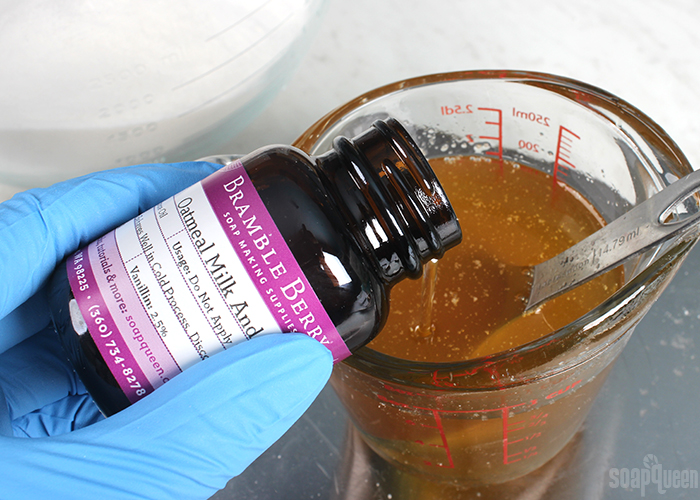
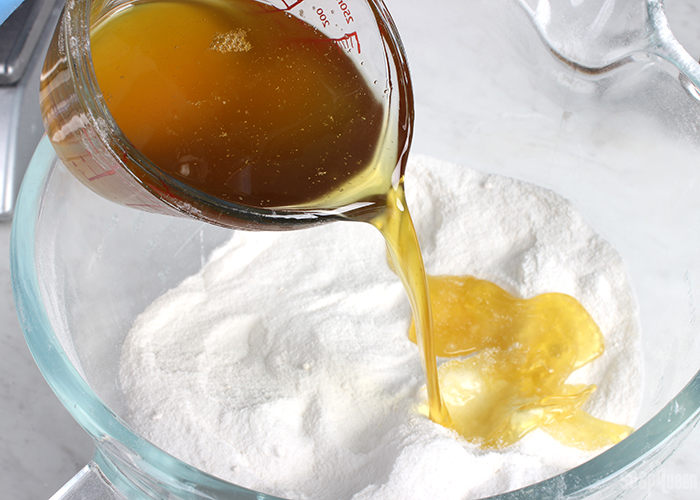
TWO: Add the cocoa butter to a small heat and fragrance-safe container and melt in the microwave using 30-60 second bursts. Be careful when removing from the microwave as the container may be hot. Add 0.7 ounces of Oatmeal Milk and Honey Fragrance Oil, 0.6 ounces of polysorbate 80, and 1 ounce of oat extract to the melted butter. Use a spoon to fully mix the ingredients together.

ONETHREE: Add the oil mixture to the powder mixture. Use your hands to fully mix the ingredients together.
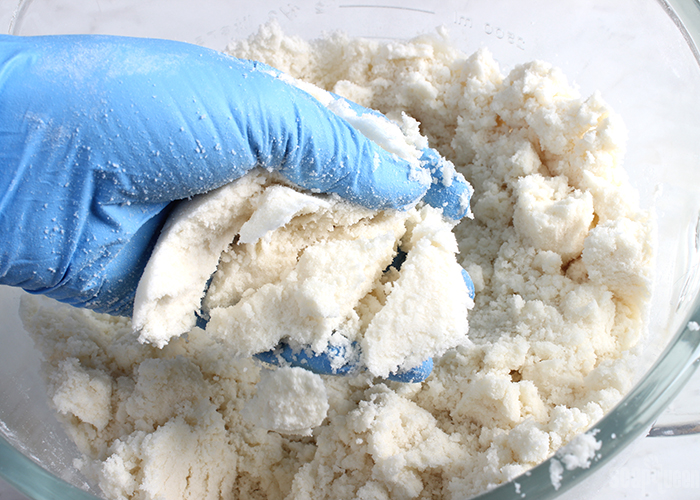
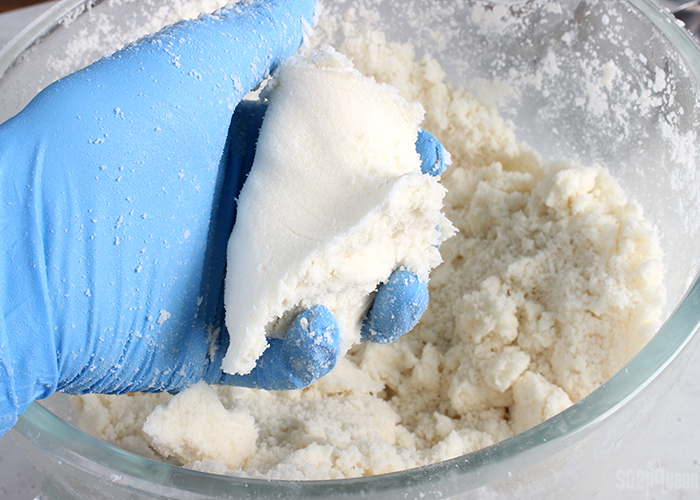
TWOTHREEFOUR: Test the consistency of the bath bomb mixture. The perfect consistency for molding is a texture similar to damp sand that holds its shape when squeezed. If it’s too dry, use one hand to spritz the mixture with witch hazel and one to mix. Continue spritzing until the mixture holds its shape when squeezed. Below, you can see that the mixture forms a ball when squeezed. This means that the mixture will hold its shape in the mold as well.

FOUR
FIVE:
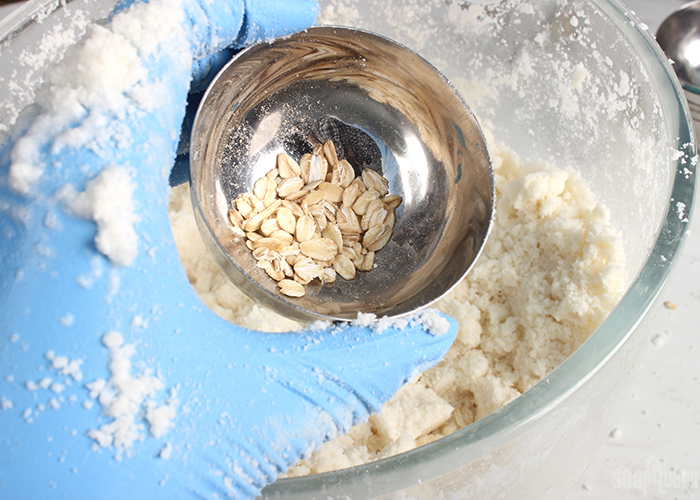
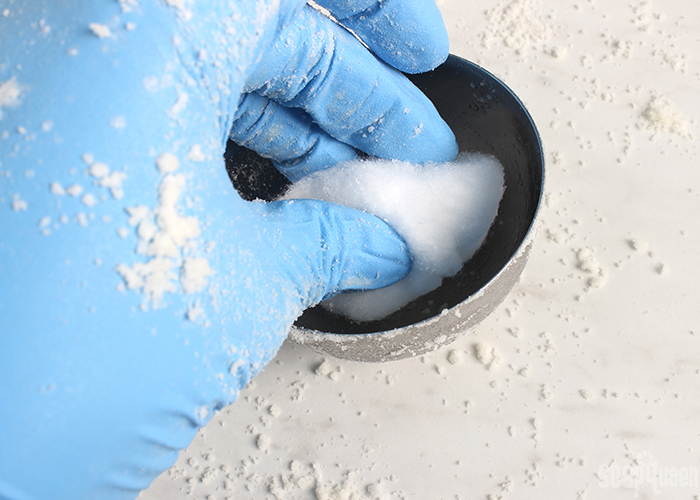
Add a pinch of oatmeal to the bottom of one half of the mold and cover it with bath bomb mixture. Press the mixture lightly into the mold. Fill the other half of the mold and press the mixture in lightly. Then, scoop more of the mixture on top until it’s mounded in the center. Fill up the second half of the bath bomb, mounding the mixture in the center again. Having loose bath bomb mixture on both sides of the mold and a mound in the center acts as the “glue” when they are pressed together.

FIVESIX: Press the two halves of the mold together firmly until they touch. Then, begin to twist and pull the top half off carefully. Once the top half is removed, allow the bath bomb to sit in the bottom half for several hours up to overnight. If they don’t stick together the first time, keep trying. It can be a little tricky to get the bath bombs to stick together, but practice makes perfect! See how to use the stainless steel molds in the How to Make Bath Fizzies video on Soap Queen TV.

SIXSEVEN: Repeat the process with the other bath bombs. When they’re unmolded, allow them to sit for 24 hours before using or wrapping in plastic wrap to protect them from excess moisture. Learn more about packing and storing your bath bombs in the How to Store Handmade Bath Products post.

Oatmeal Bath Bomb Tutorial

4.0 from 1 reviews

Mondo Oatmeal Bath Bomb DIY

image

These Mondo Oatmeal Bath Bombs feel soothing and luxurious in the tub.

Author: Soap Queen

Recipe type: Bath Bombs

Serves: About 7 Bath Bombs

Ingredients

  • Stainless Steel Bath Bomb Mold
  • 4 cups Baking Soda (Sodium Bicarbonate)
  • 2 cups Citric Acid
  • 1 oz. Colloidal Oatmeal
  • 4 oz. Cocoa Butter
  • 1 oz. Oat Extract
  • 0.7 oz. Oatmeal Milk and Honey Fragrance Oil
  • 0.6 oz. Polysorbate 80
  • Witch Hazel in a Spray Bottle
  • Optional: Cyclomethicone

Instructions

OPTIONAL MOLD PREP: Cylomethicone helps the bath bomb release more easily. Pour a small amount on a cotton ball and coat both halves of the mold. This step is optional, but if you have never used the Stainless Steel Bath Bomb Mold before, it’s recommended.

  1. In a large bowl, mix together the baking soda, citric acid, and colloidal oatmeal. To get rid of clumps in the mixture, you can push the powders through a sifter or break them up with your fingers. Citric acid has a tendency to take off nail polish, so wear gloves to protect your manicure. Thoroughly stir the ingredients together.
  2. Add the cocoa butter to a small heat and fragrance-safe container and melt in the microwave using 30-60 second bursts. Be careful when removing from the microwave as the container may be hot. Add 0.7 ounces of Oatmeal Milk and Honey Fragrance Oil, 0.6 ounces of polysorbate 80, and 1 ounce of oat extract to the melted butter. Use a spoon to fully mix the ingredients together.
  3. Add the oil mixture to the powder mixture. Use your hands to fully mix the ingredients together.
  4. Test the consistency of the bath bomb mixture. The perfect consistency for molding is a texture similar to damp sand that holds its shape when squeezed. If it’s too dry, use one hand to spritz the mixture with witch hazel and one to mix. Continue spritzing until the mixture holds its shape when squeezed. Below, you can see that the mixture forms a ball when squeezed. This means that the mixture will hold its shape in the mold as well.
  5. Add a pinch of oatmeal to the bottom of one half of the mold and cover it with bath bomb mixture. Press the mixture lightly into the mold. Fill the other half of the mold and press the mixture in lightly. Then, scoop more of the mixture on top until it’s mounded in the center. Fill up the second half of the bath bomb, mounding the mixture in the center again. Having loose bath bomb mixture on both sides of the mold and a mound in the center acts as the “glue” when they are pressed together.
  6. Press the two halves of the mold together firmly until they touch. Then, begin to twist and pull the top half off carefully. Once the top half is removed, allow the bath bomb to sit in the bottom half for several hours up to overnight. If they don’t stick together the first time, keep trying. It can be a little tricky to get the bath bombs to stick together, but practice makes perfect! See how to use the stainless steel molds in the How to Make Bath Fizzies video on Soap Queen TV.
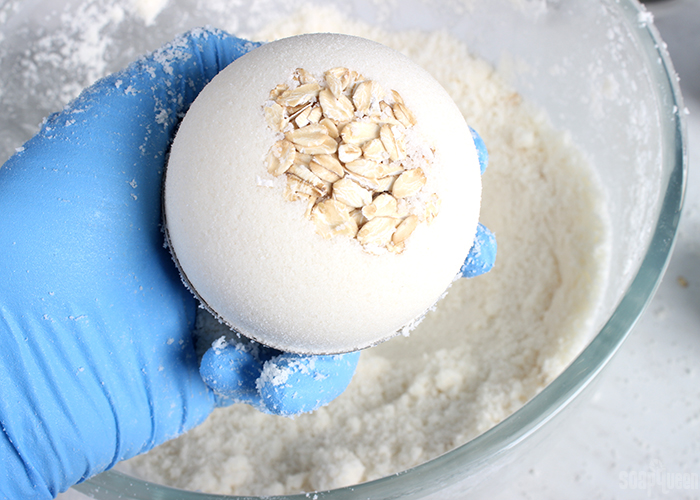
  7. Repeat the process with the other bath bombs. When they’re unmolded, allow them to sit for 24 hours before using or wrapping in plastic wrap to protect them from excess moisture. Learn more about packing and storing your bath bombs in the How to Store Handmade Bath Products post.

3.3.3077

Saturday, May 6, 2017

Copper pipe electrolysis from touching galvanized steel?

Read article : Copper pipe electrolysis from touching galvanized steel?
topic 24664

An ongoing discussion from 2003 through 2016 . . .

(2003)electrolysis in copper pipe

Q.I recently had a 1/2" TYPE L HMP flexible copper pipe that sprung a leak, unfortunately it was inside the wall going up to the second floor. After splicing the pipe where it was leaking another spot started leaking. I noticed inside the pipe a bunch of green "blobs" & the outside of this (HOT) water pipe a lot cleaner than the other pipe (COLD) that would have been put in at the same time, 20-25 years ago I'm guessing. I did notice one spot where the copper pipe was touching an old galvanized pipe seemed to be wet and green. Could there have been some electrolysis going on that caused this pipe to start getting finer than pin hole leaks & how much damage might have been done to the rest of the plumbing if that is the case?

THANK YOU FOR YOUR HELP,

Alex H [last name deleted for privacy by Editor]
do-it-myself-er - Cedar Rapids , Iowa

(2003)

A.Copper pipes can corrode in at least three different ways, but the differences are quite technical. I would suggest that the corrosion could be induced by a galvanic couple caused by contact with the galvanised pipe and this results in an induced local anodic polarisation of the copper pipe. I would normally expect such a failure to occur where the two pipes come into contact, but if this point is dry, no corrosion will occur and the effects of the galvanised pipe will be transmitted onto the copper pipe where it will react in a more favourable wet environment. Your photograph clearly shows the green copper salts on the inside of the failed straight pipe, so it must have been in an area where the copper is oxidised and failed. The propensity for copper pipes to fail is related to how the pipe was made, the local water composition and the environment it is used in. I would suggest there may be other not be other problems with your copper pipes, as there has already been a failure of an induced polarity, but if there are other non-compatible pipes in contact with each other, there could be a repeat of this. It may be wise to ask a plumber to check your system out.

trevor crichton
Trevor Crichton
R&D practical scientist
Chesham, Bucks, UK

(2004)

Q.I was told by a local plumber that electrolysis can occur in copper pipes when the hot water heating system is part of a forced hot water boiler system. The solution is to put nylon fittings between the copper connections and the galvanized boiler system so as to prevent any electrolysis action from taking place in the copper pipes running throughout the building. I would like to get other opinions since this is an expensive fix and it takes a long time to determine whether the fix in fact works.

Dan W [last name deleted for privacy by Editor]
property management - Juneau, Alaska

(2004)

A.It is the right advise, Dan. For galvanic corrosion to occur you need a metallic circuit and an electrolyte circuit. If you break the conductive metal circuit between the copper and galvanized pipe, galvanic corrosion ("electrolysis")" does not occur. This is not to say that no form of corrosion will ever occur though.

Ted Mooney, finishing.com
Teds signature
Ted Mooney, P.E. RET
finishing.com
Pine Beach, New Jersey
(2004)

A.Copper pipe failure began to occur approximately eight years after completion of a new home in Brewster Co. Texas. The leaks were always in the cold line.

A split-core ammeter revealed a slight current flow between the steel gas pipe and the hot side of the copper system. No current could be detected between the cold copper pipe and the hot, or the steel gas line. This led me to conclude that the cold line was acting as a sacrificial anode between the other two while absorbing all voltage drop.

No electrical bonding could be found.

My solution was to isolate the steel line (which included some galvanized parts), from the copper system with a PVC adapter.

Current flow cannot now be detected unless a jumper is placed between the steel and copper.

Is the problem solved? I don't know! What can be said is that there is no further measurable evidence of electrolytic activity in this particular system.

Sam D [last name deleted for privacy by Editor]
- Alpine, Texas
(2004)

A.As others have mentioned, there are three different ways for holes to develop in a copper line, and I have seen all three.

A typical trade mark of electrolysis is pit on the inside of the pipe where the electrical current has actually eaten away at the piping, this doesn't sound like what is going on.

Another way is corrosion from the outside, normally when the piping in in a damp location with high acid soils, or even in an unsealed sleeve (copper run inside another pipe, usually PVC, and normally from the meter to the house). This is evidenced by pitting on the outside of the pipe.

The last one I have come across, and am still researching, is what it sounds like this gentleman has. It typically will have build-up on the inside of the piping and will often times leave large "blobs" of build up. I don't know what this is for sure, but I do know it isn't electrolysis, and it has nothing to do with water that is too clean (mentioned on another website as a possible answer). I think it has to do with the water quality to a certain degree, but I think it may be the molecular structure not the chemicals used. I think the buildup is a protectant for a "micro-atmosphere" high in maybe hydrogen. But I could be wrong, I am still researching this. I will post any further findings.

Jereme Grisenti
plumbing - Blountville, Tennessee

(2005)

Q.If we were to rivet or otherwise attach a copper sleeve to galvanized chimney pipe, would this cause the galvanized pipe to fail? We have fireplace chimneys on the beach. we have several copper clad chimneys that are doing well, but the maker went out of business. Now we have only galvanized pipe to work with and the outside of it corroding causes an eye sore.

Bryan Malt
- San Diego, California
(2006)

Q.This is a piggy back question.

Three 1/2 inch copper pipes running from my basement to the Laundry room one floor above show the same kind of erosion as the picture accompanying the original question. In each case the green copper salts and pin holes developed where the pipes pass through the floor. You can see the leaking water from below but not from the laundry room level.

After one of two plumbers to replace one of the leaky pipes stated that at one point he felt a very mild electrically shock, I had an electrician check the system. The electrician said he could not find a problem. The electrician checked the system before and after the plumber felt the shock. We could not duplicate the shock with the plumber or the electrician.

The plumber reinstalled the three pipes and wrapped the new pipes in electrical tape at the point where the pipes go through the floor.

Since we have not yet found a source of electrical charge would it be prudent to ground the copper line to an unused galvanized pipe so any current would flow to the unused galvanized pipe? Any help would be appreciated.

Greg Butts
- Stafford, Virginia
(2007)

Q.When copper pipes are plastered over into walls do they need to be protected from corrosion either by cement or plaster?

Mrs M Bridger
Homeowner - Steyning, West Sussex, England
(2007)

Q.I have a brick wall in my bathroom and want to cut a groove in the brick run the copper pipe inside and cement it back up. Will this have a long term effect on the pipe
thanks daz

Dario Ruberto
designer - Toronto, Canada
(2007)

Q.I have some questions regarding electrolysis, or galvanic corrosion between the copper and galvanized water pipes in my house. The house in on a municipal system and it is my understanding that acidic or soft water is not a problem in my area.

I have extremely low pressure in the upstairs bathrooms, and moderately low on the main floor kitchen. In my basement I have galvanized pipes coming in from the street, they supply the hot water heater, and they run the hot water for a few feet beyond the tank. At one point they are connected directly to copper pipes which take the hot and cold supply upstairs to the bathrooms.

I intend to replace the galvanized pipe, but I am trying to decide whether or not to replace the copper pipes going upstairs, and as well the hot water heater.

To make this decision I need to understand a little more about what is going on with the electrolysis. Before discussing the ramifications with the hot water heater, I have the following questions:

1. Where the galvanized and copper connect in the basement, does the electrolysis happen only locally? It seems that the electrons would travel only within the magnetic field created by the metals and therefore only affect the pipes within about a foot or so of the connection. Or, since the water exists through all the pipes, does the electrolysis affect the copper all the way to the upstairs bathrooms?
2. Once the galvanized pipe is removed, will the electrolysis cease? (I understand that new copper and old copper will also create electrolysis but I assume this condition is not as severe.)
3. I understand why galvanized pipe corrodes when coupled with copper but I don't understand why it is that the galvanized pipe becomes filled with gunk on the inside and restricts flow, I would think the corroding would make it get slightly wider on the inside, not more narrow.
4. If I remove the galvanized pipe, can I clean out the remaining copper pipe to make sure there is no corrosive material setting in them? How is this performed?

As far as the hot water heater is concerned, galvanized pipe feeds it and takes the water out of it, however, there is copper flexible tubing that actually connects directly to it. I assume this means the heater has corrosive material in it and will likely not last as long. If I leave the existing heater in place and wait for it to fail, will it contaminate any new piping that I put in?

Also, if I run the new copper water service through the front yard within a few feet of the gas line will this cause electrolysis? If yes, will it affect the pipes inside the house or just in the front yard? Which pipe will get holes and which will narrow? Can I insulate the copper to prevent this?

Justin Zavislak
buyer, hobbyist - Seattle, Washington
July 13, 2008

Q.I have type k copper coming from the main to the shutoff in the house. after reporting a leak it was dug up to be repaired and all was found was a pipe with walls that have thinned considerably and covered in grooves resembling termite damage on wood. it was also riddled with pinholes.

the ground for my electrical is connected to this pipe. could that be a possible cause. please help. there other houses in the area that have had there lines replaced twice in the last 20 years.

thanks, cy

cyrus lambert
hobbyist - conne river, Newfoundland, Canada
July 20, 2008

A.Where I work they were having problems with the copper pipes. The anode rods in the water storage tanks had been all wore down. Plumbers found the electrical system grounding rod had been disconnected & everything was grounding through the plumbing, causing the problems. You might want to check but I think it is a code violation now to ground through your plumbing only.

Alex Hatfield
- Cedar Rapids, Iowa

August 30, 2008

Q.I have a problem identical to to the lead in this thread. Green spots on rigid type L 1/2 in copper pipe with water seepage. This 14+ ft run of pipe is leading from my gas fired hot water heater (after a few short copper fittings) across the drywall finished basement ceiling to a T that feeds hot water to most of the house. I noticed a small spot of mold on the ceiling, cut it open and found this pipe with green spots like the picture above and two of the spots (at different ends of this one section of pipe) have water seepage. There are several other copper pipes , cold water and feeds for hot water heating that have no green spots,(only this one length of hot water has the spots) and also a flexible gas line in the same bay. My fix is to replace this entire length. A difficult job for me, tight spaces overhead, and hope there are no other bad pipe in the house. Please confirm the cause of this. Is it likely to be elsewhere or reoccur?

David Goldman
- W Milford, New Jersey
September 3, 2008

A.In response to the gentleman who experienced a leak on a 1/2 copper pipe and then he split it exposing this thick green blob running on the inside for some unknown length. well from dealing with similar repairs and from years of experience in the field this green corrosion that you are talking about stands far from electrolysis. this green gunk/blob is what we use to solder/sweat our copper pipes with better known as FLUX this product is applied to the outside of the copper pipe once it has been cleaned and reamed. putting too much flux on the pipe and fitting will cause the excess to flow into the pipe and will settle on the inside of the pipe until the system gets energized and water flows flushing out the excess flux. if it was not flushed out and was left as is; guess what? call your plumber.....thanks.

Armando Olvera
- Costa Mesa, California

September 14, 2008

Q.Within the last 9 weeks we have called the plumber 3 times regarding a 4 ft. section of hot water copper piping. Each time a pinhole sealing leak about 4-6 feet away from a recently replaced(5 months ago that our plumber installed) electric hot water heater. After replacing 2 inch copper pipe sections at a time we finely asked him to change a length of pipe but, only last night we developed another leak, a foot over from the new pipe, closer to the water heater. Our house is 15 years old and we use city water. The leaky pipe had green discoloration at the leak points. The plumber says this problem could be expected in this area in homes using well water after about 20 years due to the highly acidic soil but we use city water and our pipes are in the sealing. He's suggesting we may need to replace all of our pipes but it seems strange that the leaks are all near the water heater. Could the water heater be faulty or it's installation be the problem?

Chris McQuillen
homeowner - Crescent City, California
September 14, 2008

A.Hi, Chris. I'd be pretty confident that is has to do with something electrical rather than well water. I think I'd call an electrician rather than calling the plumber again.

Regards,

Ted Mooney, finishing.com
Teds signature
Ted Mooney, P.E. RET
finishing.com
Pine Beach, New Jersey

(2005)September 30, 2008

Q.can a copper water line be spliced to an existing galvanized water pipe line?

Keith Medved
- Dyer, Indiana

A.Hi, Keith. When you transition from one kind of metal pipe to another, the correct thing to do is to use dielectric unions =>

These are unions that include a plastic insulator so there is no metal-to-metal contact. I'm not saying that this is always done, but it is the right way to insure that there can be no galvanic corrosion.

Regards,

Ted Mooney, finishing.com
Teds signature
Ted Mooney, P.E. RET
finishing.com
Pine Beach, New Jersey

October 24, 2008

Q.How can one determine the cause of frequent deterioration of a 3/4" copper water supply line? The section going bad is located underground at the block wall of the foundation. The home owner had to replace this line two times within the past year. The deterioration seems to occur on the outside of the pipe. There were no problems prior to the first replacement of this pipe section 9 months ago. The home has city water and uses a sump pump due to a high level of ground water. I don't know the pH level of the water. The basement is dry, but uses on a "floating slab" to channel away the ground water. I conducted load tests of the electric panel to verify the electric wiring. All tests proved satisfactory with only about .2 amps or less flowing to the ground wire. This is when a 35 amp load is applied to each 120 volt leg. This proves that practically all current is flowing back through the neutral conductor. The electric service is lacking the required two, 8 foot ground rods. There is only one ground rod, and it appears to have been installed as a ground for the telephone system. At this point I'm thinking the corrosion and deterioration was not caused by excessive current flowing top ground via this water supply line.

Dave Baylor
- Pittsburgh, Pennsylvania
May 22, 2009

Q.Hi, Our house is 6 years old and from the time we moved in we have had this "green" problem. It has ruined my hair and has left stains in the sinks and toilets. We have had 2 different water softeners and 2 water heaters. We discussed this with the last water softener person and I guess they didn't have a clue about this problem. No one has until I
talked to some nerd at the company that tests the water for the city. He said that it was probably because of the fittings that the water softener company put on the copper pipes and if we didn't rectify the problem, we would eventually have pin size holes in the pipes and leaks! What do we do, who do we call and how do we go about fixing this problem! I want long hair again! Thanks!

Kathy L. Maxwell
- Grover Beach, California
December 8, 2009

A.While replacing the copper piping in a 150 year old home, I was puzzled by the green buildup inside of the pipe. Tracing the pipe I discovered that a ground clamp and wire from the circuit breaker box was connected to the cold water line 15' from the water meter where a jumper wire was also connected to the pipe from the street. In the circuit breaker box the Neutral buss was bonded to the Ground buss. That was okay. I also checked the sub panel to make sure the Ground buss and Neutral buss were not connected.

The wire mains from the electrical meter are aluminum. Current will find the least path of resistance, therefore current leakage to the piping is occurring. The remedy for this is to drive a conductive rod into the ground as deep as local code requires and connect a ground wire. Additionally I moved the ground clamp to the incoming side of the water meter, and removed the grounding jumper. As the water meter has dielectric connections the leakage can not return into the water piping since it is no longer grounded.

Bert Cooper
Equipment Designer - Williamsport, Pennsylvania

June 11, 2010

Q.Type K soft copper pinholes. We are having numerous issues with 3/4" and 1" and even a couple 2" services running from the mainline in the street to the property. 10 years ago or so we started having pinhole leaks appear on the copper always next to a flaired fitting so naturally everyone blamed it on a bad flair, then the specs changed and we were allowed to use compression fittings. This is now happening with the compression fittings as well, now everyone is blaming it on not de-burring the copper properly.

We just had to dig up a leak and found the pinhole leak in the middle of the 1" copper run (no fittings even close) and the copper was in a 4" sleeve under a major street which would eliminate the corrosive soil theory which the supplier will want to use, also the leak was on the top of the copper so a rubbing situation is not the answer. I have a question, is it possible for the copper at the time of production to have impurities introduced causing an electrolysis situation? Do you know of any other town having this problem. The suppliers here have no idea and have never even heard of this problem before which I find hard to believe. Thank you for your time and opinion

Bill Williams
water company - Tucson, Arizona
September 9, 2010

Q.I have recently installed and new water softener with an aerater in my home. My home is 26 years old and several weeks after the installation I noticed a blueish/green tint. I have had the water tested and the copper level is high, can the new system cause this?

Rachele Cancia
home owner -Sunrise, Florida
November 26, 2010

Q.I had an odd situation and was wondering if there is a known reason.
Last evening we noticed water dripping from the ceiling. Upon cutting open the ceiling, I noticed that the 3/4 hot water heating pipe (not sure if supply or return) was pressing firmly against the 1/2 hot water supply pipe, and that a leak had developed in the (smaller) hot water pipe where they touched. Fortunately, the heating pipe was connected to flexible copper to go up through the floor, and I was able to push the pipes apart and repair the supply line easily, but I am concerned what might have caused this leak.

Mike Paulson
former kitchen contractor, retired -falls church, Virginia

December 17, 2010

Below is an excerpt from Wikipedia's "Tap Water" page at en.wikipedia.org/wiki/Tap_water

"Pin-hole leaks can occur anytime copper piping is improperly grounded and/or bonded; nonmetal piping, such as Pex or PVC, does not suffer from this problem. The phenomenon is known technically as stray current corrosion or electrolytic pitting. Pin-holing due to poor grounding or poor bonding occurs typically in homes where the original plumbing has been modified; homeowners may find a new plastic water filtration device or plastic repair union has interrupted the water pipe's electrical continuity to ground when they start seeing pinhole water leaks after a recent install. Damage occurs rapidly, usually being seen about six months after the ground interruption."

Q.So if I understand this correctly, adding a union may cause this problem? How does one connect copper pipe to galvanized steel then, or how to bond from copper pipe (cold water line, for example) to iron pipe (gas line, for example)? What materials is the bond conductor made of?

Andy Roberts
-Maynard, Massachusetts

May 13, 2011

A.I have seen electrolysis occur with galv. steel straps, hangers and supports, with copper. It usually occurs at the point.
Pin Hole leaks are mostly caused by incorrect installation of plumbing pipes.
For example, If a plumber uses a pipe cutter, to cut a pipe, it leaves a ridge on the inside of the pipe. This causes a ripple in the flow of water going through the pipe, and will eventually start eating away at the pipe, from the inside out. This was a common occurrence back when track homes were booming, and the track rats were doing high volume production, and not installing correctly.
You can verify this, by separating the pipes at the soldered joint, and stick you finger in the pipe and feel the edge. If you feel a sharp edge, then the fitter never filed the inside edge to remove this. Which this is why it will happen in multiple places in your home. Also the reason it happens more to cold water lines, is because you use your cold water more that your hot.

Keith Van Aalst

-Anaheim California


February 3, 2012 -- this entry appended to this thread by editor in lieu of spawning a duplicative thread

Q.I need to run natural gas to an outside heater. I have a 3/4" gal water line which is no longer used, am hoping to run type 'L' flex 1/2" copper line thru this line to supply gas to out side heater, is that possible or is there something I could wrap the copper with to make it work?

Bob Hendrickson
-Pontiac, Illinois, USA
February 25, 2012

Q.I have a bunch of copper fittings. 1/2", 3/4" & 1"; I had the fittings for a year or more. Some of the fittings are starting to get corrosion on them, a greenish thick coating. What is causing this and how do I control/stop it. All the fittings are new and never used.

Ken Kramlich
-Sacramento, California, USA
February 27, 2012

A.Hi, Ken.

Copper corrodes, but usually not that quickly. The simplest fix is probably to put them in a plastic bag with desiccant. Sodium benzotriazole is a copper preservative. You can use brass lacquer if you are trying to protect them for artistic rather than functional use. Good luck.

Regards,

Ted Mooney, finishing.com
Teds signature
Ted Mooney, P.E. RET
finishing.com
Pine Beach, New Jersey

December 18, 2012

A. After reading all of the postings about plumbing -
There are a lot of factors to touch on.

Any type of pipe can be connected to a different type of pipe with the right connectors that can be found at big box or good hardware store.

The green spots inside or outside of a copper pipe is cause by Flux.
Flux is an acid that is used by plumbers when the copper piped is fitted together and soldered.
When a plumber puts too much flux on the copper fittings or pipe - It stays inside the pipe and causes the pipe and or fittings to corrode because the water does not get hot enough to melt flux in order to get it flushed out of the pipe or fittings.
Even if you air pressure out the lines, all of the flux will not move out of the copper pipe because flux is a paste, and what little amount of flux that does move will stick to any joining type of Copper or Plastic or PVC or Galvanized pipe or fittings.
Green spots on the outside of a copper pipe or fittings usually means the plumber did not wipe off any left over flux on the out side of the copper pipe or fittings, or the copper pipe has started to corrode from the inside out from using too much flux inside the pipe and the flux has made its way to the outside of the copper pipe or fittings and needs to be replaced.

As far as electric or electric ground going through copper - Electricity will slowly soften up the excess flux that was used on the copper pipe or fittings.
As the flux softens, and because Flux is an acid, it will slowly break down the copper pipe or fittings and needs to be replaced.

NOTE:
Most electric or electric ground going through a copper pipe is not a high enough voltage to melt flux -- it will only soften the flux.

NOTE:
If your phone line is grounded to the copper line then this alone is enough to soften the flux.
If you put some flux on both the neg. and pos. post of a small charged 9 volt battery you will find that the flux will soften.
If you leave the flux on the battery the flux will corrode the battery because flux is an acid.

NOTE:
If your phone or cable is grounded to your copper pipe this is enough electric for a person to get a small shock when touching the copper pipe.
After a person touches the pipe and gets a small shock, it takes quite a while for the electric to build back up because the voltage is quite low.
It is because the voltage is so low that when a person touches a copper pipe and gets a small shock you have depleted the electric in the copper pipe and a shock will not happen again until the electric builds back up in the copper pipe.

NOTE:
Anytime you have to run a copper pipe behind a wall that will be closed in, only use HARD copper pipe (NOT ROLLED TUBING OR SOFT TUBING). Place the copper pipe inside of a piece of PVC pipe and do not have any fittings or couplings that have been soldered inside the PVC pipe.
If you need to soldier on fittings - Solder the fittings on after you have cleared the wall that will be closed in. It will also be helpful to use liquid foam between the copper pipe and the PVC pipe to stop any pipes from clanking when the water is turned on or off. You can pre make up the pipe with the foam in order to let the liquid foam set up.

I hope this information is helpful.

Jim Drake
- Fredericksburg, Virginia, USA

April 20, 2013

A.To those dismissing the "green blobs" as residual flux are not understanding what I think are the inquisitors' issues. We built our home in 2004 and within a couple of years we started experiencing problems in our master shower. Initially, I was able to disassemble the hot water supply in the manifolds and clear out the green "blobbish" crystals. Our master shower is large and has multiple shower heads and two shower manifolds. Since then the problem appear to only exist in the master bath "hot" water lines. I have never had any issue with the cold water lines.

To give a little more detail. The green blobs I am experiencing a hard crystals and not any type of pasty or flux consistency. I have found galvanized steel nipples between the copper supply lines and the brass shower fittings. Two years ago the galvanized nipple on the shower with the most serious blockage, had nearly corroded away completely. Fortunately I had decided inspect the inside of the shower wall after suspecting some sort of "electronic" cause. This morning I found the same union on the second shower head that is now almost completely blocked.

I should have recognized something was wrong in the construction of our plumbing lines during the build simply because of the sloppy solder joints. I have a rudimentary knowledge of plumbing as my father was a plumber. Unfortunately, I was traveling extensively and didn't have time to address the bootleg plumbers my builder contracted.
I guess I was depending on the inspectors to alert us of any issues, but I have learned that lesson.

In summary, I would conclude that the green crystals are formed from kind electric current activity in addition to the hardness of your water. Our municipal water is very hard and my water softener is worthless so we are going to rip out the bathroom walls to see what other surprises we have in store and get a new water softening system.

Vaughn Broadnax
- Carmel, Indiana, USA

copper pipe secured with metal straps
May 21, 2013

Q.During a bathroom remodel, the plumber used some metal strapping (likely galvanized steel)to further secure the copper piping from the shower valve to the shower outlet. (see photo) Days later, my contractor had secured a loose toilet supply valve with a plastic part and explained that a metal material could negatively interact with the copper and eventually cause a leak. (I think he himself had just come upon this info when he went to home depot to pick-up the part.)
I then remembered seeing how the plumber used the metal strapping to basically tie back the copper piping. The wall has since been scratch coated and is about to be floated. I've alerted my contractor about this and am awaiting a reply. I really do not want the float to happen until I know for sure that there is definitely no problem with the set-up, or, until it is corrected. Any input on this would greatly be appreciated.

Jack Goldstein
- Mission Viejo, California, USA

May 22, 2013

A.Hi Jack. You need 3 things for galvanic corrosion:
- dissimilar metals so there is an inherent voltage between them,
- metallic contact path between the two metals so that electrons can flow from one metal to the other,
- a moist and conductive ionic path so that positively charged ions can follow the electrons, transporting atoms of metal from one point to another.

You certainly have the first two, but whether the third condition is met well enough for serious concern is always the question, and sometimes hard to define. When such a condition is sealed behind a wall, it sounds to me like poor practice -- then again, I'm not a plumber. You might see if you can find anything in the plumbing code about it. The problem would have been easy to avoid with any kind of plastic between the pipe and strap; you can hopefully get a scrap of Visqueen in between them without much damage to the wall. Good luck.

Regards,

Ted Mooney, finishing.com
Teds signature
Ted Mooney, P.E. RET
finishing.com
Pine Beach, New Jersey

June 3, 2013

Q.Having pin hole issues on the cold water line repeatedly over approx. 8 years -- same area.
The house used to have copper pipe coming in from the street and we did not have a ground strap on it. I can see how the pin holes would happen then. Then the copper pipe was replaced with PVC out to the street so there seemed to be no need for the ground on the street side of the meter, but I left the ground connected on the house side (still copper here). Was this wrong? Still another pin hole problem this year.
Tired of water leaks, Tom

Tom Canarecci
- Mishawaka, Indiana, USA
July 11, 2013

Q.We have an apartment building that keeps getting leaks in the first apartment. I have read everything and understand the problem, but we don't have money to replace all the pipes, so every few months there is a leak. The last time we had to replace all the carpet because it was leaking over a full weekend.

I have been told by one plumber that he heard of a product that can be put in the pipes that would coat the insides and help prevent the pinholes from developing.
Is there any such product?

Also someone told me of a product that can be painted on the pipes like a silicone or latex component that might be able to help.

If you know of any products like this that I can try, please let me know.

Thank you.

Lisa Keylon
- Fountain Valley, California, USA
February 11, 2016

Q. I just noticed there is corrosion at the elbo 90 connector of hot water copper pipe going out of water heater. Both are copper pipes - so wondering what's causing the corrosion. Otherwise I'm planning to
Simply planning to use fix-it stick/Keeny pipe wrap tape as temporary fix until I get time to call plumber to cut the pipe and rejoin.
Please advise:
1) is it ok to fix temporarily
2) if I need to dig in further to find the cause before I fix it.
3) are there any other things I need to check / replace while I'm fixing it.
Btw- this is house is 10 yrs old.

Venu Reddy
- Waukee, Iowa

April 8, 2016

A. You can also use a brass nipple between copper and galvanize .

Rodolfo ruiz
- Pasadena California usa
April 2016

thumbs up signThanks, Rudolfo. Yes, you can use a brass nipple between them ... but I don't think it will do much towards stopping galvanic corrosion.

Regards,

pic of Ted Mooney
Ted Mooney, P.E. RET
finishing.com
Pine Beach, New Jersey
Striving to live "Aloha"

This public forum has 60,000 threads. If your question seems off topic to this thread, you might prefer to search the site:


Disclaimer: It's not possible to diagnose a finishing problem or the hazards of an operation via these pages. All information presented is for general reference and does not represent a professional opinion nor the policy of an author's employer. The internet is largely anonymous & unvetted; some names may be fictitious and some recommendations may be deliberately harmful.