Showing posts with label clean. Show all posts

Thursday, February 22, 2018

How To Clean An Acrylic Shower or Bathtub

Read article : How To Clean An Acrylic Shower or Bathtub
How to Clean Your Acrylic Delta Shower or Tub

When it comes to cleaning a bathtub or shower made of acrylic material, there is a right way and a wrong way. Using the proper cleaning supplies and non-abrasive cloths will keep your tub or shower looking new for a long time. However, if you use caustic cleaners or scratchy materials, you could do permanent damage. Here is our best advice for keeping your acrylic shower or tub clean and in mint condition.
 

We recommend that you clean your acrylic bathing product made of Delta ProCrylic or Acrylic with Innovex Technology with non-abrasive soaps and cleaners, such as:

    •    Dishwashing detergent
    •    Lysol® Power Bathroom Cleaner
    •    CLR® Bath & Kitchen® Cleaner
    •    Formula 409® All-Purpose Cleaner
    •    Iron Out® Rust Stain Remover

When it’s time to clean, always use a terry cloth towel, soft cloth or sponge to avoid scratching the acrylic surface. Don’t use abrasive scrubbing pads, steel wool or sponges, cause permanent damage to the acrylic material. If you use a drain cleaner or clog remover, be sure to rinse thoroughly with water so no product is left standing near the drain.

Some chemicals and cleaners may deteriorate acrylic surfaces, causing cracks and, potentially, property damage. To avoid this, don’t use cleaning products that state on their label that they are not suitable for use on Acrylic, ABS, Polystyrene or Plastic. Be sure to check the label of any product before you apply it to the surface; it’s easier to avoid damage than to try to remedy it.


Chemicals we do not recommend using to clean acrylic showers/tubs:
    •    Solvents (turpentine, lacquer thinner, mineral spirits, paint thinner, MEK, xylene, acetone, naphtha, etc.)
    •    Simple Green® All-Purpose Cleaner
    •    Pine-Sol® Original
    •    Scrubbing Bubbles® Cleaner
    •    Tilex® Bathroom Cleaner
    •    The Works® Tub & Shower Cleaner
    •    Lysol® with Hydrogen Peroxide Multi-Purpose Cleaner
    •    Windex® Vinegar Multi-Surface Cleaner

Sealant Information  

We don’t recommend that you use silicone and acrylic latex sealant because of potential adhesion and shrinkage, which could lead to leaks. To get the best results, use an advanced kitchen and bath polymer sealant, such as:


    •    DAP® 3.0™ Kitchen, Bath & Plumbing High Performance Sealant
    •    Red Devil® RD3000™ Advanced Kitchen & Bath Sealant
    •    ECO-BOND® Kitchen-Bath-Plumbing Adhesive and Sealant

Sealant Application Tips  

When you’re ready to apply sealant, a little planning goes a long way. Pick up some painter’s tape and use it to mask off the seam to help make cleaning up easier. When you’re applying the bead, use a constant, steady speed to avoid an uneven finish. Use a caulk tool or a plastic spoon to work the sealant into the joint. Wetting the tool with denatured alcohol will help create a smooth finish. Follow the directions on the back of the tube for cure time.
 
Certain chemicals and cleaners may deteriorate acrylic surfaces, causing cracks and, potentially, property damage. After you’re finished applying it, clean up the product surface and remove any excess sealant with denatured alcohol. Don’t use solvents (turpentine, lacquer thinner, mineral spirits, paint thinner, MEK, xylene, acetone, naphtha, etc.) that can wreak havoc on an acrylic surface.
 
With a little care and consideration, you can prevent damage to your acrylic shower or tub. Keep a supply of soft cloths handy and remove any damaging products or abrasive scrubbing items from the bathroom to ensure they aren’t around when it’s time to clean. 


For more answers to frequently asked questions, connect with us online or call the Delta Help Line at 1-800-345-Delta (3358). 
 

Sunday, November 26, 2017

Keeping Kids Bath Time Fun, Clean, and Safe! | Jenns Blah Blah Blog

Read article : Keeping Kids Bath Time Fun, Clean, and Safe! | Jenns Blah Blah Blog

ga('create', 'UA-30285844-1', 'auto'); ga('send', 'pageview');

ga('create', 'UA-30285844-1', 'auto'); ga('send', 'pageview');

ga('create', 'UA-30285844-1', 'auto'); ga('send', 'pageview');

ga('create', 'UA-30285844-1', 'auto'); ga('send', 'pageview');

ga('create', 'UA-30285844-1', 'auto'); ga('send', 'pageview');

ga('create', 'UA-30285844-1', 'auto'); ga('send', 'pageview');

ga('create', 'UA-30285844-1', 'auto'); ga('send', 'pageview');

ga('create', 'UA-30285844-1', 'auto'); ga('send', 'pageview');

ga('create', 'UA-30285844-1', 'auto'); ga('send', 'pageview');

ga('create', 'UA-30285844-1', 'auto'); ga('send', 'pageview');

ga('create', 'UA-30285844-1', 'auto'); ga('send', 'pageview');

ga('create', 'UA-30285844-1', 'auto'); ga('send', 'pageview');

ga('create', 'UA-30285844-1', 'auto'); ga('send', 'pageview');

ga('create', 'UA-30285844-1', 'auto'); ga('send', 'pageview');

ga('create', 'UA-30285844-1', 'auto'); ga('send', 'pageview');

ga('create', 'UA-30285844-1', 'auto'); ga('send', 'pageview');

ga('create', 'UA-30285844-1', 'auto'); ga('send', 'pageview');

ga('create', 'UA-30285844-1', 'auto'); ga('send', 'pageview');

ga('create', 'UA-30285844-1', 'auto'); ga('send', 'pageview');

ga('create', 'UA-30285844-1', 'auto'); ga('send', 'pageview');

ga('create', 'UA-30285844-1', 'auto'); ga('send', 'pageview');

ga('create', 'UA-30285844-1', 'auto'); ga('send', 'pageview');

ga('create', 'UA-30285844-1', 'auto'); ga('send', 'pageview');

ga('create', 'UA-30285844-1', 'auto'); ga('send', 'pageview');

ga('create', 'UA-30285844-1', 'auto'); ga('send', 'pageview');

ga('create', 'UA-30285844-1', 'auto'); ga('send', 'pageview');

ga('create', 'UA-30285844-1', 'auto'); ga('send', 'pageview');

ga('create', 'UA-30285844-1', 'auto'); ga('send', 'pageview');

Monday, October 30, 2017

16 Ways To Deep Clean Your Bathroom - And Keep It Clean

Read article : 16 Ways To Deep Clean Your Bathroom - And Keep It Clean
Deep Clean Your Bathroom - And Keep It Clean!

If there were one room in the house you were to hate cleaning the most, it would be the bathroom. Somehow it just always seems a little dirty, yet it’s the room we clean ourselves up in. All the dirt just somehow manages to find a way to store up in the little nooks and crannies we often forget about, where it gets worse until you eventually do something about it.

With just a few household items and these helpful tips, you’ll be on your way to effectively deep cleaning your bathroom in no time.

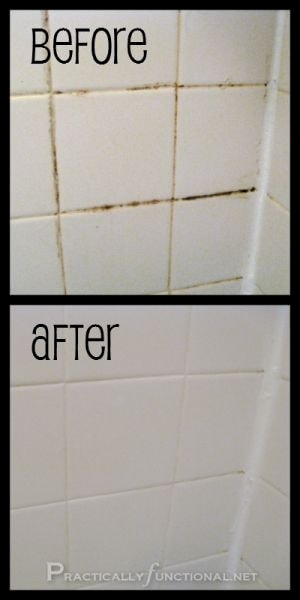
1. Make shower grout sparkle again

With a baking soda and bleach concoction, a toothbrush, and some time to scrub, you’ll have immaculate shower grout in no time.

image

2. Easily get rid of stubborn mold in caulking

By soaking cotton balls in bleach, you can get rid of stubborn mold the easiest way possible. Simply set the cotton balls along the stained or moldy caulking, allow it to sit overnight, and presto!

image

3. Accomplish a clean jetted tub

You don’t need the help of dish detergent or harmful cleaners to clean the small crannies of tub jets. With just the help of a little baking soda, vinegar, and water, you can let it soak and easily scrub it with a toothbrush and towel.


4. Clean out the bath drain

Throwing some Draino in there is an easy, quick fix, but it doesn’t get down to the root of the problem. By cleaning out your drain the old-fashioned way, you can. All you’ll need is a few tools to disassemble the tub stopper, vinegar, and baking soda.


5. Create a spotless plastic shower curtain

Did you know a plastic shower curtain can be cleaned in the washing machine?! Just add one or two cups of white vinegar to the load and a couple of towels to avoid the shower curtain clustering together. Make sure to allow it to air dry as the plastic will melt in the dryer.


6. Say goodbye to deep stains in the sink

This will take a little more time, as it is a three-step process. But you don’t have to worry about scrubbing until your hands burn with the help of a product known as “Bar Keeper’s Friend.”


7. Fix a slow draining bathroom sink

If you have a U-shaped trap, you know just how easily grime, hair, and other crap builds up. To ensure your sink works better for a longer period of time, you can completely clean it out with the help of this tutorial.


8. Remove hard water buildup with ease

Forget about CLR or other cleaners that promise to remove hard water buildup. With a mixture of white vinegar, dish soap, and lemon juice, the grime will be gone in no time.


9. Keep the toilet clean all year without scrubbing

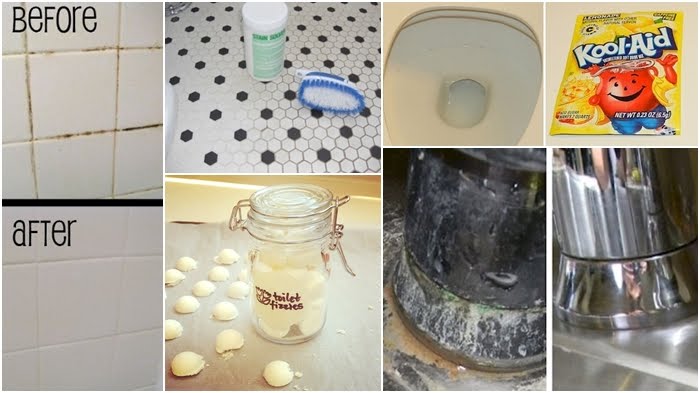
Try making your own DIY tablets to clean the toilet. All you need is citric acid from the canning aisle, hydrogen peroxide, baking soda, vinegar, and any essential oil you prefer. PopSugar

image

10. Abolish hard-to-clean toilet rings

Did you know Kool-Aid actually contains citric acid that can break down grime and even hard water deposits?! Just sprinkle a little Kool-Aid (lemonade flavor only) around a toilet bowl, let it sit for a couple hours, and stubborn toilet rings are gone in no time.


11. Eliminate grout stains in the floor

To make your home look brand new again, a little powdered oxygen bleach and water can go a long way. Scrub the mixture into the floor, and watch it transform.


12. Make your own floor cleaner

Not only do store bought floor cleaners smell like chemicals, they don’t always clean as well as we’d like them to. You can make your own that will leave your floors in squeaky clean condition by mixing equal parts vinegar, water, and rubbing alcohol with a few drops of liquid dish soap. It will cut through grease easily, and you can even personalize it by adding your favorite essential oils to aid in the process and make your house smell wonderful. Tea tree oil, for example, is great for disinfecting.


13. Don’t forget to clean the bathroom exhaust fan

As one of the most neglected things probably in your entire home, it needs a good cleaning from time to time too. Because you’re taking the cover off to clean the entire fan, make sure you turn off the breaker to make sure you don’t accidently shock yourself. You can find a full tutorial here.


14. Rejuvenate your bathroom storage cabinet

Whether you have a cabinet under your sink, or on the other side of the room, go through your bathroom storage area. Consolidate products, get rid of anything you don’t use or need, clean it out, and add a shelf liner. You can make it more productive and organized by adding baskets, hooks, or a lazy susan.

image

15. Disinfect your toilet plunger often

After uses, rinse off the plunger by flushing the toilet a few times. Then, mix dish soap with bleach directly in the toilet, swishing the plunger around in the mixture. Your toilet and plunger can all be cleaned at the same time.


16. Remember to clean the toilet brush too

If you think about it, the toilet brush is probably one of the dirtiest things in your bathroom. Combine hot water with two caps of bleach, let the brush soak for an hour, and then rinse it off with hot water.

 image

Wednesday, October 25, 2017

How Often You Should Clean Your Sheets (and 14 Other Household Items)

Read article : How Often You Should Clean Your Sheets (and 14 Other Household Items)

Whether you’re a neat freak or a bit messier, it’s not uncommon for certain cleaning projects to wind up at the bottom of your chores list. But keeping a clean home is imperative for anyone trying to live a healthy life. Seriously, a dirty home that’s full of dust mites, bacteria, and mold can have some nasty consequences for your health (salmonella poisoning, anyone?). And just because you’re not a complete hoarder, doesn’t mean your home is spotless.

Let’s take a look at what in your home needs some scouring.

Kitchen:

Sponge: Clean every day

sponge It’s no surprise that your sponge is pretty gross. | iStock.com

Kitchen sponges are a breeding ground for bacteria. Just think about everything you use them for: cleaning dishes, wiping up spills — you name it.

")};

As The Huffington Post points out, a sponge with an odor is a sponge with germs — germs that may lead to some serious health issues such as salmonella or pneumonia (yikes!). But don’t worry, there’s a solution. To properly clean your kitchen sponges, soak them in a mixture of one part bleach and nine parts water for about 30 seconds.

Dish towels: Clean once a week

kitchen utensils on vintage planked wood The many uses of your dish towels make them a breeding ground for bacteria. | iStock.com/Cleardesign1

In most homes, dish towels see quite a bit of action. There are usually a handful in rotation, but you might not be changing them as often as you should. Maeve Richmond, founder of a home organizing company, tells Grandparents.com it’s best to toss dish towels in the wash every week. Not only are they used by lots of people, but dish towels often collect food crumbs and are the number one go-to for spill clean-ups.

Refrigerator: Disinfect and wipe out every week

leftovers in the fridge From spills, to leaky containers, your fridge has a lot going on. | iStock.com

Seeing as the fridge is an everyday appliance, upkeep is crucial. The Academy of Nutrition and Dietetics says, “Mold, bacteria, and spills in the refrigerator can put you at risk for food poisoning.” Because of this, you should clean spills immediately, and do a larger cleaning job weekly. But of course, be weary of using your trusty kitchen sponge. A cleaning disinfectant spray and paper towel is the better way to go.

Trash can: Spray it down every two weeks

orange garbage bag Clean your trash can, or you’ll have to buy a new one. | Pixabay

This is one you may easily forget, but it’s important. There’s not really much explaining to do here, as you’re well aware your trash can sees more germs that most other places. And even scented trash bags don’t negate the filth that lies beneath.

Bathroom:

Towels: Wash after three uses

young woman wiping hair with towel If you just showered, you don’t want to dry yourself with a moldy towel. | iStock.com/Central IT Alliance

Bath towels can easily slide under the radar when it comes to keeping them clean. However, it’s important to wash them after just three uses. Kelly A. Reynolds, Ph.D., told BuzzFeed, “Towels used after bathing or showering that are just damp could be hung to dry and used up to three times. Bacteria and mold will begin to accumulate but growth will be slowed as the towel dries.” You know the smell of a moldy towel, so don’t ignore it.

Bras: Wash every two to three wears

colorful Bras on Clothesline You probably don’t wash your bra as often as you should. | iStock.com/Metaphortography

While underwear should quite obviously be washed after each and every use, bras are a bit different. They don’t require a washing every day, but they do need some TLC.

According to Bustle, a dirty bra could result in acne breakouts, rashes or infections, and chafing nipples. For these reasons, Josh Zeichner, M.D., tells Shape you should wash your bras every after every two to three wears — every five is the very max.

Toilet: Give it a scrub every week

baby pulling toilet paper Some nasty things go in and around the toilet, clean it! | iStock.com/markcarper

Now clearly, cleaning your toilet works on an as-needed basis. When you see something, you should probably clean it right then and there. But if you simply never feel like cleaning your toilet, just give this fun little article from HowStuffWorks a read.

A dirty toilet is, no doubt, putting you and your fellow bathroom-goers at risk.

Shower loofah: Clean it once a week

Woman holding shower head over her face Do you even know how much bacteria is on your loofah? | iStock.com

It may sound counter-intuitive that you have to wash something that washes you, but it needs to be done. Similar to the kitchen sponge, your favorite loofah is ground zero for all kinds of bacteria. Yikes! Dermatologist Melissa Piliang, M.D., recommends cleaning it weekly (by soaking it in a diluted bleach solution), and replacing it every three to four weeks. Or, on second thought, just toss it for good and switch to washcloths.

Makeup brushes: Clean them every two weeks

a palette of nude colored eyeshadows and colorful pigments on a wooden background Makeup brushes carry plenty of dirt, oil and bacteria. | iStock.com/Bubbers13

When you think about it, makeup brushes can actually be pretty gross. You use them on a daily basis, and they remain covered in product. Not only are they collecting makeup, but just think about all of the oil that’s already living on your face before you’ve applied anything at all. So, the secret to makeup brush maintenance? Cleaning about every two weeks. And if you’re not sure how, check out Kayleen McAdams’s explanation of the process in Elle.

Toothbrush: Replace every three to four months

toothbrush, toothpaste Are you replacing your toothbrush often enough? | iStock.com

There are all kinds of brushers out there. From those who think it’s no biggie to share theirs with others to the ones who religiously brush their teeth in the shower, toothbrushes are put through the ringer. So, it should come as no surprise they need to be replaced every so often.

Bedroom:

Bed sheets: Wash them once per week

Handsome man Your sheets are likely long overdue for a wash. | iStock.com/rilueda

Now for one you’re likely neglecting: your sheets. While you’re probably well aware of all the germs living in your bed, do you really know how often you should be changing your sheets?

For a trusted opinion on the matter, we turned to the expert — Martha Stewart. Her site recommends you wash bed linens once a week. After all, just think about all the dirt, dust, and sweat you could end up rolling around in on a nightly basis. When you think about it that way, a weekly wash makes a lot of sense.

Duvet cover: Wash it monthly

young man smiles as he lounges on his stomach in bed Just because it’s protecting your comforter doesn’t mean it can bypass a good cleaning. | iStock.com

Nothing’s better than a down comforter, which is why lots of folks choose the down-comforter-and-duvet-cover route. Aside from feeling as though you’re sleeping on a cloud, a good duvet offers your comforter protection from filth. This, once again, is a case for Martha Stewart’s team of experts, who recommend washing comforter covers weekly if you don’t use a top sheet, and monthly if you do.

Mattress: Clean it every season

Bed sheet and pillow on mattress Believe it or not, your mattress does need to be cleaned. | iStock.com

While cleaning your mattress sounds like a pain, it’s easier than you may think. PopSugar recommends using a mixture of baking soda and essential oil. After sprinkling the cleaning solution, rub it into the mattress, spreading evenly. Give it about an hour to work its magic, then vacuum it up. Whatever you do, don’t skimp on mattress spring — or summer, or winter, or fall — cleaning.

Pillows: Wash them every six months

Coral pink triangle pattern pillow setting on bed with foldable reading lamp next to bed Pillows collect plenty of icky stuff and also get flat after a year or so. | Kwanchai_Khammuean/Getty Images

While your pillowcases can be tossed into the sheets category, the actual pillows themselves are a different story. Besides collecting all the grossness that comes along with their cases, pillows eventually lose their fluff factor, and you certainly don’t want to be laying your pretty little head on an unsupportive pillow. If you’re not quite sure how to go about washing your pillows, Good Housekeeping breaks it down based on type.

Carpet: Clean it once a year

carpet being cleaned Everything gets tracked onto the carpet. | iStock.com

Vacuuming is key, but it doesn’t mean you can skimp on deep cleaning your carpet, as well. According to Angie’s List, you should get a carpet cleaning service every 12 to 18 months for high-traffic areas, and every two years for the entire carpet. If you have children or pets, it’s another story: Your carpets may require stain removal more frequently.

'); } /* * Revcontent */ else if(csads.btf_rec_widget_images.widget == 'revcontent') { var rcId = csads.btf_rec_widget_images.rc_id; document.write('

'); (function(publisherCategories, defaultWidgetID) { if(!publisherCategories){ publisherCategories = []; } var totalCategories = publisherCategories.length; var rcWd = csads.btf_rec_widget_images.rc_wd; var rcDefaultWidgetID = defaultWidgetID || rcWd; var rcCatMap = csads.btf_rec_widget_images.rc_cm; var rcContextualCatID = undefined; if(totalCategories > 0){ for(c=0; c

Sunday, October 1, 2017

Word Wenches: Keeping it Clean

Read article : Word Wenches: Keeping it Clean


Joanna here, talking about Georgian and Regency bathtubs and the joys of getting clean.  The_bath-stevens C19
 
There is a general view that historical people were rather dirty, there being a dearth of historical folks getting up at six and grabbing a bar of soap and popping in to warble un bel dì vedremo in the shower.  I'm afraid we all feel rather smug about our acres of colored tile with the running hot and cold.

How clean were they?  The townsfolks as they merrily hung aristos from the lamposts, Ninon de l'Enclos, Voltaire, (Did you know Ninon left money in her will for the 9-year-old Voltaire to buy books?) Napoleon, Jane Austen, the kitchenmaid grinding coffee in the morning? How clean were they?

Degas woman washing her left leg 1883 to 6 the met This is a case where the written historical record tends to desert us, somewhat, as folks do not record in their diary, "I got up and Mary-the-perky-maid brought me six liters of water and I washed my face, hands, underarms and, last off, various parts south of the waistband." any more than we text to our BFFs to say we've had a morning shower.

So we end up making some 'best guesses' about this whole business.

You had your everyday getting clean.  You had your gDegas-edgar-the-tub-bathing-woman-1886etting wet for recreational purposes. And you had your washing the body to treat diseases.

This last one gets written about a lot in a 'I went to the baths to see if I could get rid of this nasty skin condition' or 'the physician prescribed a course of cold baths with sulfur powder in them and I feel much better now that I have stopped' sorta way.  Marat, you will recall, was in exactly such a medicinal bath when Charlotte Corday brought it, and him, to an abrupt end with a knife.

Rowlandson comforts of bath the bath Medicinal Baths and Thermal Spas.  The mineral baths at Bath and other spa towns provided an immersion intended to improve the health, not so much wash the body, though it did that too.  Some places there were separate baths for men and women.  Some places, everybody bathed together.
They went into the water dressed. Wearing their periwigs and bonnets.  I should think the fumes did neither periwigs nor bonnets much good, frankly.

Up at four o’clock, being by appointment called up to the Cross Bath . . .  very fine ladies; and the manner pretty enough, only methinks it cannot be clean to go so many bodies together in the same water. Good conversation among them that are acquainted here, and stay together. Strange to see how hot the water is; and in some places, though this is the most temperate bath, the springs so hot as the feet not able to endure. . . . Carried away, wrapped in a sheet, and in a chair, home; and there one after another thus carried, I staying above two hours in the water, home to bed, sweating for an hour.
         Pepys' Diary

Let us leave the whole subject of medicinal baths very quickly, as it is generally unpleasant, even if you're not getting stabbed.

Though I should point out that folks still do this medicinal bath bit, in the way of putting baking soda in a bath for some poor sufferer from poison ivy, and modern herb baths hold anything from lavender to chamomile and thyme.  The 'it's good for you' bath is not going to disappear anytime soon.

Beaumont 3rd quat c19 Out in the Fresh Air.  The opposite of taking a bath because it was good for you was getting wet just for the fun of it.  Any warm day would probably see the local youths sporting in the local river.  There are a good many references to folks doing exactly this -- including a Paris ordinance forbidding nude bathing in the Seine, but only near the bridges -- to avoid the scandalizing the public.


Pepys, in his diary, notes the sad death of a young boy bathing in the Thames.
and at Somerset-stairs do understand that a boy is newly drowned, washing himself there, and they cannot find his body.

Or this Englishman travelling in America.
Early the next morning, my kind, attentive host entered into my bedroom and inquired if I should like to take a bath. I replied in the affirmative, and immediately rising, was conducted to one in an adjoining field which is filled by a small brook and is therefore always fresh.
          A summary view of America, Isaac Candler  1824

Period pictures are not an entirely reliable guide to actual practice.  Showing folks bathing in pools and rivers is a great excuse to paint nekkid people, after all.  But from an extensive personal survey,it looks like bathing -- where folks actually got wet all over as opposed to wading in the water -- tended to be young people and they were segregated into women and men.  


Bathing in the sea, for fun and medical benefit, became fashionable in the Eighteenth Century, with 'bathing machines' on offer from mid century. 

The fourth is its fondness for bathing-machines,
Which it constantly carries about,
And believes that they add to the beauty of scenes-
A sentiment open to doubt.
          Lewis CarrollMermaids at brighton 1825

Bathing machines were high-wheeled wagons, with a canvas or wood structure on top, towed from the shore into the sea. 

Image to yourself a small, snug, wooden chamber, fixed upon a wheel-carriage, having a door at each  end, and on each side a little window above, a bench below – The bather, ascending into this apartment by wooden steps, shuts himself in, and begins to undress, while the attendant yokes a horse to the end next the sea, and draws theBenjamin west last quarter C18 the bathing place at Ramsgatecarriage forwards, till the surface of the water is on a level with the floor of the dressing-room, then he  moves and fixes the horse to the other end – The person within being stripped, opens the door to the sea-ward, where he finds the guide ready, and plunges headlong into the water – After having bathed, he re-ascends into the apartment, by the steps which had been shifted for that purpose, and puts on his clothes at his leisure, while the carriage is drawn back again upon the dry land; so that he has nothing further to do, but to open the door, and come down as he went up.
                                   Tobias Smollett  1771

Men plunged into the waves starkers.  Small children, of course, went into the water naked, as they do in European countries today.  Women wore a long flannel shift, sometimes with lead weights sewn into the hem to keep the skirts from floating up.

In all this bathing, women took to one end of the beach and men the other, so modesty was maintained, in any case.  Hefty and agile attendants supervised so folks didn't drown, a real possibility when wrapped in several yards of soaking flannel, I should imagine.  

But how did people wash? I hear you asking.  How did they keep clean?

Public Baths.  In France, the custom of public bath houses, cheap, respectable and widely available, Le bain economic des incroyables de la rue dela tannerie a quinze centimes never died out.  This was an amazement and joy to travelling Englishmen and women who have left us detailed records of the process since this was something they did not have at home. 

Paris baths had private rooms with hot and cold running water, big tubs, fireplaces, nicely heated robes and towels, waitresses offering coffee and drinks, and a selection of bath oils and bath herbs.  There were also bathin g pools for both men and women and, in one bath on the Seine, swimming lessons for both.
I'm surprised English folks every went home again.

Meanwhile . . . at home. In England, in this period, folks did their actual getting clean by sponging off with a pitcher of water and a little basin on their dresser, or by immersing themselves in a tub not too different from a modern bath tub, or by standing in a smallish tub on the floor and washing with a pitcher of water.

The habit of washing the body and the introduction of wash basins and portable bath tubs began to spread among wealthy households in the late 18th century.
     The Family, Sex & Marriage in England 1500-1800 
Laurence Stone


You had yer bath tubs.

I think and feel that, after a day's bard riding, there is no luxury comparable with a 'warm bath—it is so grateful and refreshing, and disputes the title of "tired nature's sweet restorer" with sleep
The Inspector, literary magazine and review, Volume 2

These were not necessarily in a 'bathroom'. 

The idea of having a room devoted to washing in a tub goes right back to the Seventeenth Century.  Pepys mentions such a bath in a private home.

Thence with Mr. Povy home to dinner; where extraordinary cheer. And after dinner up and down to see his house. . . .  his grotto and vault, with his bottles of wine, and a well therein to keep them cool; his furniture of all sorts; his bath at the top of his house, good pictures, and his manner of eating and drinking; do surpass all that ever I did see of one man in all my life.

But this would have been rare.  Rooms devoted to bathing were for palaces and the grandest mansions.

Jonghe late c19 apres_le_bain Moveable tub baths were more common.
What folks of middling means did when they wanted to take a bath was fire up the hearth in their bedroom, pull a screen round to close off the drafts, and send for a tub. 

And water.  They had 'running water' of a sort.  They sent a footman to run and get it.  It came up in biggish cans, generally one hot and one cold.  A housemaid might linger nearby and keep a kettle on the fire and add more hot water from time to time as the bath cooled.
This process was what you might call, labor intensive.  Water and bath hauling was done by footmen.

Warning:  Author anecdote time.  My father grew up in a house with exactly this kind of 'running water'.  His job was to go to the well and carry in all the water used for cooking, cleaning, bathing and washing for a household of ten people.  It will come as no surprise that he ran away to sea.

How common were these tub baths? Adam 1842 crop

Every house of every nobleman or gentleman, in every nation under the sun, excepting Britain, possesses one of these genial friends to cleanliness and comfort (bath tubs).
           The Mirror of Graces (1811) 

So the British may have been well behind their continental counterparts in the matter of home bath tubs, just as they were in matter of public baths.

And when there was a tub in the house, it's worth noting that its use involved a whole production.  Boiling water, carting it upstairs, and then carting it down again after use.  I wonder how many of the ordinary gentry folk would have seen this as a daily necessity when you could get just as clean with . . .


Basin and Pitcher.  This was the standard wash equipment all through the period.  

Basin and pit 1795 sevres metWashing with a pitcher of water would be part of the morning routine, or undertaken again after a long day of work or play.  This was what you'd expect to find waiting for you in a decent inn.  This was the normal way folks got clean. 

Pitchers held about the largest amount of water one person could easily manage to pour.  Call it one to two gallons.  (Four to eight liters.)  You wet a towel or flannel and washed yourself, using the basin to catch the used water. Or you might pour the water in and splash it on yourself.  Basin stand mid c18 VandA

The towels, by the way, weren't the fluffy terry cloth we think of today when we say towel.  That's mid-nineteenth century fabric.  Our Georgian and Regency folks used woven linen to dry off.  Cassat woman bathing

The soap would most likely have been spherical, about the size to fit in the palm of the hand, because that's how it would have been form -- piece by piece between the palms of the hand.  Your character might have called this a 'wash Silver soap ball attrib British museum ball'.  

It would be kept in a soap ball holder on the washstand. After the 1790's the soap might have been 'Pear's Soap', which was transparent and flower scented. And . . . There might be sponges. 

Your basin and pitcher might sit on a sideboard or Toulouse lautrec 1896 washing a dresser, or you might have a fancy, purpose-built washstand in the corner.  It was typically a maid who brought the pitcher of hot water up to you. The amount of water was limited by the amount you could lift and pour yourself.  That meant a maid could easily carry it. 

How clean did you get, washing this way? 

I don't see any reason to believe you couldn't keep yourself just as clean as bathing in a tub.  Even today, this is 'how it's done' for most of the world's population. 

Whether our Eighteenth and Nineteenth Century folks felt the need to wash as often as we do today or righteously refrained from washing on the grounds that it 'opened the pores' and let sickness in . . . I don't think anybody will really know.

It's not a British reference, but:

Having completed it, [my work]  I went to the stream to wash myself thoroughly, and then to the sailor's chest to change my coat, that I might make a decent appearance at breakfast, and give my sons an example of that cleanliness which their mother was at all times eager to inculcate.
                   Swiss Family Robinson 1812

And Beau Brummel advocated frequent washing
On the other hand, he felt he had to advocate frequent washing.

Rub a dub dub.  A couple final questions remain in my mind.


Bad-mit-schokolade c17 Why the devil did women sometimes wear their shifts in the bathtub?  And what is with putting a sheet along the bottom of the tub?

I have cogitated upon this from time to time when I am not concerned with other great issues of the day like, 'Why does the car always break down when I have to be somewhere in twenty minutes?' and 'Why are taxes so complicated?' and 'Why would anyone name his kid Cedric? Isn't it obvious he's going to be a supporting character and come to a sticky end in a graveyard?'

I won't call this the final word on sheets in bathtubs . . . But this is what I think:
There is cloth on the bottom of the tub because these tubs were either (a) wood and full of splinters or (b) metal and cold.

  So why are women wearing a shift in the water?

I think bathing in a tub was seen not so much as washing to get clean, as it was an enjoyable interlude. 

Think of modern habit of spending an hour reading in the bathtub.  If it took a couple man-hours to prepare and clear out that tub, it seems to me you wouldn't put your household to that much trouble and then not take full advantage of it. 

Washing with a basin and pitcher was solitary, but tub bathing, by its Romanet2 1774 le bain nature, was a group effort.  It seems to have been something of a social occasion for some folks.

Marie Antoinette wroteI dictate from my bath, into which I have just thrown myself, to support, at least, my physical strength. I can say nothing of the state of my mind;"

If Marat had not been of the opinion that receiving visitors in the bathtub was an unexceptional practice he might have lived a while longer.

So maybe -- a shift was worn for modesty when the bedroom was apt to be crisscrossed by servants running errands and you planned to be in the tub a while? 

washstand from the Victoria and Albert. Ewer and basin, soap ball, and the Degas statue of Woman Washing Her Leg are from the Metropolitan Museum. 

What do you think?  Were they clean and sweet in Regency times, or deplorably . . . uncleanly. 
(Not Mr. Darcy.  Say it ain't so.)

Monday, August 14, 2017

Never take a bath or shower again, Cambridge Company Says Live Bacteria Spray Will Keep You Clean

Read article : Never take a bath or shower again, Cambridge Company Says Live Bacteria Spray Will Keep You Clean
I got back from a what was actually a rather sedate bike ride a bit ago.

Covered is sweat, swear running down into my eyes.

Why do I think this product wouldn't help much?

But a quick shower or dip in the pool works wonders.

If the picture in the article is the guy pushing this product I'm not surprised he thinks no one gets outside or is connected to nature any more, he sure looks like he wouldn't have the slightest idea or what to do out in the wild or in a garden.

EDIT: Actually his claim to not have showered in 12 years pretty much proves he at least does not get active outdoors. Anyone who was would have a hard time going 12 days without some activity that left part of them covered in dirt and mud.

Tuesday, May 2, 2017

40 Bathroom Hacks, Projects and Tips to Make it Clean, Tidy and Stylish - Page 2 of 4

Read article : 40 Bathroom Hacks, Projects and Tips to Make it Clean, Tidy and Stylish - Page 2 of 4

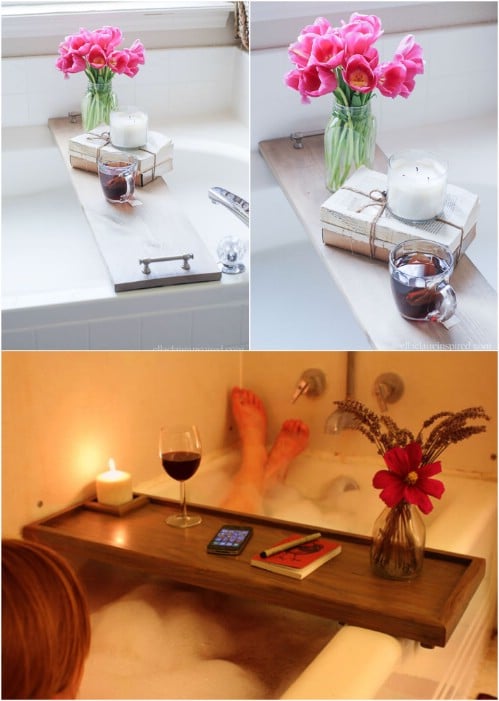
Bathtub Tray

Bathtub Tray

Although I’m more of a shower person myself, I know there are many of you out there who really look forward to soaking in the tub after a long day. A bathtub tray is the perfect little project for you, then, so that you can rest your cup of tea (and by ‘tea’ I mean ‘wine’, of course), set your scented candle, and keep your book dry and safe.

DIY Instructions and Project Credit –  Lil’Luna and Instructables

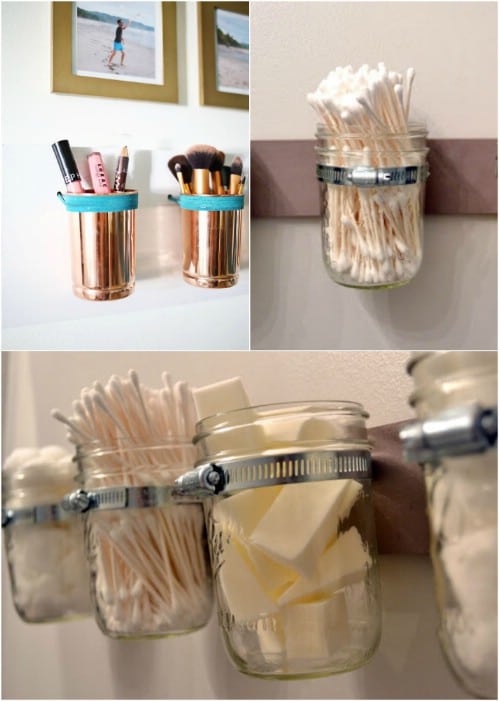
Cup/Jar Organizer

Cup/Jar OrganizerIn need of some more space for your cosmetics or other little bits? This wall-mounted cup or jar organizer is absolutely perfect! Not only does it utilize wasted space, but it looks so neat and clean – almost like a piece of minimalist modern art.
DIY Instructions and Project Credit –  ABeautifulMess and LovelyLittleDetails

Glass Top Vanity

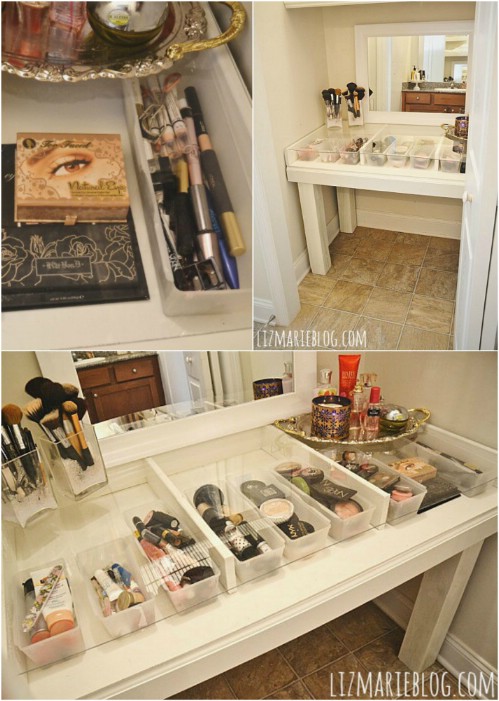
Glass Top VanityI keep my cosmetics in a little chest of drawers in my bathroom, but the real issue is that I can’t always see everything I have, and this becomes a serious problem when I find myself in a mad Monday morning rush. This glass top vanity overcomes this issue wonderfully, and, despite all the visible products and tools, it actually looks neat instead of cluttered.
DIY Instructions and Project Credit –  LizMarieBlog

Hide Linoleum Floors

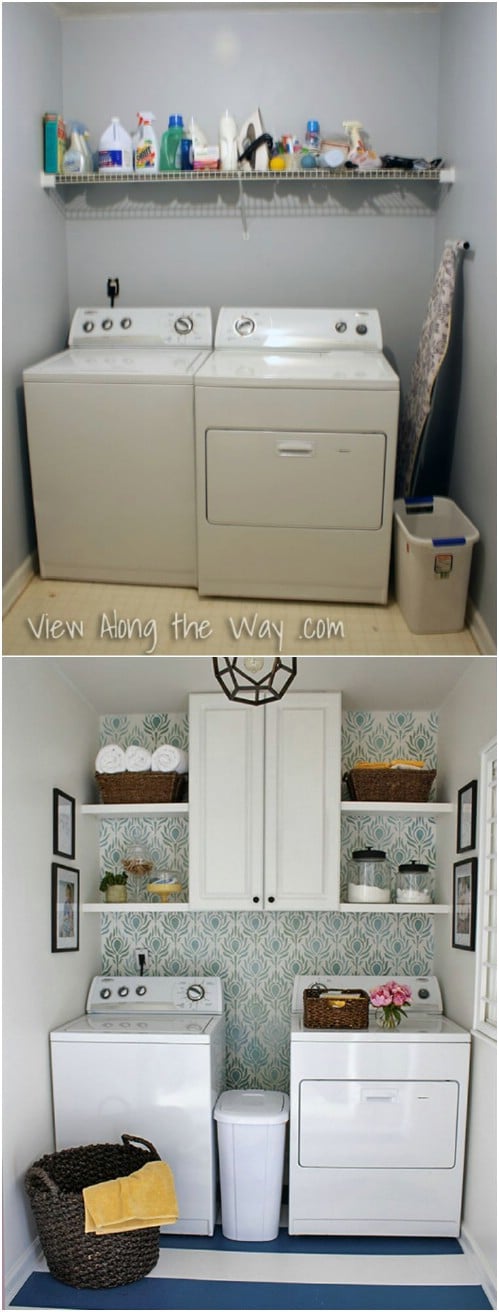
Hide Linoleum FloorsIf you live in an older house you may be cursed with those unsightly vinyl or linoleum bathroom floors; it’s really not the fun kind of retro, unfortunately.  How do you save yourself from the ugliness everyday? Simply paint it! You can go neutral, or turn your bathroom floor into a real statement piece.
DIY Instructions and Project Credit –  ViewAlongTheWay

Coke Toilet Cleaner

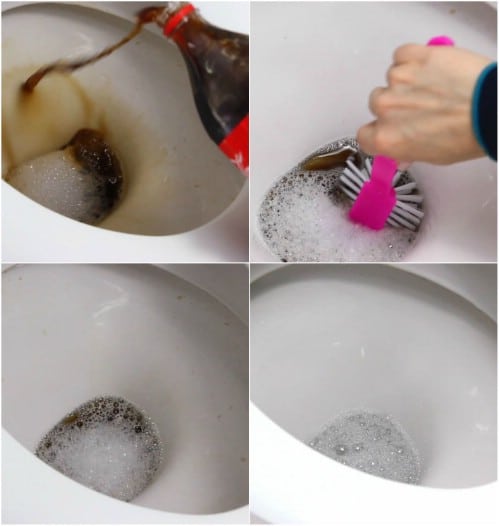
Coke Toilet CleanerHave you ever found yourself in a rather embarrassing bind where you notice that your toilet is looking a little dirty and you have people coming over, but no toilet cleaner around and you don’t have time to go buy some? Surprisingly—or maybe not so surprisingly—, Coca-Cola will come to the rescue!
DIY Instructions and Project Credit –  WikiHow

No More Foggy Mirrors

No More Foggy MirrorsDon’t you just hate how your mirrors fog up after a nice hot and steamy shower or bath? Wiping them just makes it even worse! Well this awesome little trick only requires a bar of soap to ensure that you can stare at your beautiful reflection the second you step out the shower.
DIY Instructions and Project Credit –  TheCreekLineHouse

Unclog Drains

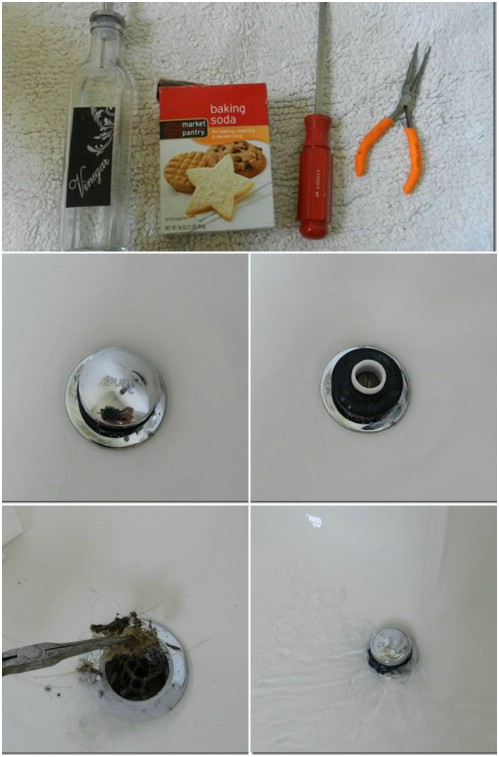
Unclog DrainsWe ladies are all too familiar with hair and products clogging our shower and bath drains; it’s an unfortunate, inescapable fact of life. Instead of dishing out on drain cleaner though, you can simply combine two common household ingredients to get that water flowing in no time.
DIY Instructions and Project Credit –  GiraffeLegs

Clean Your Shower Head

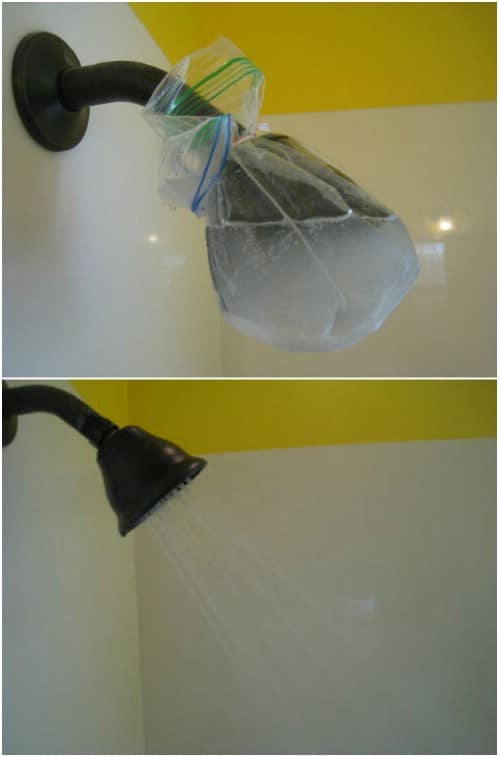
Clean Your Shower HeadI’m not sure when you last inspected your shower head, but I’ll bet that once you do, you’ll feel a little grossed out by all those water deposit marks. Thankfully, this is really easy to clean with everyday household products… and no scrubbing!
DIY Instructions and Project Credit –  FrugallySustainable and TheNYMelroseFamily

Pretty Towel Storage

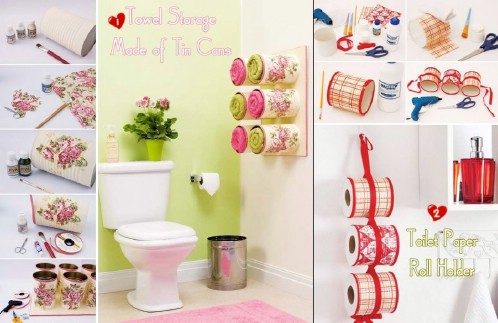
Pretty Towel StorageInstead of simply folding or hanging your towels normally, why not make an interesting and pretty wall holder? This brilliant project uses decorated tin cans to house rolled up towels. And there’s even a bonus little project to hang your toilet rolls, too.
DIY Instructions and Project Credit –  Thewhoot

Mason Jar Soap Pump

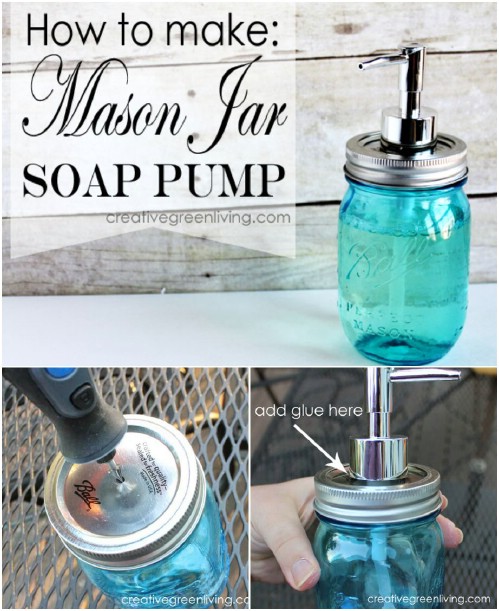
Mason Jar Soap PumpI much prefer liquid soap to a bar of soap sitting by the sink, but if you want to make it look even prettier, ditch the boring plastic bottle and make your own refillable Mason jar soap dispenser. These jars are a DIYers dream, so why not make use of them all over your home?

DIY Instructions and Project Credit –  CreativeGreenLiving