Read article : Hotel Insider: The Balmoral, Edinburgh
The welcome
The hotel’s grand, hulking facade, dating from 1902 and complete with an enormous clock tower, is impressive enough, but there is also a team of kilt-clad doormen, one of whom seems to be at least seven feet tall, who help us in with our bags. The lobby is lofty, though somewhat muted with a striped carpet and neutral wall colourings.
The neighbourhood
The hotel is brilliantly situated at the end of Princes Street, next to and above Waverley train station. Edinburgh Old Town, New Town and the main shopping areas are all very close. Arthur’s Seat is also within walking distance.
The scene
A mix of business and leisure guests; in the mornings, business peoplecan be seen having informal meetings in Palm Court, a gorgeous drawing room behind the lobby; later in the day, it is popular for afternoon tea. Tourists tend to be from elsewhere in the UK, Europe and North America. The recently refurbished Number One restaurant is slick, with red lacquered walls and an exclusive, snug feel to it.
The room
My room,No 420, was a junior suite with a fabulous view of Edinburgh Castle and Princes Street, and it was set back far enoughfrom Princes Street to be quiet. From one of the windows, I could also see Arthur’s Seat. The historic rooms have high ceilings, but the green-and-white-checked curtains and headboard, and brown carpet were strangely ordinary. There was a small three-piece-suite and glass coffee table. The bed and bedding were comfortable and it was nice to be able to open the windows; the marble bathroom was also attractive and had underfloor heating.
An executive room. Courtesy The Balmoral Hotel
The service
Rather complacent. After being asked what newspaper I wanted, this was not delivered; it was also difficult to attract the attention of staff at breakfast. When my room was cleaned, my bikini, which was drying on the towel rail, was swept up with the towels and I had to nag housekeeping to return it. Some train tickets that I had left in an envelope on the table were also discarded by housekeeping. Reception failed to confirm whether or not my airport transfer had been booked, even the night before departure. In contrast and as you would expect, service in the hotel’s signature restaurant, Number One, one of Edinburgh’s four one-Michelin-star restaurants, is faultless.
The food
The breakfast buffet in Hadrian’s brasserie is extensive and of high quality, with a good choice of hot and cold items. The full buffet is£27 (Dh127), or you can order a la carte. In Number One, a three-course menu is good value at£75 (Dh353) per person. Starters include house-smoked salmon theatrically presentedunder a hood of smoke, and juicy, perfectly browned scallops, while mains range from partridge with puy lentils and truffle to wild seabass and lemon sole. The cheese trolley was generously administered at dessert.
indoor swimming pool. Courtesy The Balmoral Hotel" src="https://www.thenational.ae/image/policy:1.622496:1503564089/LF24-AUG-HOTEL.jpg?f=default&q=0.3&w=1024&$p$f$q$w=6bb6911" class="img-responsive full-width" /> The hotel's indoor swimming pool. Courtesy The Balmoral Hotel
Hated
The service issues.
The verdict
A beautiful hotel in a great location, offering true relaxation. Only the staff need to wake up.
The bottom line
Double rooms at The Balmoral Hotel (www.roccofortehotels.com) cost from£175 (Dh823)a night including taxes and excluding breakfast.
___________________
Read more:
Driving through Scotland in an Aston Martin
Executive travel: Etihad business class from Edinburgh to Abu Dhabi
Adding a basement bathroom is a big, complicated project. But that doesn’t mean you can’t do it. Thousands of DIYers successfully tackle the job every year, and so can you.
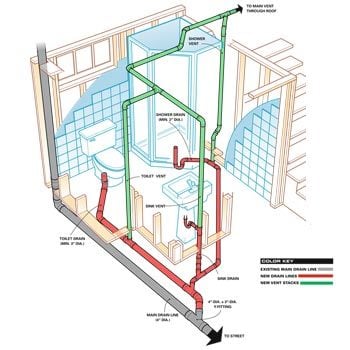
We will focus on installing the “DWV” system (drain, waste and vent), which is the most difficult part of plumbing a basement bathroom. The DWV system requires some hard labor—breaking up concrete—and enough know-how to construct it so waste will be carried away without problems. You supply the labor; this article will supply the know-how.
The materials for the DWV system shown here cost about $250. Plumbers’ labor rates vary a lot by region, but most licensed pros would charge $1,200 to $2,000 for a job similar to the one shown here.
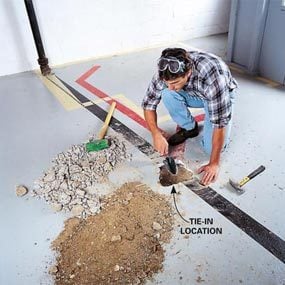
Break through the concrete to verify that the main line is where you think it is and that it’s deep enough to allow adequate downhill slope in the new drain lines.
You’ll have to connect new drain lines to an existing line under the basement. So before you can do any real planning, you have to find that line. First, locate the “main stack,” the large (3 or 4 in. diameter) vertical pipe that runs into the basement floor. From there, the pipe runs under the floor and out to the city sewage system under the street. But it may run at an angle rather than straight out to the street. Look for a cleanout plug along the street-facing wall of the basement. If you find one, that’s most likely the spot where the line exits your home. And usually, the line runs straight from the main stack to the cleanout.
If you have a private septic system, your main line will run toward the location of the drain field. If you’re unsure where the line is, you have a couple of options. You can punch through the floor where you think it is (Photo 1). You might end up enlarging that hole or breaking a second exploratory hole, but that’s not as bad as it sounds; all it will cost you is some wasted time and a couple of extra bags of concrete mix when you patch the floor. Your second option is to get a plumber to help. In most areas, a brief house call will cost you $75 to $150. Some plumbers have access to high-tech equipment that locates lines precisely, but expect to pay $200 for that service.
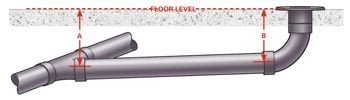
Drain lines require a downhill slope of at least 1/4 in. per linear foot (see note below) so that waste flows smoothly through the pipes. To determine if your plan allows for that, take a few measurements:
A: The depth of the center of the main line (at the tie-in point). B: The future depth of the horizontal pipe beneath the drain.
Now do a little math: (A – B) x 4 = the maximum length (in feet) of the drain line, from the main to the end of the horizontal pipe under the drain. If A is 13 in. and B is 10 in., for example, the maximum length of the drain line is 12 ft. (13 – 10 = 3; 3 x 4 = 12).
Once you’ve located the line, you’ll have to make sure it’s deep enough to allow downward slope in the new drain lines that will run from your future bathroom. Then grab a pencil and mark out the whole bathroom on the basement floor: walls, toilet, sink, shower and finally the drain lines.
Consider it all a preplan at this point. Chances are, you’ll have to make some changes as the plan develops. You may want to mock up sections of the system and lay them out on the basement floor using sections of pipe and an assortment of fittings. When the whole system is planned, mark it out on the floor. For photo clarity, we marked out bold lines on the floor. But simple spray paint is fine for drain lines.
A cast iron pipe snapper works by tightening a cutting chain until the pipe cracks. They’re available at tool rental stores. Old cast iron pipe can crush rather than crack. If that happens, you’ll have to abandon the snapper and cut the slow way: with a reciprocating saw. If you have plastic pipe, cutting into the main is quick and easy with a reciprocating saw.
A plain old sledgehammer will bust up a basement floor. Breaking through at the tie-in point (see Photo 1) may take a few dozen whacks. But once you have a starter hole, the job gets easier because the concrete has space to crack and break off. Within a few minutes, you’ll learn to aim your blows and bust out a neat trench line. Pick out the larger chunks of concrete as you go. Ideally, most of your trench will be just wide enough for your spade. When digging, toss the dirt on a pile separate from the larger chunks of concrete. You don’t want big chunks in the soil you’ll use for backfill later.
After completing the trenches for the new lines, cut into the main line so you can install a Y-fitting. Our tie-in point was near an existing hub, so we cut out the hub. Make sure no one runs water (or flushes!) while the line is open.
Slip rubber couplers onto the main line, insert the Y-fitting, slide the couplers over the joints and tighten the bands. Then plug the inlet and grant your family the freedom to flush again.
The location of the drains and vents is critical—check and double-check your work before you glue joints together. Determine where the exact location of the shower drain will be after the walls are framed. Cap open pipes to keep sewer gas out of your home. Don’t bury the lines until the building inspector has approved your work.
Backfill the trench with soil and screed 3 in. of concrete over it. Pack the soil firmly so it won’t settle later. Smooth the concrete with a steel trowel.
Begin the drain system by cutting into the main line (Photo 2) and splicing in a Y-fitting (Photo 3). We used a no-hub cast iron Y-fitting to tie into our cast iron main. But you can use a plastic Y-fitting instead if you glue short sections of pipe into the Y-fitting to accommodate the rubber couplers. Use that same method to tie into a plastic main.
For your DWV system, you can use ABS plastic (as we did; Photo 4) or PVC. Both are easy to cut and join. The hard part of any underground pipe work is building branches that end up exactly where you want them while maintaining a constant slope of at least 1/4 in. per running foot.
Here are tips to help you get it right:
Buy twice as many fittings as you think you’ll need and a few types that you don’t think you’ll need. Return the leftovers when the job is done.
If you don’t have a torpedo level, buy one (see Photo 7). It’s the handiest tool for checking the slope of pipes.
When a section of pipe is complete, pack dirt under and around it to keep it from shifting as you build other sections.
Know the “rough-in” of your toilet (the distance from the wall to the center of the drain, most likely 12 in.). Don’t forget to account for the thickness of framing and drywall.
Backfill the trenches with care (Photo 5). You want to pack the soil tightly to prevent settling later, but be sure not to move the pipes as you tamp the soil.
After framing the bathroom walls, assemble the vent lines. We ran our vent lines below the floor joists and later framed a lower ceiling to hide the pipes.
Set the shower pan in place and measure from the walls to determine the exact location of the drain. Assemble the drain and trap without glue. Then set the pan in place again to check your work before you finally glue up the fittings.
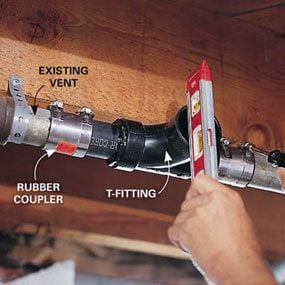
The vent system is a lot simpler than the drain system. We ran vent lines under the floor joists (Photo 6) and framed in a lower ceiling later. If you want to preserve ceiling height by running pipes through the joists, you’ll have to bore some large holes, which can weaken the joists. To avoid that, see “How to drill through floor joists.”
In most basements, you can tie your new vent system into the line that vents the laundry sink. Our plumbing inspector allowed us to connect our new 2-in. vent line to an existing 1-1/2-in. vent. Before cutting a section out of the old steel vent, we installed extra metal strapping to support the pipe during and after cutting.
Note: Plumbing codes vary by locality. The rules we give in this article generally follow the strictest codes. Your local rules may be more lenient about issues like vent sizing, the choice of fittings, etc.
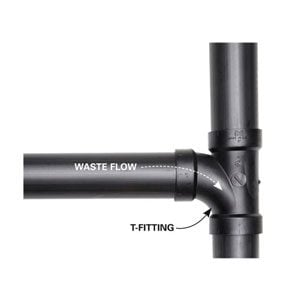
Use a T-fitting in drain lines to connect a horizontal pipe to vertical pipes. It can also be used to tie vent lines into horizontal drains or to join vent lines.
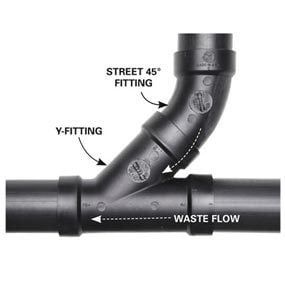
In the drain system, use a Y-fitting to connect horizontal pipes (Photo 3). Along with a 45-degree “street” fitting, you can use a Y-fitting to run vertical drainpipes into horizontal pipes as shown. A Y-fitting can also be used in vent systems.
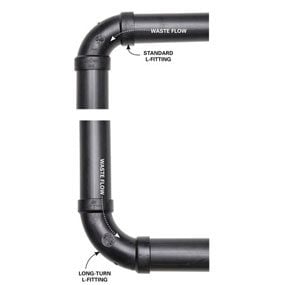
A standard L-fitting is used for horizontal-to- vertical flow in drain systems.
A “sweep” or “long-turn” L-fitting is OK for almost any situation and is required in two situations: horizontal-to-horizontal turns and vertical-to-horizontal turns (as shown). But it can be used in any situation where space allows.
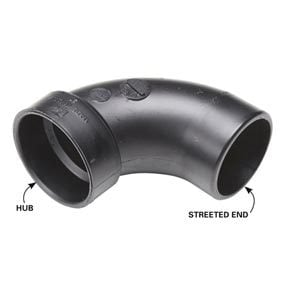
Standard fittings have hubs that fit over pipes. A street fitting has a “streeted” end that fits into a hub, so you can connect it directly to another fitting without using a section of pipe. That saves labor and space.
What size drainpipe should I use? The toilet requires 3-in. or larger. Use 2-in. for the others; pipes smaller than 2 in. aren’t allowed beneath a concrete slab.
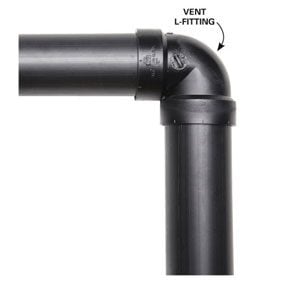
A vent L-fitting can be used anywhere in the vent system, but only in the vent system—never where waste flows. The other two types of L-fittings are OK for venting, too.
What’s the vent for? A plumbing vent is kind of like the air intake on a gas can; it lets in air. Without venting, a slug of sewage racing through a waste line creates air pressure and vacuum in the pipe. That means noisy, gurgling drains. Even worse, vacuum can suck all the water out of traps, allowing sewer gas to flow freely into your home. Yuck.
Vent-to-trap distance—there’s a limit Every drain needs a trap, and every trap needs a vent. The maximum distance between the trap and vent depends on the diameter of the pipe.
Memorize these distances for midterm exams:
For 1-1/4″ pipe, the max. horizontal distance to vent is 30″ For 1-1/2″ pipe, the max. horizontal distance to vent is 42” For 2″ pipe, the max. horizontal distance to vent is 5′ For 3″ pipe, the max. horizontal distance to vent is 6′ For 4″ pipe, the max. horizontal distance to vent is 10′
Note: A toilet has a built-in trap, so it doesn’t need one in the drain line. It still needs a vent, though.
Can vents run horizontally? Yes, but horizontal vent lines must be at least 6 in. above the “spill line,” which is the level where water would overflow the rim of a sink, tub or toilet.
What size vent pipes do I need? A typical bathroom like the one we show (sink, toilet, shower or tub) requires a 2-in. vent. You could run smaller pipes to the sink or shower, but it’s usually easier to use one size for the whole system.
Read article : What You Need To Know When Designing Your Bathroom (2)
December 7, 2016
BOOKMARK THIS STORY
Our blogposts on bathroom designs (see 10 Dreamy Bathroom Designs to Fantasise About and 9 HDB Bathroom Makeovers For Every Budget) may have gotten you excited at the beautiful bathroom designs in Singapore.
But before you start shopping around for your sanitary items, here's a quick guide on the factors you should take into consideration, so that you will not end up with an incompatible item for your bathroom.
There are a few types of basins in general (see image below). Homeowners today prefer the countertop as they fit in with the modern décor. Due to space constraints however, many opted for wall mounted ones instead.
The choice is pretty much a personal decision and preference for the general design and outlook and well, budget. Some things to take note of are:
The available space
The profile of your bathroom users
Where your basin connections are:
Water supply pipe locations
Water discharge to main sewage location – if they are on the wall, you will have to skip some freestanding basins. Take note of the measurements before shopping for the basin.
If you have young kids or living with elderly parents, always go for function and safety first. In such cases, the wall mounted and semi-recessed basins are much more practical as it puts the useable bowl area closer to the user. If they have to sit or stand on a stool to use the bowl, they don’t have to stretch too far.
Also, consider installing sturdy grab bars on the areas around the basin for surer support. Select bars that can double up as towel bars too.
Homeowners should select the basins first before buying the basin taps. The design of both the basin and the tap have to go well together. Basins typically pose more restrictions due to the size. The specific characteristic of the basin may also pose requirements for the tap. For example, if a countertop basin is selected, then the basin tap will need to be a taller one.
Exposed shower mixer - where you can still see the valves amd sometimes, the pipes.
Concealed shower mixer - except for the handle and control plate, everything else is concealed behind the tiles.
Before deciding on the type of shower mixer system, first bear in mind the building regulations, as some of the older buildings do not allow water supply piping to be concealed. As such, you can only go with the exposed shower mixers. Newer BTOs all come with concealed pipings within the wall, but homeowners need to check if they can install concealed shower mixers due to certain waterproofing issues. When in doubt, check with your interior designer/contractor.
There is a common misconception that all toilet bowls are the same and we just need to select a design we like. Here are some factors you should pay attention to:
Ceramic bodies should not sit on the hole or block the pipe connection to the hole. It's also important to know the difference between “S” trap water closets and “P” trap water closets. The former is suitable for sewage outlet on the floor only, while the latter can be for the floor or the wall, depending on the connection pipes.
Some newer designs of toilets feature what we call a back-to-wall design. In these sorts of designs, the water supply point will have to be located within the water closet’s ceramic body.
If you are collecting your keys soon, drop us a complimentary quote request and we’ll recommend you five interior firms that suit your style preferences and budget needs, for free! Homeowners who engage an interior designer, following a request for quote, are covered under the Qanvast Guarantee.
For more great local interior ideas and tips, download our app on the App Store and Google Play to discover thousands of interior design ideas!
Read article : When we were there for the wedding, as many... - Review of Ayres Hotel Seal Beach
The Ayres Seal Beach is an elegant hotel at a family price. An internet discount made my cost far less than any other comparable, surrounding area hotels that still didn't live up to the quality of Ayres Seal Beach. I have very high standards for customer service and cleanliness. The Ayres exceeded those standards. I appreciated no charge for using the parking lot that so many other like-hotels charge. The lobby is beautiful and comfortable. Check-in and check-out are very quickly handled by the friendly and helpful staff.
The location is smack in the center of 3 freeways that will connect you to many popular areas of So Cal. Having a full breakfast included in the price can save a family money. The only thing I would suggest is for the chef to alternate each day the bacon and sausage rather than offering the same meat for a whole week. I only had time once to enjoy the evening snacks. Bottled water should be added in with the other drinks as well.
Being there for 10 days/9 nights was like a home away from home. I appreciated the laundry room down the hall from my room since I had many clothes to wash. This immaculate room also includes the ice and soda machine. Housekeeping does an excellent job keeping the entire hotel clean, sanitary, and looking brand new. I think they even change out the comfy quilt before new customers check in. It appalls me how many hotels avoid cleaning blankets, quilts, bed coverings until they are really disgusting. I won't go into that....
I was working 2 different laptops at the comfortable desk in my room and did not have a problem with Ethernet or Wi-Fi. It was nice to have a good size refrigerator, microwave, and coffee maker.
The marble & tile bathroom is huge. It privately separates the shower/tub and toilet from the sink area. Again, it's all very clean with lots of fluffy towels changed daily if you so prefer. The sitting area includes a sofa, coffee table, and small marble-top table with two chairs where you can eat or even do more business tasks. The flat screen TV is nice and located inside a huge Armoire that contains plenty of drawers for all your clothing. The mirrored closet is also roomy with lots of hangers and iron/board.
I didn't have a chance to use the outdoor pool and spa but they looked refreshing. The covered, outdoor courtyard is very pleasant with lots of sturdy tables and chairs. Many chose to eat their breakfast here rather than inside. There's even a working outdoor fireplace to add to the ambiance.
There are plenty of banks/ATMs, shopping centers, gas stations, churches, restaurants, and fast food places, some located within walking distance and the rest all along both sides of Seal Beach Blvd./Los Alamitos Blvd. Unlike many other 3-story hotels, this one has two elevators. Yes, I feel spoiled from my stay and miss the housekeeping now that I'm back home. :-)
If I could suggest just one main thing in the future, it would be for the Ayres Seal Beach to offer Concierge service. I had lots of luggage for my long stay and it was not easy putting it all onto the cart and then trying to push it back inside to fit into the elevator and down to my room. I also had a good distance to take the cart outside as there is not a designated zone for loading and unloading and I certainly wasn't going to park in one of the nearby handicap spaces.
As much as I also enjoy the DoubleTree Hotel Spectrum in Irvine, Ca., the Ayres Seal Beach far surpasses the good things they also have to offer (except for the cookie!!).
Without hesitation, I highly recommend the Ayres Hotel Seal Beach and look forward to one day cashing in my Stash Points (once they build up) for a "free" room. Thank you, Ayres Hotel Seal Beach for having a large, bedroom window that fully opens for that fresh, cool, beach air! It kept me from using the wall A/C most of the time.
Read article : The World's Most Beautiful Voyage - Hurtigruten Review
The world's most beautiful voyage is how the Hurtigruten cruise line bills the coastal voyage from Bergen to Kirkenes. They are so right! We were on the Midnatsol the same time as karoggra who posted a review titled, Best scenic cruise in the world. The voyage is rarely on open sea so you have scenery on both sides of the ship most of the trip.
My husband and I were traveling on a tour arranged by travel agency so we had a pickup from our hotel to the dock. We arrived about 6 p.m. after an all day Norway in a Nutshell® tour. Check-in took seconds and we boarded with our carry-on bags. The cabin cards were handed to us as we entered the covered walkway to deck 6. The deck 6 entrance is only used at Bergen. Our bags were waiting at the entrance to our cabin. Since we were doing a round-trip and started at the home port, baggage handling was done by the ship crew.
Ship: We had an starboard outside cabin on deck 4. It was 2 cabins away from the atrium where the More elevators are located. All the traffic on and off the ship on the voyage takes place on deck 4 by the elevators so it was very handy. The ship has its own gangway which opens up on the side of the side. Stand on deck 5 and watch the gangway open sometime. It is very interesting.
There are two other openings in the side of the ship further down for cargo and cars. The ship doesn't have to rely on port gangways which take time. The ship is very efficient getting in and out of ports. Some stops were for only 15 minutes. I learned how they did that visiting the bridge.
The cargo hold is designed for pallets so the forklift trucks would be whipping around on the dock unloading or loading. At Stamsund, we had over an hour stay so while we were out walking around the village, the forklift operators were unloading mattresses and building supplies.
There is another elevator near the back of the ship serving decks 4 - 8. It is handy for those in the stern of the ship. Public restrooms are available near the dining room on deck 5 and near the main elevators on deck 5 and 8. There is a conference area on deck 5 which is used for presentations or conferences. It is not an entertainment venue. We did have three slide presentations on the ship: The Royal Family, National Day and National Costumes. We are onboard for National Day, May 17. There was a parade around deck 9 with flags, banners, and national costumes.
Cabin: Our cabin was very functional. We had a cabin with one twin bed under the window and one perpendicular to it. The bed under the window made into a sofa during the day. The beds are hard but still comfortable. The covers are duvets with a quilted liner. It was too hot for me so I just used the sheet. There was one extra pillow in the room and we asked for another. There are two wool blankets to use on the outside decks. Yes, we needed the blanket when lounging topside some days.
You receive one bath towel and one hand towel to start. If you want a clean towel, leave it on the floor. There are no washcloths. I bought a few with me. There is a mounted container of hand soap/shampoo by the sink and in the shower area. To save room packing, I used Twitter @HurtigrutenASA to find out that there was a dryer in the bathroom. There is.
The cabin has desk area with small mirrored cubbies on either size of the big mirror. There is a plug by the mirror which we used to charge the camera batteries and iPad. You will need a converter and adapter for the European style plug.
The hanging closet had two sections (his and hers) with 5 hangers in each section. The clothes hang front to back rather than side by side. There were two sections of shelving in the main closet and two more big shelves by the desk. The suitcases fit under the bed.
The bathroom was very functional and I liked it better than some of the US market ships I have been on. There is a step up to the bathroom. There is a small step down to the shower. It is designed to have an angle to allow more room. The curtain is long enough to keep the water in the shower area. The shower head can be kept mounted on the pole or used as a hand-held. There is a retractable clothes line. The floor can be heated with the switch on the wall outside the bathroom. There is a big wall cabinet with shelves for all your toiletries. I still had space in it after stowing everything. There is a towel bar by the sink with wall mounted cup holders.
I found out that the inside cabins do have TV as well as the suites. No TV in the outside cabins. It was not missed. The telephone has some radio stations that you can listen to.
There are 4 washing machines on deck 4 close to the rear elevator. You purchase a token from reception and they give you the soap. The dryer is free. There are posted instructions in English. The machines are labelled in Norwegian. We did two loads for about $10.
What to do: If you take the round trip cruise you will receive a 130-page book with colored photos and an explanation of what you will see broken down by days. It is a great resource to read about what you are seeing along the way. The Tour Director does make announcements as described in three languages, English is always the second one. She gave us a heads up to what scenic wonder was coming our way so we could get to observation lounges or the correct side of the ship. You can turn off the announcements on the phone in your cabin.
As mentioned, there are many lounges without any waiters to bother you about drinks. If you want a drink, you go to the bar and get it yourself. There was a tray for self-busing of cups and glasses in most lounges.
We liked the forward lounges on deck 8 and 9 and the library on deck 8. The library has games and some English language books left by passengers. The deck 8 and 9 lounges have windows on three sides so you had a great view of the scenery. Deck 9 lounge is actually open to deck 8 lounge. It does get a little warm up there so we preferred deck 8.
Deck 9 had three major sections, the inside lounge, the outside deck with glass walls to protect from the wind and the back deck. We liked to lounge in the back. The chairs are not loungers so if you want to put your feet up, use another chair.
There are many teak round tables and matching chairs near the doorway on deck 9. The smokers were usually in this area.
Food: I was more impressed with the food than other reviewers. The food presentation at dinner was very impressive. Two chef teams took over the buffet area (in the center of the room) to dish up the food. One did the sauce, one plated the entree and sides and another added the garnishes. We received a booklet with the menus for the trip so we knew what night we would have the reindeer or the salmon. I am not a great fish eater but I did enjoy the meals.
Granted the breakfast and lunch buffets didn't vary much but they had a different hot breakfast item daily and hot lunch items. I discovered the hot oatmeal and added dried fruit and granola stuff to it. There was soft and hardboiled eggs very morning. I liked the whole grain breads. They did have a breakfast pasty item each day. They had a 6-slice toaster if you wanted toast. We learned to grab juice and water from the machine and stake out a table for the open seating breakfast. Than we headed to the buffet to stock up. Keep in mind the buffet is designed for the European market so expect cheese and cold cuts on the breakfast menu. Where else can you have cottage cheese and herring for breakfast. My husband was delighted with the 4-5 cheese selections at breakfast and lunch. He reports that they were mostly soft, all delicious, but no cheddar.
You won't find tacos, pizza, or hamburgers on the menu. If you want french fries, go to the snack bar and pay for them. The soups were excellent. I like smooth cream soups and these were excellent. Who knew asparagus soup could taste so good. The desserts were good and don't miss out on the slab ice cream at lunch. I didn't discover that until day 4!
Coffee: The coffee came out of one of the machines where you press a button and you get a cup of coffee. It is strong! I would have a cup with breakfast and than take another cup out to the lounge. Coffee was not provided at the table for dinner. The coffee machine is located on deck 8 by the bar. After dinner you go for coffee. If you want coffee between meals, you pay 25 KOR ($3.85) for a cup. They do have a coffee plan which is good for an entire year! You pay 209 KOR ($32.20 at this time) for a red metal lined mug which allows you to get coffee or tea for the trip. If you were a commuter and traveled frequently, it would be a good deal. We opted not to do that and were fine with the free coffee after meals.
Water: Although there are signs on the dining room table for purified water for 19 KOR, we found out that you just ask for tap water and they bring a carafe of water (no ice) to the table. They do that at lunch and dinner. I brought my own water bottle with me which I refilled from the bathroom sink. The water is nice and cold and tastes like bottled water.
Tours: We went on the following excursions: (Northbound) Trondheim Folk Museum, Tromsø City Tour (Polaria and Arctic Cathedral), and (Southbound) Tromsø Midnight Concert [the ship arrives at 11:45 p.m.], Lofoten Islands countryside tour, Trondheim City Tour (includes Nidaros Cathedral). We might have gone on more tours but they are not cheap. My husband says, the Folk Museum could have been skipped.
I did the Bridge Tour to see the Captain and the Bridge on day 11. I found it very interesting and worthwhile. That is posted in the daily program.
Shopping: The gift shop on board has a very nice selection of Norwegian products. We ended up doing most of our souvenir shopping on board. There is a nice gift shop at the Polar Bear Club in Hammerfest right by the dock. By the way the public library is across the street and has free wi-fi. There is a nice gift shop and ice bar in Honningsvåg close to the dock.
Internet Access: There are 4 computers on deck 8 by the library. There is a 40 KOR ($6.22) charge per hour of use. I used my iPad and iTouch with the wireless that is available in the public areas. It is satellite so the reception is dependent upon a good signal so don't expect much when in the fjords or when there are mountain ranges on both sides of the ship. The mountains do impact reception. Deck 8 or 9 is the best. There is no coverage in the cabins and deck 5 is not as strong as deck 8. Thanks to the purser who helped me get the wi-fi started on my new iPad.
Staff: The staff are great. All are Norwegian and most switch effortlessly from Norwegian to English to German. The staff work 22 days on and then 22 days off including the captain. We did see some new faces over the course of the cruise. There is not a culture of tipping so we didn't have to worry about an add on for tips like most cruises. There is a big wooden bowl by the head waiter's desk at the entrance to the dining room. There is a small sign that it is for TIPS with Thank You in several languages. We left the rest of our Norwegian money in the tip bowl.
The staff are helpful, have a ready smile, are efficient but are not fawning. Since the Hurtigruten line does ferry and cargo service besides us tourists, they have some systems that are not the same as a regular cruise line. What you won't see: no towel animals, no nightly program in your room, (pick it up in the announcement area on deck 8), no turn down service, no free between meal snacks, no singers and dancers (singer and keyboard in the lounge deck 8 in the evening), and no rah rah cruise director. What you will find is a comfortable trip in the midst of spectacular scenery with plenty of time to relax and read or look out the window.
As Americans, we were in the minority. The prominent groups were Norwegian and German. The weather was good for most of the trip. The last few days were overcast with clouds hiding the mountain tops. We had clear skies for a good part of the trip and enjoyed the midnight sun. Less
In February, Nepal is cold. In the mornings, in the shadows, after the sun goes down and whenever you’re indoors, it’s freezing. And most houses in Nepal don’t have central heating and rely on solar panels instead, so although there’s a certain amount of warmth when in the sunshine, the temperature drops rapidly when you’re out of it.
I spent a month in Kathmandu, where I volunteered at an orphanage and taught in the local school. I also spent a few days at Chitwan National Park and in Pokhara, but the vast majority of my time was spent in Kathmandu. So here are my packing tips for the capital city, suited in particular to travellers, volunteers and backpackers who aren’t going trekking.
Nota bene: The best tip for dressing in Nepal is to wear layers, in order to cope with a climate that changes throughout the day. That way you can strip off and layer up again, depending on the time and location. As a general rule of thumb, I always wore at least a top & long sleeved shirt, plus my fleece – and I always kept another layer in my bag too, just in case!
1 pair of jeans: warm enough to be worn in the chilly mornings/evenings or at work – plus they’re smart enough to teach in!
1 pair of lightweight full length or capri trousers: to wear during the day or when it’s particularly sunny.
1 pair of comfortable yoga pants (optional): great for long bus journeys, casual days or for some extra warmth in bed!
2 pairs of leggings: an extra layer under jeans or worn by themselves when it’s warmer.
>>Check out these great pants for traveling women.
4 – 6 tops: I took a range of strap tops, vests and sleeved t-shirts, but the tops/vests were only worn as base layers. It’s also a good idea to keep your shoulders covered, as Nepal is predominantly a Hindu country and the cultural norm dictates it.
2 long sleeved shirts/cardigans: a necessary layer addition to whatever top you’re wearing.
1 fleece: I lived in my fleece, so make sure it’s one you’re comfortable wearing a lot!
1 lightweight sweater: good for a quick extra layer that can be removed as necessary
1 waterproof jacket: I didn’t bring a waterproof with me and had to buy a fake North Face one in Thamel when the rains started. Check the weather forecast before you go, but definitely take a waterproof just in case.
5+ pairs of underwear: the exact amount is a personal preference, but do bear in mind that you could be hand washing (see below), so quick dry material is often a good suggestion.
2 – 3 bras: decide on colours when you’ve chosen what tops you’ll be packing.
Socks: I took about three pairs of socks to Kathmandu, and regretted not having more. I didn’t envisage that I’d be taking off my shoes in people’s unheated houses and wandering around the cold floors; my socks were filthy in no time, and it took me a while to find standard elasticated socks to buy instead of the typical thick hiking socks which didn’t fit inside my trainers!
* I didn’t take skirts or dresses with me to Nepal, but some of my tops were long enough to be worn over leggings. The Hindu culture doesn’t accept shoulders or knees being uncovered, plus I felt like teaching required me to be as smart as I could manage with my clothes collection – so trousers and tops sufficed.
Nepal packing list - Flora Baker in Nepal on Elephant" width="600" height="450" class="size-full wp-image-5620" />
The only opportunity to wear my bikini was during the elephant bathing at Chitwan National Park. I still wore leggings and a t-shirt too, but it was sensible to be in my suit!
Lightweight trainers: I spent the majority of my time in waterproof trainers, but I did wish I had slightly nicer shoes to wear while teaching opposite the stunning female staff at my school, all dressed in saris.
Hiking shoes with ankle support: these are essential if you’re planning on trekking. Otherwise you can get away with just wearing trainers!
Sandals/flipflops: the condition of the Nepali roads and the cold, wet weather didn’t encourage my wearing of flipflops, but they were still useful for the shower and walking around the house. Although I did succumb to the sock/flipflop combo on a few cold occasions.
Razor: Although I embraced the hair during my time in Kathmandu, chances are you’ll want to remove yours.
Mooncup: I recently purchased one of these babies and now am a little bit in love with it. I took tampons to Nepal but they aren’t that easy to find on the ground so I’d definitely suggest investing in a Mooncup! (We’re big supporters of menstrual cups here at HPL, and especially the Diva Cup!)
In Nepal, almost all power is run via hydroelectricity, so a system of load shedding is in place, which provides energy to different areas of the city for a few hours at a time. Although there’s an official schedule for when the accompanying power cuts occur, it’s not strictly adhered to – and this often means a lack of hot water, no electric light and a difficulty in knowing exactly when to charge your electrical items.
Often you’ll find that your area doesn’t have any electricity during the night – so if you’re out all day, a sensible option is sometimes to leave your electronics plugged in and the outlet switched on. You won’t be overcharging your appliance or rinsing the electricity as chances are it will only be on for a few hours anyway!
Laptop or tablet (plus charger): An optional choice, but they’re great to back up photos, talk to friends and family over Skype, and blog about your adventures. There are plenty of internet cafes in Thamel though.
iPod (plus charger): Listening to music is a great way to relax or keep you company on long bus journeys. It’s also a great icebreaker with the person sitting next to you!
E-Reader (plus charger): Great for reading on the go.
Camera (plus charger): Indispensable if you want to take photos to show your family and friends back home. Plus Nepali children (and adults!) adore looking at photos of themselves!
Adapters: Because Nepal is a developing country, it has a few different types of socket, including the European and the Indian, so taking a universal travel adaptor is probably your best bet.
Sleeping bag and/or silk liner: Most guest houses and hostels will provide you with sheets and/or bedding, but I like to be prepared and at least have a liner with me. It’s an extra layer of warmth plus you know it’s clean!
A bandanna / scarf to cover your nose and mouth: Kathmandu has some of the most polluted air in the world, and if you don’t cover your face when walking around the city and weaving through the traffic, it’s absolutely certain that you’ll get a cough and/or a cold.
Sunglasses & sunscreen: I didn’t wear sunscreen for my first few days in Nepal because I was so cold I assumed the sun wasn’t strong. Then I endured a red, burnt nose to go with my head cold! The sun in Nepal is pretty high risk, so definitely keep a bottle of sunscreen to hand – and wear sunglasses when it’s bright.
Hat & gloves: Always good to have with you, but they can also be found in abundance in Thamel.
Head torch: I found mine indispensable in a number of situations; when the streetlights went out on a particularly pothole filled road; navigating my way through the house to the bathroom; and one particularly scary toilet experience.
Medicine (in particular, diarrhoea medication): Three days after I started my anti malarials (in preparation for travelling onwards to India) I came down with an acute attack of diarrhoea. I still don’t know if it was a direct side effect of my anti malarials but it lasted for about three weeks and was utterly horrific. You should never be without sachets of dioralytes and Imodium.
Refillable water bottle: The tap water is not safe to drink in Nepal, but you can often find filtrated water in large barrels at hostels, shops and hotel receptions, which charge a small fee to fill up your own bottle.
Eye mask and earplugs: The streets of Kathmandu can be very noisy, even at night. If you’re staying in a hostel then these two items are usually indispensable.
Copies of important documents (passport, vaccination certificates, travel insurance) & spare passport photos: Because you never know when you might be asked to show them.
Thamel is the main tourist district of Kathmandu, and it’s stuffed to the gills with all the kit you’ll ever want or need for hiking; every slogan slapped across a tshirt for souvenir shopping; and brightly coloured pyjama trousers for attempting to blend in with the local hippies.
Bartering is expected in Nepal, and it’s advisable to be even more confident about the prices you haggle for in Kathmandu – and Thamel in particular. That said, there’s obviously a limit to how low you can go without taking it too far – most of the stall owners make very little money so it should be kept in mind.
In terms of beauty regimes, threading is very common in Nepal. So if you want some perfectly defined eyebrows while travelling then don’t hesitate to pop in to a local salon – and you might even make friends with the women working there!
There are plenty of launderettes in Thamel for clothes washing, but depending on where you stay you could find yourself doing a fair bit of hand washing in the ubiquitous wash tubs that live in every Asian bathroom. With this in mind, make sure you take some detergent or clothes soap – and perhaps consider if the clothes you take are quick dry or a real chore to wash by hand! After days of damp clothes littering my cold bedroom, I started wishing I’d brought slightly thinner material with me…
About the Author: Flora is a travelling storyteller with a self-penned obsession for the weirdnesses of the world. She chronicles her adventures at Flora The Explorer, but you can also find her waxing lyrical about various travelling oddities on Facebook and Twitter.
Read article : The 23 Most Romantic Hotels in the Caribbean
With infinity pools overlooking the water, canopied beds ideal for cuddling, and elegant spas for couples' massages, many Caribbean hotels were designed for romantic escapes. But of course, some are better than others for vacationing with a significant other, so we set out to find the best of the best. After visiting hundreds (and hundreds) of hotels throughout St. Lucia, Aruba, Barbados, Jamaica, the Bahamas, and dozens more Caribbean destinations, we compared and evaluated each breathtaking property. Take a look at the most romantic hotels in the Caribbean, and get inspired!
Romantic? Undoubtedly. Unique? Absolutely. Expensive? For sure. Through an innovative, open fourth wall, each of Jade's 29 enormous suites overlooks the sea from its canopied bed, raised whirlpool tub, and (in all but the entry-level category) private infinity pool. Getting to Jade Mountain can be tedious, even nauseating, but its organic cuisine, doting service, unwavering silence (no TVs, radios, or children), and extraordinary design make the long journey worthwhile.
Interiors here are designed by fashion icon Oscar de la Renta, and the 30 rooms feature comfortable four-poster beds with crisp, white Frette linens and unique wicker canopies. Bathrooms have coral floors, deep hot tubs, large stand-up glass showers, and toiletries from L'Occitane -- about as good as it gets in the D.R. The best part: the nightly turndown includes a drawn bath with floating red flower petals and tea lights. Tortuga Bay's luxury Six Senses Spa is one of the D.R.'s best.
This unique luxury resort in St. Lucia is made up of 32 one- and two-bedroom villas, each carefully carved into the surrounding hillside overlooking the island’s iconic twin Pitons. The treehouse-style villas -- which have missing fourth walls, and in most cases, private plunge pools -- are a main draw, as are the spectacular views and lush grounds. The resort also features some fabulous amenities, such as an infinity lagoon pool, a gorgeous open-air restaurant and bar, a (tiny) open-air fitness center, and a lovely spa with a multi-level series of small outdoor mineral pools. All of this comes at a price, but Ladera is still significantly cheaper than the ultra-glam Jade Mountain (rates are often around half as much). Ladera is within close range of several of the island’s best tourist destinations -- notable cocoa plantations are within walking distance, the pristine white sands of Jalousie beach are a short drive away, and tourist hot spots like the volcano and Tet-Paul nature trails are both nearby.
This 23-room luxury boutique hotel is a Balinese-inspired paradise in Curacao where the details make the difference -- hand-carved teakwood pieces, gift bags left on the beds, and candles lit all around the property are just a few examples. The highlights of the resort are the elegant rooms and villas, some with private pools, the excellent fine-dining restaurant, and a lovely (though man-made) stretch of tranquil beach. This is the top luxury resort on Curacao, without contest.
One of Jamaica's most romantic escape (for adults only), the Caves' 11 unique, private cottages and suites are tucked along lush garden paths and dramatic seaside cliffs (there's no beach) carved with steep stairways down to the water and into incredible grottos.. A top-shelf bar, an Aveda spa, free cooking classes, and intimate, incredibly attentive service make it Jamaica's best all-inclusive. High-quality food celebrates local ingredients, and the scene is laid-back and bohemian -- suited to travelers who appreciate outdoor showers and artful decor in favor of conventional luxury.
This luxury all-inclusive resort is one of the most elegant and well-regarded hotels on the island, with 64 posh suites dotting a quarter mile of beachfront. Spice Island is a serene oasis amidst the bustling Grand Anse beach area, with clean lines, and a polished, upscale vibe that still maintains the laid-back charm of the Caribbean. The resort includes two restaurants, a beautiful spa, and a variety of activities, but peace and relaxation are also easy to find. The nice pool area is quiet and private, yet the beach -- though beautiful and clean -- is shared by locals and guests of nearby resorts.
Accessed via a 30-minute boat ride from Providenciales, this 1,000-acre resort on a private island is the definition of tranquility. With an incredible infinity-edge pool, world-renowned COMO Shambhala Spa, waterfront Balinese-style villas, doting service, and more than three miles of pristine beaches, it's easily one of the most luxurious and romantic options in the Caribbean. But hefty price tags put it out of reach for many, and the rare level of privacy comes as the cost of convenience -- a boat commute is required to reach any nightlife or shopping.
This luxurious Viceroy is truly a stunner. It has arguably the best location on St. Lucia, right in between the Pitons, St. Lucia's famous volcanic spires, and on a beautiful white-sand beach. Its 79 rooms are minimalistic, chic, and mostly white, and all come with private plunge pools, butlers, and 24-hour room service; the larger villas and cottages offer living rooms and huge bathrooms (some with outdoor showers and hot tubs). Features include a family-friendly pool, fitness center, tennis courts, and free water sports. The romantic tree-house spa is one of the island's best. The resort's restaurants and bars are pricey, but all-inclusive rates are available to help guests keep costs in check. Unlike Ladera and Jade Mountain, the other two St. Lucia properties on this list, Sugar Beach does allows children, but it tries to ensure peace and quiet for couples, as well, and opened an adult-only beach in spring 2016.
The Geejam is made up of only five private, high-tech cottages on the lush (rainy) foothills of Port Antonio. The setting is gorgeous, the service is extraordinary, and one of the Caribbean's most beautiful beaches is only 10 minutes away. Quiet seclusion it has; a pool, spa facilities, and direct beach access it does not.
This adults-only luxury resort offers just two room types: deluxe rooms on the second floor, and slightly larger junior suites on the lower level with access to the beach. Sprawling across 11 acres on the west coast of Barbados, the property is situated closer to the waterfront than others in the area, due to it being built before legislation forced future resorts to build further inland. The pink Colonial-style property is romantic, and offers two restaurants and bars, as well as free afternoon tea on the terrace. Because there are only 72 rooms, the beach never feels crowded. Excellent amenities include an outdoor pool, tennis courts, and free non-motorized water sports. But all this comes at a price -- room and restaurant prices are some of the steepest in Barbados.
One of Barbados' most exclusive resorts, The House is the definition of luxury. Located on the ritzy west coast, the adult-only property doesn’t even have a sign out front on the road. The property is secluded and private, with manicured gardens, koi ponds, and a chic lounge area. The rooms are spacious and contemporary with upscale amenities including a massage jet shower and a free bottle of rum punch. Thoughtful freebies include welcome drinks, champagne breakfast, and jet lag revival massages. There is no spa on-site -- surprising for a hotel of this caliber.
This is called One&Only for good reason -- there’s nothing quite like it on Paradise Island, or anywhere in the Bahamas for that matter. The 106 rooms and suites, split into two sections, are luxurious, though those in the newer Crescent Wing are a bit more modern and stylish. Guests have access to the amenities at the Atlantis but the advantage of being removed from the crowds. Expansive manicured grounds have two outdoor pools, a romantic garden and statuary modeled after Versailles (a dream for weddings), and the endless stretch of white-sand beach and turquoise waves. Health and wellness nuts are spoilt for choice with daily yoga, an 18-hole golf course, tennis courts, an indoor/outdoorfitness center, and a Balinese-style spa with private villas. After a day in the sun, guests return to the room to find champagne and strawberries waiting, and many choose to begin their evening with sunset drinks at Jean-Georges' Dune restaurant.
Rosewood Tucker's Point's obvious lures aside -- four pools, a private beach, a championship golf club, a tranquil spa, four restaurants, and spacious rooms featuring million-dollar views -- it’s the fine-tuned details that make this 200-acre property truly spectacular. For example, in the library just behind the lobby, old photos of Bermudian cricket matches, cabinets filled with china, and an antique Oriental rug feel like a swanky 1920s living room frozen in time. Rosewood is easily one of Bermuda’s top luxury resorts, but the rates are also higher here than anywhere else on the island. But perfection (or near-perfection) has its price, and at Tucker’s Point, it’s well worth it.
Crowded beaches are unheard of on this private island resort where a maximum of 28 guests at a time have free range of 50 acres and three beaches. Personal boats for daily excursions, on-call service, spacious villas with fully stocked kitchens and wet bars, and a host of all-inclusive activities make Fowl Cay a standout gem in the Exumas. However, some of the villas feature outdated decor and worn furnishings that seem inconsistent with the resort's high nightly rates.
If you ever wondered where the stars might go for R&R, look no further than the minimalist Le Sereno, a chic five-pearl boutique hotel reserved for travelers seeking all-around luxury. The simple, elegant interiors by famed designer Christian Liaigre are matched by top-notch amenities and lovely views of the ocean, and the option of in-room (or oceanfront) spa treatments as well as 24-hour room service makes for a truly pampering experience. The hotel’s restaurant, while tasty, is quite pricey -- even for fancy St. Barth's -- and the semi-private beach is not as pretty or wide as the island’s numerous other strips of sand. The hotel is best for couples who don’t mind paying a little extra and renting a car to reach the secluded romance of this hillside hotel.
This luxury boutique is heavy on style and refinement, with British Colonial design and 28 huge multi-room suites (they start at 1,080 square feet) featuring kitchens, terraces, and high-end bathrooms. Property highlights include a lovely, tranquil pool, personal beachfront service, a small but spectacular spa, and one of the Providenciales’ most romantic dinner spots. However, its remote location on the point of the beautiful, 12-mile Grace Bay beach -- while peaceful and quiet -- makes it necessary for guests to rely on expensive taxis or car rentals to explore the island.
The Caribbean Club is a luxury boutique hotel located on Grand Cayman’s famous Seven Mile Beach. The 37 spacious suites and villas are individually owned and exquisitely decorated, and all have full kitchens, balconies with ocean views, and marble bathrooms with separate whirlpool tubs and rainfall showers. The Club has one of the nicest stretches of beach along the Seven Mile coast with white sand, turquoise water, and calm waves. The beach and pool areas are not crowded, allowing for a quiet and serene tropical getaway. The restaurant here is one of the best on the island, but note that there is no spa.
Easily the most luxurious resort in St. Martin, the 55-acre La Samanna resort brings tranquility to an otherwise tourist-filled island. Featuring two beautiful pools, an extensive wine cellar, a yoga and Pilates studio, a European-style spa, and the island's most pristine beach, this 81-room, eight-villa retreat is hard to beat. The vibe is about as fancy as it gets for St. Martin, so of course everything -- from the nightly rates to the dinners and spa treatments -- comes at a sky-high cost.
Decked out in signature pink, the 112-room Sandy Lane is the creme de la creme of Barbados -- indeed, it's one of the most luxurious resorts in the world -- known for unparalleled service and distinct touches. Guest amenities run rampant; perhaps the most noteworthy is access to the super exclusive Green Monkey golf course with a separate apparel line that can only be purchased after completion. A Rolls Royce Phantom, top-notch spa, outstanding restaurants, and celebrity sightings are just a few aspects that set the elegant Palladian-style hotel apart from the rest. This is a very special place, for those who can afford it.
Sandals is the epitome of a couples-only Caribbean mega-resort. With 11 restaurants, 373 luxurious rooms, and six pools, it's expansive, if not a bit overwhelming. You could easily get lost in the 27 acres of meticulously groomed gardens and along the pathwayswinding between buildings. The Sandals brand is evident at every turn, and the experience can feel generic, pre-packaged, and lacking in authenticity. However, this popular upscale all-inclusive with elegant rooms is definitely dedicated to creating memorable, romantic getaways. (Just be prepared to share yours with a few hundred other couples.)
The relaxed, tranquil environment of this adults-only boutique resort is a major part of its appeal. This isn't Antigua's fanciest property, but it doesn't need to be: Simple Caribbean style (think: thatched roofs, stone, and rattan), a truly gorgeous beach, and all-inclusive food that's better than average for the island make for a winning combo. Water sports are also included in the rate, but the ocean here can get a bit rough so guests shouldn't count on being able to swim in it every day.
The Bucuti is a romantic, adults-only resort at the southern end of Eagle Beach. This intimate, 104-room property has 14 acres of beach, and the main activity here involves lingering on the sand under shaded palapas; there's also a chic infinity edge pool. Rooms are stylish and have higher-end amenities such as iHome systems, charging docks, and built-in TVs in the bathroom mirrors. A free breakfast buffet is served daily, and dining is a highlight -- including five-course menus at the intimate gourmet spot, Carte Blanche -- and plenty more restaurants are within walking distance. The resort sees a high percentage of repeat visitors, so book early.
This charming all-inclusive boutique resort, situated on a bluff overlooking the sea, features 57 separate cottage-style rooms painted in Caribbean pinks and blues. The rooms have a rustic style featuring exposed wood beams, and some have private plunge pools. It is a posh adults-only property catering to couples, wedding parties, and honeymooners -- but it offers a much more intimate atmosphere than massive couples-only resorts like Sandals.











 Nepal packing list - Flora Baker in Nepal" width="600" height="450" class="aligncenter size-full wp-image-5621" />


