Showing posts sorted by relevance for query you may also enjoy. Sort by date Show all posts

Sunday, July 30, 2017

Top 15 Tips For Saving Thousands On Your Bills - Hifow

Read article : Top 15 Tips For Saving Thousands On Your Bills - Hifow

Quick & Easy Food Recipes at Hifow.com

Saving money is the hot word at the moment as the world economy gulps for air. Here I give tips on how you could save thousands by making a few changes to your home and lifestyle. The items are listed in no particular order, and the amounts I personally saved by trying these tips is listed at the end of each segment. Enjoy!

Holidays are often seen as a necessity, but luxury holidays can work out more expensive than they are worth. Traveling to other countries for your holiday can be full of hidden costs, such as airport taxes, insurance, and even the price of a passport, so one thing to consider is just how far do you need to go for have a few weeks of fun?? At the bottom end of the scale, camping holidays can be enjoyed for the price of a tent and a food budget, and a well planned trip could mean you are waking in a new location every day. Similarly, consider hiring a camper or motor-home – and take a tour of the wilderness. Holidaying in foreign parts may still carry a note of prestige, but who needs prestige when you’re broke? Average yearly saving (£): Over £2,000 ($3,000).

851706632 Ade5Eadc6A

Buying ‘New’ costs more, and even more so when considering buying cars. A car can lose up to 50% of its worth in just 12 months, so the second-hand car market is ripe with good quality almost-new vehicles. At the bottom end of the market, a good car may cost as little as £1,000 and could be just as comfortable, reliable and economical as a brand new equivalent. The second-hand hard goods market is also awash with good quality gear. Online auction sites are by far the best places to buy gifts and gadgets at a fraction of the cost of their retail counterparts. For example, a one-week-old computer processor was found for just £90 on EBay – saving £60 – £80 on the price of a brand new one. Charity shops can be gold mines for clothing, drapes, toys and dvds, and because charity shops almost always insist on goods being of the best order, whole outfits can be bought for next to nothing. Average yearly saving by not buying new (£): Unlimited.

Generic Cola Cans 1980S

Many items have a higher price tag even though they may be carbon copies of other brands; simply because they have a popular label. Many motor manufacturers rebrand imported products to sell the same thing for a higher price. Many clothing manufacturers do the same. So if you can swallow your vanity and shift the ego, there really is no need to wear a label in order to look smart. If you must do, why not just buy a box of sew-on labels and do it yourself! On the shopping front, you may have to ask why you always buy Pepsi when multipak cola feeds the same need for less? Ok, so it might taste better, but it also costs… Again, if you must be suckered into wearing named brands, there are many places which sell the same things for less; and charity shops always have a nice selection of pristine labels on offer. Average yearly saving (£): £250 ($380).

Redneck-Wedding

The second most expensive single item on this list is a wedding. Weddings happen to most people, and most have to save for years to get what they want. However, there are always alternatives. One way would be to organize your own wedding using one of the many priests in your area. For example, I asked a Shaman to marry myself and my wife-to-be in a special clearing by a river; I created my own vows; and the whole thing came to under £400. There are many people willing to marry folks for the fraction of the price of a church service, and getting married on a beach, or in a forest – or having a themed wedding – may prove much more memorable and special. Collective saving over a church wedding (£): Over £2,000 ($3,000).

Streamline House

Perhaps the most controversial item on this list is the Rent vs Mortgage argument. In a lot of cases, renting can be as low cost as getting a mortgage and comes with a number of benefits. Firstly, you won’t owe £150,000 to be payable over 40 years! This means these debts wont be passed on to your next of kin should you die before you pay for the house. Renting means you can move to a larger or cheaper place as and when you like – or to a new area altogether. House maintenance should be taken care of by your landlord, and even some utility bills may be thrown into the price. If you fail to keep up your mortgage repayments, the banks will move pretty swiftly to boot you out, but many rental agencies or private landlords can often be paid much smaller sums in order to keep the roof over your head. Finally, if you are lucky enough to get help with your housing costs, many agencies will pay more to rented tenants than mortgaged individuals. Buying a house may still be seen as a good investment should the housing market go up in price – but at the moment it’s going down! – turning the whole thing into more of a gamble. Average lifetime saving (£): Variable.

P9010178

With Gas and Electricity prices rising all the time, by far the easiest way to heat a home is to go back to the old ways – with a wood burring stove. Stoves can be bought relatively cheaply, and one will pay for itself in a couple of years. Fuel is never a problem (and often free) as long as you live near a wood yard, a coppice project, a paper mill, a saw mill, or even a dump (where wood is available by the skip load). A cheap circular saw can be bought for as little as £10, and means you can chop up tables, cabinets, dressers, and just about anything else. Sick and tired of all that junk mail? Bung it in, and make it heat your home! Endless stacks of paper products?, cereal boxes?, packaging? Recycle it the original way and save the planet. Supermarkets are also a good source of material – and are usually more than willing to see the back of banana boxes and all kinds of packaging. On top of all that, a good stove burner could be adapted into the water system of your home; so you can use it to take a bath. Stoves can also be cooked upon too!. Finally, they are great for giving a home that natural heat that helps you feel drowsy and have a good nights sleep. Average yearly saving (£): Over £140 ($210)

Apple Tv Intro Graphic

With the advent of the Internet, technology now allows a cheaper viewing experience. If you are lucky enough to live in an area where most of the material on TV is available online and on demand, there really is no reason to pay for TV anymore. In the UK, the cost of a TV license can be over £100 a year. With a good graphics card on your computer, you should be able to connect your TV to it; meaning ANY output from your machine can be directed to play on the big screen with the touch of a button. This also means that your television watching habits can be tailored to your own on-demand needs, and you won’t be paying for all those waste-of-time shows which clog many networks these days. Finally, with the advent of shared downloads, you can now have your favorite shows on your hard drive and play them direct – saving you buying or burning all those DVDs. Average yearly saving (£): Over £120 ($180).

Budget Main

Now this had to come up at some point, but this could make a HUGE difference to your expenditure over a year. By far the easiest way to budget is to type in all your outgoings and bills in monthly columns on a spreadsheet. Below these, enter whatever income you have – and then take the outgoings amount away from your combined income. Hay presto! Your disposable income pops up at the bottom. Budgeting a whole year in advance can show you what shape your bank account will be in during the months to come; helping you save more if things look tight, or to afford those little luxuries without fear of going into the red. A budget can also help you as you tinker with the figures – shaving money off here and there – allowing you to maximize whatever money you have available to you. Average yearly saving (£): Unlimited.

Mgtn151L

On several occasion I have house-shared as a means of cutting the house-hold bills in half. A paying guest can ‘lodge’ for any price you set – and many are happy to pay as much as you would pay to rent the house on your own. Similarly, many are willing to split the rent and the bills; resulting in a very much less expensive way to live. Of course, house sharing does have a few drawbacks; such as privacy;
but at the end of the day it’s up to you whether you want to keep them or to send them on their way. House mates can also be very good company, very good partners on a night out, may be great (free) babysitters, and may be a convenient way to car share. Average yearly saving from a house-share (£): £3800 ($5,800).

Water Meter

In some parts of the world, water bills are calculated on the average usage in your community, or at least on your block. That is fine if you use as much as everyone else; but not so good if you live on your own or prefer to smell nasty from not taking baths! For singles or students then, having a water meter installed could save you a small fortune as it means you will only pay for what you use. So, by not washing the car, or by doing the dishes in a bowl rather than in a dish-washer, or taking showers instead of baths – you can save on your usual water bill. For quite a few household jobs – such as watering the garden and washing the car – the water you need comes from the sky – for FREE – and is worth collecting if you have a water meter. Average yearly saving (£): Over £120 ($180).

image

Running a car can be a very expensive business, so fuel economy can be an easy way to save those extra penny’s. First of all, keeping your car in shape is by far the quickest way to start saving. For example: ensuring the tires are inflated to the correct PSI and have plenty of rubber, changing the air and oil filters, removing excess weight, and driving carefully; can mean your fuel can last at least 10-20 MPG longer. Race starts, revving the engine, and driving over 70MPH (112kph) uses up fuel quickly, and could only result in saving you minutes at the other end. The best speed for fuel economy is 56MPH (90kph). Buying a diesel or a car with good fuel economy (over 50mpg) is also a big consideration, and could cut the average fuel bill by half over a year. Car sharing is great as it means you are sharing the cost of driving between you, and if you alternate between each others cars it could mean you are traveling half as often in your own car. Small journeys eat into your fuel reserve more than long ones because of the time it takes the car to warm up. If you reach your destination before the ‘choke’ switches off you will have used an extra 10% of fuel in your journey. For this reason, it is better to shop around all in one day rather than popping into town every day for little bits. If you can, walk. Walking is free, and every trip saved is an extra trip you can make on the same tank of gas. Average yearly saving (£): Over £100 ($150).

07 Bonappetite Lg

Now this might sound obvious, but eating take-outs can be far more expensive than eating your own home cooked meals. Take-outs; although often very tasty; can contain materials which actively make you hungrier or thirstier – causing you to consume more as a result. Ordering out for food or going out for meals can really make a big difference to a shopping budget, and can turn one of life’s greatest luxuries into a taken-for-granted habit. Saving take-outs for special days (i.e. Saturdays) and special occasions can make the experience even more exciting, even more sumptuous, and a whole lot cheaper. Average yearly saving by eating less take-outs (£): Over £120 ($180).

Smoking-1

If saving on food is a little beyond your comfort zone then this next classic will have you screaming. With the credit crunch propaganda infiltrating the airwaves of late, many are left wondering how they will afford the basic household bills. One way is simply to economize on life’s luxuries – and by far the most common (and most expensive) luxuries are those concerning cigarettes and alcohol. For example, if you were to smoke 20 cigarettes a day, your yearly expenditure may average around £1800 ($2,800). If you were to cut down from 20 cigarettes a day to 10, this would go down to £900 ($1,400, a saving of £900 a year – or x30 fuel bills!). 7 cigarettes a day, and the cost goes down to around £550 ($850) a year; quit smoking and you could save the full £1800 ($2,800). Alcohol is very similar in that a single night out may cost anywhere between £20 and £60; so by going out just once a week less often; you could save between £960 (1,470) and £2880 ($4,400) over a year. Average yearly saving after quitting drinking and smoking (£): Over £6,660.

Mall Of America

There are many ways to cut the shopping budget down to size. For starters, choose your shops carefully. If it can be ordered and delivered cheaper online (i.e. hard goods, media), this could save up to 50% on retail prices. As far as food goes, one supermarkets’ prices may not be too unlike anothers’, but there can be huge saving to be made if you are willing to shop around for the basic items. Convenience stores often hike their prices thinking that consumers will shop there anyway and swallow the difference. Milk, for example, may be a third more expensive at your local shop or gas station than it may be at a superstore. Over the year, these expenses mount up. However, if the price of a cheaper loaf of bread would cost you more in gas money to drive over and pick one up, then this would be false economy in that it would cost more overall for the same result. Average yearly saving (£): Over £480 ($).

Mixed Vegetables

Finally, why not maximize your income by eating healthily! Contrary to what you may think, eating veggie is very VERY cheap, and a full weeks worth of food may cost from as little as £10 ($15) a head. By far the cheapest way to have the best quality vegetables for your pot would be to grow your own. For the price of a packet of seeds (or a few carrot tops and sprouting potatoes) you can grow and rotate your stocks to provide an endless free supply of basic foods. A good steamer unit, an oven, and a magimix (for soups) will also save hours of gas or electricity bills as neither of these use too much juice to run. Eating veggie doesn’t necessarily mean avoiding meat – that’s up to you – you don’t have to be a vegetarian to eat veggie! Meat, fish and chicken can be used as you like, along with eggs, cheese, sauces, pickles and spices. The point is to avoid shopping for pre-packaged foods; in whatever variety they come; and simply eat fresh. Aside from fresh being far less expensive (even totally free!), fresh also contains far less additives, comes with far less packaging, and is FAR more beneficial for the mind and body. Average yearly saving by growing your own veggies (£): £900 ($1,400) per head.

Summary: So there you have it. If you invest in a good budget and a wood burning stove to heat and cook on, get a suitable house mate, cut down or cut out the cigs, booze and the take-outs, get a water meter, don’t pay for TV, and grow and eat veggie – you could save a fortune. I did all the above, and although I didn’t sacrifice too much of my social life I still managed to save… £12,700 year-on-year ($19,500).

Contributor: Lifeschool

Read more: http://listverse.com/2008/11/30/top-15-tips-for-saving-thousands-on-your-bills/


Quick & Easy Food Recipes at Hifow.com

Source link

Friday, March 3, 2017

Should you live in an RV? Here’s why some young people are ditching homes for the nomadic life.

Read article : Should you live in an RV? Here’s why some young people are ditching homes for the nomadic life.

The days of living in the same home until you retire are becoming as outdated as that pair of denim jeggings stashed in the back of your closet. Some millennials are ditching the notion of the white picket fence altogether and opting instead for a home that will travel: better known as a recreational vehicle or “RV.”

To cut expenses — think, five-figures for a used RV versus six-figures for a home — and live less tethered to one city, young people are increasingly drawn to the “house on wheels” concept. The chance to take road trips without paying for hotel rooms and restaurant meals doesn’t hurt either.

RV ownership is at an all-time high, with more than 9 million households owning an RV as of April 2017, according to the Recreation Vehicle Industry Association. With ownership up 16% since 2001, buyers between the ages of 35 to 54 make up the largest share of owners.

What would prompt someone to reject the age-old tradition of home ownership? For Chris Trenschel and Tamara Murray, who moved out of their California condo and into a camper van, it was the desire for more meaningful life experiences. “We were dead inside,” Murray told Vice in February 2016. “Travel, learning about new cultures and meeting new people, having meaningful experiences — that’s what is important to us.” Like many millennials, Trenschel and Murray began working remotely so they could travel as much as possible.

Other young professionals have similar stories, where they had previously established what appeared to be the perfect life, only to discover that instead of owning possessions, the possessions owned them. Selling everything, finding remote work and purchasing a house on wheels, such as an RV, trailer or motor home, pushed the reset button on their lives and allowed them to embark on a new life adventure.

What are the upsides to buying an RV?

The movement to bypass or delay a traditional home purchase makes sense as millennials prefer experiences over things. Millennials “aren’t spending our money on cars, TVs and watches,” Taylor Smith, CEO and co-founder of employee benefits firm Blueboard told CNBC. “We’re renting scooters and touring Vietnam, rocking out at music festivals or hiking Machu Picchu.” In fact 78% of millennials in a 2014 Eventbrite poll said they would rather spend money on an experience rather than purchasing an item.

This includes young families like the Podlahová family, who purchased an RV so they could see the country from their RV. While the family lives in a condo in Foster City, California, Michelle Tsai Podlahová said in an interview they purchased their RV so they could continue to camp and enjoy nature with their two young sons.

image

The Podlahová family on an RV adventure

Source: Michelle Tsai Podlavhová

“We decided to get one because we used to camp and hike before we had kids and still wanted to do it with them,” she said. “Camping is really difficult with little ones, but the RV allowed us to still be in nature, but with the added comfort of having our own bathroom, shower and being able to cook food.” Podlahová and her family love their RV so much, they decided to ditch a traditional Christmas this year and instead spend the holiday traveling the countryside with the kids in the RV.

What are the real costs of RV life?

Aside from the allure of travel, RV or mobile living can save you over $139,000 over 15 years, according to calculations from the travel site Wand’rly. First off, a used motorhome can be relatively affordable, with an average cost of about $35,000. But even a new RV would save you money.

Consider this example: You purchase a home for $343,000 (the average home price in 2015), which includes a monthly mortgage payment of $1,310, utilities at $240, property taxes at $150, insurance at $50 and homeowners association fees for about $300 per month. Over 15 years you end up paying around $437,600. (This estimate does not include gas or parking fees.)

Compare this expense to purchasing a new motorhome, which goes for about $122,000. Your monthly payments could be a little higher at $1,380, but you don't have to worry about utilities and property taxes. Insurance could run about $135 a month. Over 15 years, your total approximate expense is $297,900. That’s $139,700 less than you’d spend on your home.

For those interested in just using their RV for a vacation, you still save cash. A party of four traveling by plane, renting a car, eating meals in restaurants and staying in a hotel would spend about $4,045 for a seven-day trip, according to Recreation Vehicle Industry Association estimates. Travel by RV, on the other hand, can get your costs down to $2,035 for a seven-day vacation, for a savings of over $2,000. (This excludes the RV purchase price.)

Before you buy

While you can save money on travel and homeownership living in an RV, do your research before taking the plunge. Here are four key things to consider:

1. Rent before own

If you aren’t 100% sure RV life is for you, rent one for a period of time to see if you like it, Go RVing.com suggested. Typical rent prices can range from $50 to $450 per night for a newer motorhome, RV Share reported. This will also help you figure out which amenities are most important to you and how much you can afford.

2. Decide whether to buy new or used

While a used RV will be significantly less expensive, consider some of the same factors you might ponder if you were to purchase a new or used car. Before purchasing a used RV, consider depreciation, if the vehicle is under warranty and if you can spot any unknown damage, TripSavvy advised.

3. Have a parking spot

Unless you live in a suburban or rural area that allows you to park your RV in your driveway you’ll have to consider where to keep it when you aren’t traveling. RV parking spots can run anywhere from $50 up to $450 a month depending on the size of your RV and needs, Storage.com stated.

4. Factor in extra costs

Maintenance, gas and the sales tax on your initial purchase can all add up. Gas is surprisingly expensive since most RVs only get six to eight miles to the gallon. That means you could drop as much as $10,000 on a 20,000 mile trip around the country, Kiplinger estimated. Maintenance costs include $2,500 for tires, $1,700 to replace carpets, $182 for a new toilet and $120 to upgrade your thermostat, according to AxleAddict.com.

Is the nomadic life right for you?

After you’ve figured out the practical side, it’s time to do some soul searching on whether RV life is really what you want. Although you can save cash and travel, it’s wise to have a serious talk with your partner (and yourself) about whether life on the road is your true calling. Make sure you can deal with living in a small space without a large shoe closet and room for a lot of clothes and accessories, as well as put up with your partner's items or clutter.

No matter how fun it might sound to travel at the drop of a hat, it’s definitely not for everyone. “Trulia’s research shows that many millennials would rather live in a more traditional home and neighborhood,” Lynnette Bruno, Trulia’s real estate and lifestyle expert said in an email. “The inclination that we see among young adults to live in RVs, yurts, shipping containers, micro-apartments and tiny homes is more of a reflection of how hard it is to find and buy an affordable home in today’s market.”

Be realistic about the nuisances you may encounter. Those with olfactory issues may be put off by some smells that are amplified in a small space, plus you may have more mold and mildew than what you’d find in a regular home, the RV Nomads notes. You may also encounter noisy neighbors at some campgrounds, and you should be open to rotating through a variety of doctors, dentists and mechanics, since you’ll be moving a lot.

image

See the country in your RV.

Source: Travel Math/Pinterest

But for those who find the journey to be more exhilarating than the destination, RV ownership may be ideal for you. Just do your homework and have a budget to ensure you can not only afford to purchase an RV but maintain it for years to come.

Sign up for the Payoff — your weekly crash course on how to live your best financial life.

Saturday, February 17, 2018

How to Take the Best Bath Possible

Read article : How to Take the Best Bath Possible

Taking a bath is not about getting clean—that’s what showers are for. Baths are about calming your troubled mind and soothing your aches and pains, both physical and emotional. As a highly sensitive person, I find baths to be necessary, and I’ve gotten very good at them.

This isn’t to say that baths can’t be cleansing in their own way, especially the steamier ones, but removing dirt is not your goal in the tub. (Plus, if you do remove a lot of dirt while in the tub, you’ll just end up sitting in a body of dirty water. If your goal is to sit in a body of dirty water, I suggest a lake.)

Advertisement

Anyway. Taking a good bath isn’t as easy as filling the tub and hopping in. Plans must be made. Moods must be set. Playlists must be curated. Learn from me, my children. Follow my bath-time plan and reap the most restorative benefits.

Step 1: Clean Your Bathroom

It’s hard to relax in disordered, dirty surroundings, so take a few minutes to straighten up, wipe everything down, and maybe shake out your bath mat and give the floor a quick sweep, as there is nothing worse than emerging from the tub, all blissed out, only to have your joy stolen by the feeling of grit and hair sticking to your feet.

Advertisement

I’m not saying you scrub every tile and little line of grout, but give the tub a quick spray of all-purpose cleaner, wipe up any grody spots, and rinse it well. If your bathroom is in need of a deep clean anyway, go ahead and do that, then reward yourself with a very nice bath. (Honestly, my love of baths and bathing is what motivates me to keep my bathroom pretty clean.)

Step #2: Decide What Kind of Bath You Want to Have

The baths I take can be divided into four categories: physically pain-relieving, beautifying, pre-date, and I’m-going-to-murder-the-world-if-don’t-chill-out. Each one requires slightly different strategies and supplies.

The Pain-Relieving Bath

This is the bath to take if you have aches and pains from working out or—in my case—picking up your dog weird, because I’m old now, and never work out my core. This bath requires Epsom salts, an adult beverage, a cold glass of water, maybe a cold compress, and the hottest water you can stand. I’m a big fan of Dr. Teal’s Epsom salts because they’re cheap (so you don’t feel like you have to ration them) and come in a wide range of excellent smells. I like the Ginger & Clay, but there’s even one for manly men, because sometimes masculinity is just too fragile.

If your pain is anywhere but your head, put on some Netflix or a good playlist (more on that in a moment), making sure it’s something that will keep you in the tub for a while, so that you may reap the maximum amount of restorative benefits. If your pain is in your head, dim the lights, and put a cold, damp rag on your forehead or over your eyes.

The Beautifying Bath

This bath is slightly less relaxing than the others, but still soothing in its own way. The treatments you use will vary, depending on your skin type, but I recommend choosing one for your body and one for your face. A face mask is an obvious choice, and I cannot recommend the TONYMOLY sheet masks enough. Not only do they have one for every single type of skin concern you can conceive of, but they’re easy to put on, cheap, and require no scrubbing afterwards. In fact, the serum they leave behind isn’t meant to be removed at all; just gently massage it into your skin.

For body treatments, epsom salts are once again a good option, but I’m a fan of a moisturizing bath bomb or melt, usually from Lush. If you wish to exfoliate, however, get yourself some viscose. I have a Baiden Mitten, but apparently Korean Italy Towels work just as well and are much much cheaper. To use either one of these scrubby miracles, just soak yourself in hot water for twenty minutes and then rub your whole body with your viscose of choice. Dead, dull, skin will roll off of you like magic, revealing a super smooth, new you underneath.

You’ll want to use your mitten or towel at the end of tub-time, and rinse off in the shower after. No one wants to walk around with rolls of dead skin on them.

The Date-Night Bath

The date-night bath is similar to the beautifying bath, only a little less aggressive, and a little more mood-enhancing. You could do a face mask, but I don’t like to do any intense or new facial treatments before a date, just in case my skin reacts poorly. Sensual, fragrant bubbles are must for the date-night bath, either by way of this bubble bar or (once again) a wonderfully scented Teal’s product. A playlist is also needed, preferably something a little sexy but still relaxing. Cigarettes After Sex is my current go-to for cultivating date-night bath vibes. Feel free to use it yourself.

Article preview thumbnail
Cigarettes After Sex: Complete Discography, a playlist by Cigarettes After Sex on Spotify

Explore more of Cigarettes After Sex in the playlist below, featuring EP’s, singles and the full…

Read more

It also doesn’t hurt to have a cocktail, because most good dates begin with cocktails.

The I’m-Going-to-Murder-the-World-If-I-Don’t-Chill-Out Bath

Also known as the “fuck-it-all bath,” this is the bath you take when you have ceased to be able to even, and must submerge yourself in hot water to replicate the soothing feeling of being in your mother’s womb, when things were simpler, less aggressive, and no one wanted anything from you. This bath is about indulging in whatever you need in that moment, and there’s no wrong way to take do it. For me, it usually involves a cocktail (shocking), and some sort of fragrant bath product, but it has also included ice cream and macaroni and cheese (with potato chips crumbled on top).

The one thing this bath does not include is beauty products or, like, shaving. This is your time to sulk, not make yourself more pleasing to look at by patriarchal standards.

You can of course create your own bath, taking elements from each of mine as needed to craft your best bathing experience. I sometimes combine the pain-reliever with the fuck-it-all; there are no rules.

Step #3: Gather Your Supplies

I am never more enraged than when I sink into the warm, caress of the my tubs embrace, only to realize that I left my drink or book in the other room. A little bit of prep work prevents such a disaster, and you will thank yourself for having such brilliant foresight. Before you even begin to fill the tub, gather the following:

  • A couple of hand towels: Place them within easy reach of the tub, so you can dry your hands as needed to prevent your books, magazines, or phone (tweet in the tub at your own risk) from getting damp.
  • Entertainment: Set your laptop on a chair near the tub so that you may watch your favorite show, grab some reading material, or cue up a podcast or playlist.
  • Beverages: Though a very concerned citizen warned me against it, I enjoy an alcoholic beverage in the bath; I even have a little cup holder for such imbibing. You should also take a big glass or bottle of water in there too, because dehydration is no fun.
  • Any beauty treatments: Gather your bath bombs, face masks, or anything else you plan to apply to your person. This applies to exfoliation devices as well.

Step #4: Shower, or at Least Wash Your Feet

If you haven’t showered recently, you probably will want to do it before your bath, lest you wish to stew in the filth you’ve accumulated that day. At the very least, make sure your feet are clean, otherwise all that grit and grime will float off of them and contaminate your otherwise perfect bath. Save yourself some rage and wash your damn feet.

Step #5: Unwindulax

Get in the tub, enjoy the blissful time in your tub, emerge renewed. Wrap yourself in a very absorbent towel, then put on pajamas. (Unless you just had a pre-date bath. Then you should put on your sexiest little number, or just stay nekkid, depending on how you conduct your dates.)

Sunday, August 20, 2017

California Dreamin' Part II: From San Jose to Big Sur, Spending Only $51 a Day

Read article : California Dreamin' Part II: From San Jose to Big Sur, Spending Only $51 a Day

Created with Admarket's flickrSLiDR.

Getting away from the big city isn't always easy, but the proximity of the magnificent beauty of Big Sur to the major metropolises of California makes it an ideal and popular weekend drive.

Getting There

There's no point in poking around San Jose, so speed on down to the Monterey-Carmel area on US 101 to Prunedale, then westward on 156 to Seaside, where you join the Pacific Coast Highway, Number 1. If you can tear yourself away from the delights of those two cities, start on down the highway, taking your time and stopping at as many turnouts or vistas as you can.

If you have time, return on the same marvelous routing, catching different views and vistas, the better to see the mist creeping in, or a sunset, or a day when the fog bank sits along the horizon like a very thick futon, creating an amazing wall a few miles out to sea. Should you be in a hurry, however, go on down Route 1 to Cambria, and then turn eastward on State 465 to Templeton, where you pick up speedy US 101 for your return trip north.

Highlights

The best weather here is in the spring and fall, the former being the time when wildflowers abound (especially lupines and poppies, as well as the tall purple cones called "the Pride of Madeira"). May is still peaceful, as the big summer season and the crowds begin in June, with warm weather and a chance even to dip into the rivers here. Indian summer and it's requisite marvelous fall colors, with poison oak showing deep red, the maples, sycamore, and cottonwoods their golden yellows and oranges, dutifully comes along late in September and throughout all of October. In mid-November, the season for fishing steelhead rainbow trout opens. Best of all, from the end of December through the entire month of March, you can watch migrating gray whales offshore as they traverse the route from sunny Baja California northward.

All the way down along scenic PCH1, the 90-mile stretch of Big Sur affords great views of the awesomely beautiful and rugged coastline between Carmel to the north and San Simeon to the south. The highway was completed in 1937 after 18 years of hard work, partly with the aid of convict labor. (They didn't even have electricity in these parts until the 1950s!) And although Highway One is well maintained, it has plenty of sharp curves and steep hills, so take it easy. Besides, if you drive too quickly, you won't have a chance to see the most beautiful coastline in the world, in the opinion of many experienced travelers.

If it's beach time you want, bring a blanket and a jacket, as it can be chilly, even in summer. You can get down to the Andrew Molera State Park beach, 23 miles south of Carmel, easily on a mile-long path paralleling the Big Sur River.

A cultural highlight of the drive is the Henry Miller Library, just one-fourth of a mile south of the Nepenthe restaurant on the mountainside of the road. Henry, who wrote his best-known work, Tropic of Cancer, in 1934, settled down in Big Sur (not at this building) in 1944, and wrote many other books here. This is not a library of books he collected, but of books by and about him, as well as other highly literary and experimental works for sale by other authors. It's open Thursdays through Sundays, 11 to 6 or by appointment. Phone the library at 831/667-2574 or visit the Web site, www.henrymiller.org.

Although Big Sur is as close to nature as you can get in America and still be on a highway, costs are typically high, thanks to the distance and scarcity of population. But with some digging, I've come up with lodging and three meals costing only $50.70 per person per day, sharing a double room.

Lodging

There are only 200 hotel rooms in all the Big Sur area, so pickings are slim. Except during winter, you might consider camping out when you get here. After all, that's what the whole region is about, getting back to nature in a meaningful manner. Should you decide you want to live in a tent or rustic cabin, check out the Big Sur Campground & Cabins, 26 miles south of Carmel on Route 1, phone 831/667-2322. In addition to empty sites, there are a few cabins, the tent variety costing only $12, the all-wood version going for $89 and up. The all-wood cabins have their own country-style furniture, woodburning ovens and complete kitchens, not to mention private patios.

The best-priced commercial lodging in the area is at the modest Ripplewood Resort, where there are cabins costing as little as $65 (double bed), $70 (queen), $75 (queen and double), up to $105 (queen and double, kitchen, deck, and fireplace). The cheaper cabins overlook the redwoods and the hills, while the more expensive are along the Big Sur River itself. All units have private bathroom with shower or tub. Just 27 miles south of Carmel, the resort is also the site of a wonderful cafe (breakfast and lunch only), a gas station (you can't imagine how helpful that is) and a grocery store (ditto). For reservations, phone 831/667-2242. Their Web site is www.ripplewoodresort.com.

The best little hotel in the region, in my opinion, is the Big Sur River Inn on Highway 1 at Pheneger Creek, Big Sur 93920. There are 20 rustic and cozy rooms with private baths ranging in price from $80 in winter, $90 in spring and fall to $100 in July and August. That's for a room with one queen bed. On weekends throughout the year, you pay the summer rate of $100. What's fun here is to sit in Adirondack chairs in the shallow river, dangling your feet in the water, and drinking a beer. Above the iris and calla lilies along the banks, on the lawn between river and hotel, people relax over their food, and a jazz band plays on weekend afternoons. A throwback to the 1930s, the River Inn was once known at the Apple Pie Inn, having started as a restaurant back in 1934. It has been run by the same family (Pfeiffer and Ewoldsen) ever since. Contact the Inn at 831/557-1700 or 800/548-3610, fax 831/667-2743, Web site www.bigsurriverinn.com.

You can have your adobe hacienda and not pay big bucks for it if you stay at Glen Oaks, in the Big Sur River valley. All rooms are in single story structures, and each has a private bath and walk-in shower. You also have a patio, surrounded by flowers in season and a view of the valley. There's a good restaurant on the premises, too (see listings on the next page). A queen bedroom here costs $89, queen and twin $94, two queens $99. You can have a whole cottage to yourself for $125, with a kitchen $140, beyond our price range but doable if you have four persons sharing the costs. Contact the Glen Oaks at 831/667-2105, Highway 1, Big Sur 93920.

Moderately priced during the winter (at $89), the rooms at the Big Sur Lodge rise precipitously during the rest of the year, so I can recommend it only in the November-March period, when the weather can be wonderful. There are 61 huge cottage style units, each with deck or balcony. Some units can sleep up to six persons. Nestled among the marvelous towering redwoods and oaks inside the Pfeiffer Big Sur State Park, these units are a perfect place to get away from the apparent world and enjoy the real realm of nature. There are no phones, TVs, radios, or alarm clocks. There is a restaurant on the grounds, as well as a general store, and a seasonal heated pool. They're on Highway 1 at Big Sur, 93920, phone 831/667-3100 or 800/424-4787, Web site www.bigsurlodge.com. Rates here include the admission fee not only to this park but also to four others in the immediate area. That, in turn, allows you free use of the parks, including hiking and firing up the barbecue if you feel like it.

Alternatively, if you are really into nature, and want to stay at a Catholic monastery where you get absolute peace and quiet, you might like the New Camaldoli Hermitage, about 25 miles south of Big Sur Village at Lucia, where rooms go for a suggested donation of $45. You usually need to book six months in advance here! You need not participate in the liturgical worship, but you may if you wish. All rooms are single occupancy, each with half bath and a personal garden overlooking the ocean. There is also a room with several showers and a common kitchen where you pick up your mostly vegetarian meals, to eat by yourself in the garden or room. If you want a retreat house trailer, these, too, are available, with a full bathroom (shower, not tub!), small refrigerator, small countertop gas burner, and a sun deck. Suggested donation is $55. To keep the place quiet for the Benedictine monks, you cannot use radios, typewriters, or musical instruments, nor can you bring a pet. Phone the monks at 831/667-2456. They ask that you phone them, not e-mail them (unless you live overseas). Their Web site, however, is www.contemplation.com.

Restaurants

This is the perfect place to have a picnic, down on the beach or up above, just looking at the coastline. You can stock up on everything you could possibly need at Big Sur Center Deli, located at the Post Office Center, phone 831/667-2225. Open daily from 8 AM to 8:30 PM, the deli has takeout selections of prepared food items for all three meals (including fresh pizza on Monday and Friday evenings), as well as a good selection of groceries, wine, beer, and soft drinks.

Big Sur River Inn, part of the hotel of the same name (see previous page), is a marvelously un-chic place, with quiet corners, tables out on the patio overlooking the river, or near the bar and its big sports-saturated TV screen. Breakfast starts at $5.75 for two eggs, hash browns, and toast; lunch menu items hover around $9.95 (the cheapest sandwich is $8.25), and dinner courses cost from $7.95 (omelets) through $8.95 (fish & chips) up to $17.95 for ribs. Open daily. Phone 831/667-2700.

At the Ripplewood Resort (see previous page), you can have two eggs with a potato casserole and a homemade muffin for just $5.75, or pay another dollar and have the same thing with sausage, bacon, or ham. At lunchtime, a grilled cheddar sandwich will set you back $4.50, a delicious grilled jack cheese and green chili one $5.75. All sandwiches (your choice of bread) come with tomatoes, sliced red onions, sliced pickles, lettuce, and mayonnaise, along side your choice of a green salad, marinated bean salad, or shoestring-cut french fries. They don't serve dinner. Phone 831/667-2242.

The Glen Oaks Restaurant is also part of the hotel of the same name (see previous page), with a copper fireplace and works of local artists, serving dinner only, open year round, but closed on Tuesdays. Dinner items start from $12.95 and range upward from there. Several entries on the otherwise standard menu are Asian inspired, and the pastas and bread are homemade. Wines from the California Central Coast are featured. Phone 831/667-2264 for reservations.

Deetjen's restaurant is in the hotel of the same name, with a cozy, country-inn feeling about the place. Two meals are served daily, with basic breakfasts at about $7.95, comfort-food dinner main courses from $12.95. Chicken with garlic is a local favorite. Phone the restaurant at 831/667-2377. The location is about 30 miles south of Carmel on Highway 1, Big Sur 93920.

Cafe Kevah is located just a level down from famed Nepenthe (see below) and owned by the same family. Its prices are slightly less than those up the stairs, a fajita dish costing 7.95, for instance. The view is almost as good that on the level above, but the ambiance is more utilitarian, the food (with several Mexican items on the menu) is as good, if not better. Since you'll be outside, even on a sunny day in fall, winter, or spring, be sure to bring a coat. In summer, never mind. The address is the same as Nepenthe, but the phone is 831/557-2344.

Nepenthe is not just a restaurant, but also the emotional center of Big Sur, almost since its beginnings back in 1949. It's at the top end of our price range for budgeters, but is well worth the visit. The ambiance is better than the high-priced and celebrated Ambrosiaburgers ($11.95), in fact. After you climb the long flights of stairs, you'll find the views magnificent. You may, if you are lucky, find seats at counters on the edge of the cliff, so that you look right out on the valley and ocean 808 feet below. This is the perfect place to have lunch, if only for the view. The restaurant, formerly owned by Orson Welles and Rita Hayworth, is a celeb favorite. Recent visitors include Brad Pitt and Jennifer Aniston, as well as Bill Gates Jr., and Oakland mayor and former California governor Jerry Brown. Movie fans will want to know that Liz Taylor and Richard Burton frequented this restaurant a lot when they filmed Sandpiper in the neighborhood way back in 1962. Location: On California 1, 28 miles south of Carmel, phone 831/667-2345.

Sunday Brunch

If you make it as far as the Hearst Castle, at the southern end of Big Sur, you might enjoy the Sunday brunch at the San Simeon restaurant in town, costing $12.95 for adults, $5.95 for children under 12. You can eat as much as you want at the salad bar, waffle bar, or omelet bar, partaking of country biscuits and gravy, roast beef, seafood, beef Stroganoff, and the like with a glass of champagne, too. Phone 805/927-4604.

Monday, March 12, 2018

Nepal Packing List in February for Females

Read article : Nepal Packing List in February for Females

The following is a Nepal packing list post by Flora Baker. See all packing list posts here.

In February, Nepal is cold. In the mornings, in the shadows, after the sun goes down and whenever you’re indoors, it’s freezing. And most houses in Nepal don’t have central heating and rely on solar panels instead, so although there’s a certain amount of warmth when in the sunshine, the temperature drops rapidly when you’re out of it.

I spent a month in Kathmandu, where I volunteered at an orphanage and taught in the local school. I also spent a few days at Chitwan National Park and in Pokhara, but the vast majority of my time was spent in Kathmandu. So here are my packing tips for the capital city, suited in particular to travellers, volunteers and backpackers who aren’t going trekking.

Clothing:

Nota bene: The best tip for dressing in Nepal is to wear layers, in order to cope with a climate that changes throughout the day. That way you can strip off and layer up again, depending on the time and location. As a general rule of thumb, I always wore at least a top & long sleeved shirt, plus my fleece – and I always kept another layer in my bag too, just in case!

1 pair of jeans: warm enough to be worn in the chilly mornings/evenings or at work – plus they’re smart enough to teach in!

1 pair of lightweight full length or capri trousers: to wear during the day or when it’s particularly sunny.

1 pair of comfortable yoga pants (optional): great for long bus journeys, casual days or for some extra warmth in bed!

2 pairs of leggings: an extra layer under jeans or worn by themselves when it’s warmer.

>>Check out these great pants for traveling women.

4 – 6 tops: I took a range of strap tops, vests and sleeved t-shirts, but the tops/vests were only worn as base layers. It’s also a good idea to keep your shoulders covered, as Nepal is predominantly a Hindu country and the cultural norm dictates it.

2 long sleeved shirts/cardigans: a necessary layer addition to whatever top you’re wearing.

1 fleece: I lived in my fleece, so make sure it’s one you’re comfortable wearing a lot!

1 lightweight sweater: good for a quick extra layer that can be removed as necessary

1 waterproof jacket: I didn’t bring a waterproof with me and had to buy a fake North Face one in Thamel when the rains started. Check the weather forecast before you go, but definitely take a waterproof just in case.

5+ pairs of underwear: the exact amount is a personal preference, but do bear in mind that you could be hand washing (see below), so quick dry material is often a good suggestion.

2 – 3 bras: decide on colours when you’ve chosen what tops you’ll be packing.

Socks: I took about three pairs of socks to Kathmandu, and regretted not having more. I didn’t envisage that I’d be taking off my shoes in people’s unheated houses and wandering around the cold floors; my socks were filthy in no time, and it took me a while to find standard elasticated socks to buy instead of the typical thick hiking socks which didn’t fit inside my trainers!

* I didn’t take skirts or dresses with me to Nepal, but some of my tops were long enough to be worn over leggings. The Hindu culture doesn’t accept shoulders or knees being uncovered, plus I felt like teaching required me to be as smart as I could manage with my clothes collection – so trousers and tops sufficed.

<a href=Nepal packing list - Flora Baker in Nepal on Elephant" width="600" height="450" class="size-full wp-image-5620" />

On an elephant in Nepal

Swimwear:

The only opportunity to wear my bikini was during the elephant bathing at Chitwan National Park. I still wore leggings and a t-shirt too, but it was sensible to be in my suit!

Shoes:

Lightweight trainers: I spent the majority of my time in waterproof trainers, but I did wish I had slightly nicer shoes to wear while teaching opposite the stunning female staff at my school, all dressed in saris.

Hiking shoes with ankle support: these are essential if you’re planning on trekking. Otherwise you can get away with just wearing trainers!

Sandals/flipflops: the condition of the Nepali roads and the cold, wet weather didn’t encourage my wearing of flipflops, but they were still useful for the shower and walking around the house. Although I did succumb to the sock/flipflop combo on a few cold occasions.

>> Read more about shoes to pack for an RTW trip.

Toiletries:

There are plenty of shops and stalls selling all the basic toiletries you’ll need, but you might want to bring preferred brands with you from home.

Toothbrush & toothpaste: For minty fresh breath!

Solid shampoo & conditioner: A great way to pack up to 90 washes in a handily small size.

>>See our round-up of the best toiletries for carry-on travelers.

Deodorant: To fend off unwanted body odour.

Razor: Although I embraced the hair during my time in Kathmandu, chances are you’ll want to remove yours.

Mooncup: I recently purchased one of these babies and now am a little bit in love with it. I took tampons to Nepal but they aren’t that easy to find on the ground so I’d definitely suggest investing in a Mooncup! (We’re big supporters of menstrual cups here at HPL, and especially the Diva Cup!)

Quick dry towel: Takes up minimal space in your bag and is great for absorbing water post-shower.

<a href=Nepal packing list - Flora Baker in Nepal" width="600" height="450" class="aligncenter size-full wp-image-5621" />

Technology:

In Nepal, almost all power is run via hydroelectricity, so a system of load shedding is in place, which provides energy to different areas of the city for a few hours at a time. Although there’s an official schedule for when the accompanying power cuts occur, it’s not strictly adhered to – and this often means a lack of hot water, no electric light and a difficulty in knowing exactly when to charge your electrical items.

Often you’ll find that your area doesn’t have any electricity during the night – so if you’re out all day, a sensible option is sometimes to leave your electronics plugged in and the outlet switched on. You won’t be overcharging your appliance or rinsing the electricity as chances are it will only be on for a few hours anyway!

Laptop or tablet (plus charger): An optional choice, but they’re great to back up photos, talk to friends and family over Skype, and blog about your adventures. There are plenty of internet cafes in Thamel though.

iPod (plus charger): Listening to music is a great way to relax or keep you company on long bus journeys. It’s also a great icebreaker with the person sitting next to you!

E-Reader (plus charger): Great for reading on the go.

Camera (plus charger): Indispensable if you want to take photos to show your family and friends back home. Plus Nepali children (and adults!) adore looking at photos of themselves!

>>Take a look at our travel photography packing list for gear to get the perfect shot.

Adapters: Because Nepal is a developing country, it has a few different types of socket, including the European and the Indian, so taking a universal travel adaptor is probably your best bet.

Extras:

Sleeping bag and/or silk liner: Most guest houses and hostels will provide you with sheets and/or bedding, but I like to be prepared and at least have a liner with me. It’s an extra layer of warmth plus you know it’s clean!

A bandanna / scarf to cover your nose and mouth: Kathmandu has some of the most polluted air in the world, and if you don’t cover your face when walking around the city and weaving through the traffic, it’s absolutely certain that you’ll get a cough and/or a cold.

Sunglasses & sunscreen: I didn’t wear sunscreen for my first few days in Nepal because I was so cold I assumed the sun wasn’t strong. Then I endured a red, burnt nose to go with my head cold! The sun in Nepal is pretty high risk, so definitely keep a bottle of sunscreen to hand – and wear sunglasses when it’s bright.

Hat & gloves: Always good to have with you, but they can also be found in abundance in Thamel.

Head torch: I found mine indispensable in a number of situations; when the streetlights went out on a particularly pothole filled road; navigating my way through the house to the bathroom; and one particularly scary toilet experience.

Medicine (in particular, diarrhoea medication): Three days after I started my anti malarials (in preparation for travelling onwards to India) I came down with an acute attack of diarrhoea. I still don’t know if it was a direct side effect of my anti malarials but it lasted for about three weeks and was utterly horrific. You should never be without sachets of dioralytes and Imodium.

Refillable water bottle: The tap water is not safe to drink in Nepal, but you can often find filtrated water in large barrels at hostels, shops and hotel receptions, which charge a small fee to fill up your own bottle.

Eye mask and earplugs: The streets of Kathmandu can be very noisy, even at night. If you’re staying in a hostel then these two items are usually indispensable.

Copies of important documents (passport, vaccination certificates, travel insurance) & spare passport photos: Because you never know when you might be asked to show them.

Shopping:

Thamel is the main tourist district of Kathmandu, and it’s stuffed to the gills with all the kit you’ll ever want or need for hiking; every slogan slapped across a tshirt for souvenir shopping; and brightly coloured pyjama trousers for attempting to blend in with the local hippies.

Bartering is expected in Nepal, and it’s advisable to be even more confident about the prices you haggle for in Kathmandu – and Thamel in particular. That said, there’s obviously a limit to how low you can go without taking it too far – most of the stall owners make very little money so it should be kept in mind.

In terms of beauty regimes, threading is very common in Nepal. So if you want some perfectly defined eyebrows while travelling then don’t hesitate to pop in to a local salon – and you might even make friends with the women working there!

There are plenty of launderettes in Thamel for clothes washing, but depending on where you stay you could find yourself doing a fair bit of hand washing in the ubiquitous wash tubs that live in every Asian bathroom. With this in mind, make sure you take some detergent or clothes soap – and perhaps consider if the clothes you take are quick dry or a real chore to wash by hand! After days of damp clothes littering my cold bedroom, I started wishing I’d brought slightly thinner material with me…

What would you add or subtract to make this Nepal packing list the best it can be? Add your thoughts in the comments below!

* * * * *

About the Author: Flora is a travelling storyteller with a self-penned obsession for the weirdnesses of the world. She chronicles her adventures at Flora The Explorer, but you can also find her waxing lyrical about various travelling oddities on Facebook and Twitter.

Join the Her Packing List email community!

Subscribe to get our latest packing lists, gear deals, and travel news by email.

Saturday, May 27, 2017

Homeowner 101: How to Deep Clean Your Bathroom

Read article : Homeowner 101: How to Deep Clean Your Bathroom

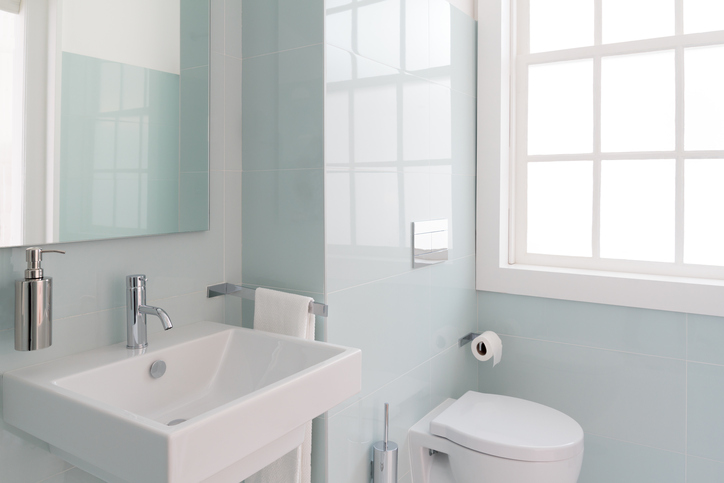
Clean and fresh bathroom with natural light

Having a clean bathroom is a strangely satisfying feeling. It’s not just having the towels hung up and the sink wiped free of toothpaste globs, but when you can see that sparkle on your countertops and in the tub and toilet that comes from a deep and thorough scrub.

If you feel the instant gratification from a shining bathroom as much as we do, read on for this easy guide for how to make your bathroom cleaner than ever before.

Cleaning Prep

If you have multiple bathrooms, tackling them one at a time is a good strategy because it keeps you focused on the room that you’re in. It’s also helpful to completely clear off your bathroom counter and your shower/bath shelves. Move all your toiletries to another room, so that you can keep your toothbrush away from chemical-based cleaning products. This also gives you a chance to throw away any empty bottles that are still in shower. Finally, take a look at your shower curtain liner—if it looks spotty, throw it in the washing machine on delicate to freshen it up and then hang it to dry.

Now that your bathroom is empty, gather your supplies and turn on a podcast or your favorite music. It’s time to clean!

Supplies

  • Toilet bowl cleaner
  • Toilet brush
  • Sponge
  • Paper towels or several cleaning rags.
  • Dishwashing gloves—these are optional, but they’ll keep bathroom cleaners off your hands—especially for when you’re cleaning the toilet
  • Bathroom cleaner of your choice—best bets are products that can handle multiple parts of the bathroom: countertops, sinks, and bathtubs
  • Glass cleaner
  • Shower cleaner: look for something that takes care of mold and mildew, to really clean the grout between shower tiles

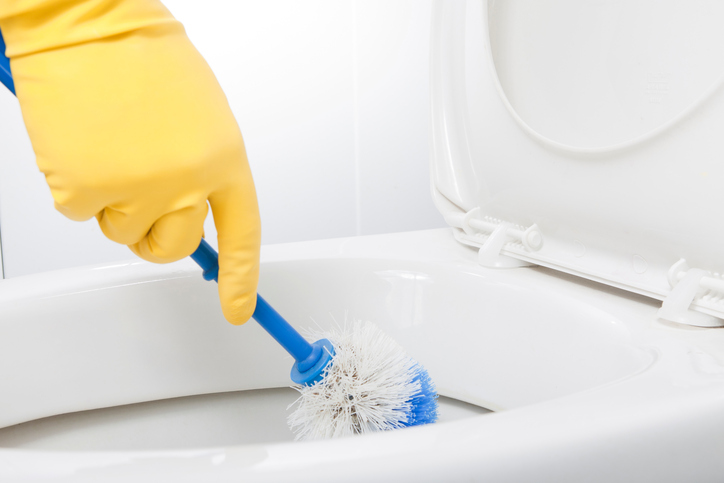
Yellow Gloved Hand Cleaning Privy with Blue Brush

How to Deep Clean Your Toilet

It’s best to start with the toilet so the cleaner can soak in the bowl while you clean the outside. Apply the toilet bowl cleaner inside the rim of the toilet according to the instructions on the bottle. Let it sit to clean away any residue. Close the lid and get to work on the outside.

Take a dry paper towel or rag, and wipe any dust and hair off the base of the toilet. Do the same on the top of the tank and the area between the lid and the toilet tank. Take another paper towel and spray it with the bathroom cleaner. Wipe down the outside of the toilet as many times as necessary.

Using the toilet brush, scrub the inside of the toilet, under the seat and any place there may be stubborn residue. Flush the toilet and rinse the brush. One round of toilet bowl cleaner is usually enough, but if it’s an old toilet, you may have to do two rounds. Place the toilet brush in its holder and put it away. You’re done with this part!

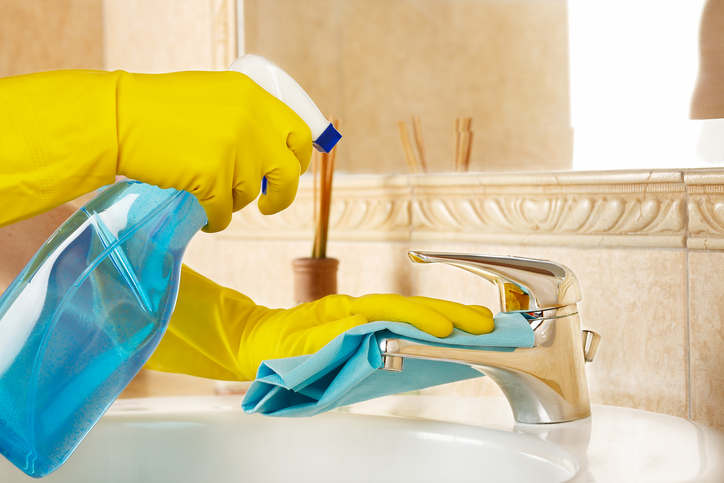
woman in rubber gloves with rag and detergent cleaning the bathroom

How to Deep Clean Your Bathroom Sink

Take the dry rag or a paper towel and wipe the bathroom counter down. This cleans off any dust, makeup streaks, or stray hairs. Then spray the bathroom sink, the faucet, and the counter with your bathroom cleaner. Let it sit according to the directions. Wipe down the counter, taking your time over any stubborn spots. Rinse the rag and then wipe the counter once more. Repeat with the faucet and the sink. Pay attention to your sink stopper, as it may need to be sprayed again with the bathroom cleaner again.

Note: If you think you have a clog, either snake your drain or use some Draino, then clean your sink.

To clean your bathroom mirror, there are two options. One is to spray the glass cleaner on a rag and then wipe down the mirror. The second is to spray the cleaner directly onto the mirror and then wipe down. Then take that paper towel and go over the faucet and handles again to take care of any streaks the bathroom cleaner left behind.

How to Deep Clean Your Bathtub and Shower

Start by spraying your shower walls with the mold and mildew cleaner, so it can work its magic while you scrub your tub. Pay attention to the corners of your shower and where the walls meet the bathtub. If you only have a shower—or if you have a shower with glass doors—let the shower cleaner sit while you enjoy a glass of water or take a quick break. Save the doors for the end, so they don’t get spotty again after you rinse your shower walls.

To clean your bathtub, spray the sides and the bottom of the tub thoroughly with the bathroom cleaner, giving extra attention to any rings that may have formed. Let the cleaner sit according to the directions on the bottle. Now take your sponge and run it under the warm water. Using the scrubbing side, scrub any stains, rings, or caked-on soap until they’re gone. It may take several attempts using the bathroom cleaner and warm water. Rinse out the sponge and use the smooth side to wash your tub a final time, making sure all residue is gone.

With your sponge, go back to your shower walls and rinse off the mold and mildew cleaner, spending time along the grout and in the corners. If your shower head is adjustable, spray it along the walls and follow with the sponge to ensure no residue remains. If you have shower doors, now is the time to clean them according to the directions. For a streak-free shine, do one pass with the shower cleaner and then follow it up with the glass cleaner.

Finish by hanging up your shower curtain and liner, replacing your toothbrush and toiletries, and giving yourself a pat on the back. You’ve just successfully deep cleaned your bathroom!

About Laura Trujillo

Laura writes for Modernize with the goal of empowering homeowners with the expert guidance and educational tools they need to take on big home projects with confidence. Laura also maintains a blog (Hello, Clementine!) as a space to share goal setting tips to help people rock their goals!

Tuesday, May 2, 2017

Inexpensive DIY Bath Gels

Read article : Inexpensive DIY Bath Gels

Looking for Homemade Shower Gel Recipe

I do not like using soap when I shower and prefer to use bath and shower gel. I am constantly buying commercial bath gel and it gets very expensive. I am trying to save all the money that I can. Are there any recipes for bath gel that I could try?
Feff

Use Less Shower Gel

I have a foamer from Pampered Chef. It reduces the amount of bath gel that I use in half!
Alicia

Try Baby Shampoo Instead of Shower Gel

This isn't a homemade solution, but it may be just as cost-efficient. Generic baby shampoo makes a great, gentle bath/shower gel. You can often find store brands in a large bottle for well under $2 (making it 50 percent or less of the price of typical bath gels). Now, they even come in a shampoo plus conditioner formula, which gives your skin extra nourishing! Hard to beat. Enjoy!
LH

Shaklee Product Works for Cleansing

I have used Basic H, which is a product by Shaklee. This is a liquid with perfect pH balance.

I had a very bad complexion in my younger days. I started using Basic H when I was about 22 years old. That was over 40 years ago! I keep a bottle (with a pump in it) on the shower shelf. One pump on my wet wash cloth is sufficient for my entire body. You feel so nice and clean with no soap scum to make you feel like your skin is drawing up! My complexion improved within three weeks and continued to improve throughout my life. People ask me all the time what the secret is to my nice complexion, as I don't have wrinkles either!

You can purchase this by the quart or gallon. I buy a gallon once a year and pour it into smaller containers for use. I also keep one pump bottle (an old Avon glass pump bottle that looks like a stalk of celery) at my kitchen sink. When I have loaded the dishwasher, I pump one squirt on my wet dishcloth and wipe up the stove, counter, and stainless steel sink. This is a smaller squirt than I use in the shower. It does such a good job that the sink rinses down and no droplets of water are left on it. They just slide down the drain. It appears like I have dried the sink with a towel!
Carol

Cheapest Shampoo is Great

For an inexpensive "bath gel", use the cheapest brand of shampoo on the shelf. Suave is usually the cheapest brand. You can add some cheap conditioner for added moisture or buy the 2-in-1 shampoo if it comes in a cheap brand. In some areas, dollar stores sell bath gels and shampoos too. You can also use shampoo as hand soap. Also, buying in bulk helps a lot. Shampoo is easy to find in bulk quantities, but be sure to compare prices carefully.
Sherry

Recipes for Homemade Shower Gel

Liquid shampoo and shower gel base provide the basis for the recipes that follow:

Base:

  • 3/4 cup distilled water
  • 1/4 cup shampoo concentrate
  • 1/2 teaspoon table salt (or substitute with 1/2 cup unscented shampoo and increase salt to 1 teaspoon)

Makes 8 ounces

Green Apple and Aloe Vera Shower Gel

This sudsy formula is ideal for total body cleansing and can also be used as a shampoo.

To your base add:

Warm the water and pour into a ceramic bowl. Add the shampoo concentrate and stir until well mixed. Add the aloe vera gel, salt, apple oil, and coloring and stir until thick and well blended. Pour into a squeeze bottle and cap.

Georgia Peach Shower Gel

This is a skin-nourishing formula enriched with Vitamin E and essential apricot oil.

To your base add:

Warm the water and pour into a ceramic bowl. Add the shampoo concentrate, stirring until well blended. Add the apricot kernel oil, salt, peach oil, Vitamin E oil (be sure to open capsules if used), and coloring then stir until well blended and thick.

English Lavender and Cream Shower Gel

This is a nourishing formula that cleanses gently, giving the skin the benefits of milk, an old-fashioned treatment for the complexion.

To your base add:

Warm the water and pour into a ceramic bowl. Stir in the powdered milk. Add the shampoo concentrate stirring until well blended and thick. Add the salt, lavender oil, and food coloring and stir until well mixed. I hope this will be of use to you. From what I have read on the subject, I am sure you can substitute any fragrance oil to suit your personal likes.
Willow

Check sale prices for Essential Oils on Amazon.

Homemade Shower Gel from Soap

I make our own version of the bath soaps that are available for a fraction of the cost. I have experimented with many different soap types and found the best success with quality soaps that have no deodorant claims. Our favorite is made with Dove Nutrium, but I've had good luck with Caress, Dove (regular), Camay, and Oil of Olay. If you use something with a deodorant property to it, it will likely "gel up" and not be the consistency you want for using with a shower "pouf".

You will need two bars of soap, coarsely chopped. Bring three cups of water to a boil (I use the teakettle), and combine the soap bits and the water. Stir until you see no more lumps and let the concoction cool. It will thicken as it cools, and you'll have a good portion of liquid soap similar to what you can buy in the store. I store it in sandwich baggies, which are tied off at the top. We refill our shower soap dispenser easily by snipping off the corner of the baggie and squirt the soap into the dispenser. While we may pay $7 for eight bars of soap, the end product lasts us well over a year, and we were spending much more than that buying the ready-made stuff.
Sue

Information on Homemade Shower Gel

I could write reams of information on this topic. The main thing that I want to point out is a potential concern about using commercial products to make a traditional soap gel. Some recipes go somewhat like this: grate one bar of soap and dissolve in 3 cups of boiling water.

The main problem that you may have with many this type of recipe is the fact that most soap bars out there are a combination of soap and synthetic detergents. These can react differently when dissolved, and their pH level can be quite low, which would allow bacteria to possibly grow when water is introduced into the mix.

Homemade soap has quite a high pH level and does not encourage bacterial growth. If you take the time to learn how to make soap and know which oils work the best for your skin, I'm sure that your own homemade bar soap will greatly surpass any shower gel/shampoo combination that you can buy on the market.

There are many soap making sites available, and most soap making supplier sites have great recipes, tips, and suggestions. There are also scads of emailing lists where you can "meet" other people who make soap. It is always fun to see what others are doing. A site that I would suggest is Majestic Mountain Sage (MMSage).

If you decide to try your hand at soap making, invest in a good digital scale such as a postal scale that measures down to 1/10th of an ounce. You should be able to find one at a business supply place like Staples for under $30. It will be the best investment that you can make. Great soap can be made using grocery store materials, so don't feel that you have to jump in and buy large amounts of specialty oils at the start. Once you make your own soap, there will be no going back. You may even like your own bar soap better than those bath gels you buy. I know that I can make a very special homemade bar of soap that is very conditioning for under $1 for a 3-ounce bar. Happy soap researching!
Shelley

Reviewed August 2017


Take the Next Step:

  • Stop forgoing your favorite beauty treatments just because you're on a tight budget. Check out the TDS Guide to Beauty on a Budget and learn the tricks to pampering yourself for pennies.
  • Join those who 'live better...for less' - Subscribe to The Dollar Stretcher newsletter, a weekly look at how to stretch both your day and your dollar! Subscribers get a copy of our ebook Little Luxuries: 130 Ways to Live Better...For Less for FREE!

Saturday, August 12, 2017

Small Bathtub Designs Made For Ultimate Relaxation

Read article : Small Bathtub Designs Made For Ultimate Relaxation

A small bathtub is a nice alternative to a regular one and not only because it’d free up more space in the bathroom. These amazing soaking freestanding tubs are made for relaxation and, well, soaking. Besides you can easily turn one into a shower and use the rest of that bathroom space for washers, storage, or simply to create an airy look in an already cramped room.

Small Bathtub Designs of Every Shape

Small bathtubs come in all shapes and different sizes. They aren’t just circular or oval. There are classical claw feet freestanding tubs in minimized versions, square tubs and all kinds of forms in between.

Cyrano Acrylic Slipper 44″ white tub 900x900 <a href=Small Bathtub Designs Made For Ultimate Relaxation" width="900" height="900" />Cyrano Acrylic Slipper 44″ white tub

This Barclay‘s Cyrano Acrylic Slipper tub is just 44″ with the beautiful brushed nickel imperial feet and a roll top. It goes to show that even if your bathroom is tiny you can still create a vintage style interior with a classic tub that won’t take up too much space.

It is ideal for the bedroom too because you won’t end up giving too much of the floor space to the bathroom area. Even though tiny it still has the presence that people like so much about the clawfoot tubs.

Marmorin small soaking tub <a href=Small Bathtub Designs Made For Ultimate Relaxation" width="800" height="800" />Marmorin small soaking tub

Circular shape is probably the most popular among the soaking tubs but this Marmorin Jena shoe-shaped design is all about ergonomics. It may look bigger than it really is but it’s all because of its high back that allows to really lean back and enjoy your me-time.

This form is getting more widespread but it surely requires a bit more space. Well, at least you can sit back and hide from the world behind those tall tub walls.

Small Bathtubs Made of Metal

Asti Copper Japanese soaking tubAsti Copper Japanese soaking tub

Material is as important as the shape of a tub. Copper is a huge design trend right now and the bathtubs that are made of it can surely add some style points to a modern bathroom. This 39″ Asti Copper Japanese Soaking Tub from Signature Hardware has an amazing albeit simple design and can probably fit into the tiniest of bathrooms.

Copper is not only quite easy to clean and maintain, it is also antibacterial. It looks well as it ages and if you choose really carefully it will serve you for quite a long time. Decor tip: match copper with teal or turquoise accents for a truly stunning look.

43" Simone Polished Stainless Steel soaking tub43″ Simone Polished Stainless Steel soaking tub

Like it or not the round shape is simply the most efficient when it comes to small bathtubs. This is another one of Signature Hardware‘s mini tubs, a 43″ Simone Polished Stainless Steel Soaking Tub, stylish and very small.

It would surely fit into any small bathroom and make it look amazing. The modern stainless steel finish can go well with both traditional and ultra modern or minimalist decorating styles. It all depends on what you’re going for.

<a href=Square Freestanding Bath Tub 41' x 41' from ADM Bathroom Design" width="900" height="900" />Square Freestanding Bath Tub 41′ x 41′ from ADM Bathroom Design

Of course, if a square tub works better for your floor plan then you’re in luck because there are quite a lot of them on the market right now. For instance, this ADM Bathroom Design square tub is a perfect fit for a small bathroom, especially if you’re planning to tuck it into a corner.

Some square tubs feature a circle carved up inside of them leaving some space around the angles for storing small things like shampoos and soaps. Some even feature a mini deck with steps to make it easier to get in.

Circular Small Bathtubs

Aquatica TrueOfuro freestanding solid surface bathtubAquatica TrueOfuro freestanding solid surface bathtub

Speaking of tall and small bathtubs, going upwards is always a valid way to economically use space regardless of the room. In a small bathroom a tall soaking tub leaves so much free space to simply move around.

Circular soaking tubs can often be quite deep and tall like the Aquatica‘s TrueOfuro freestanding tub. It is quite small but a grown adult can clearly fit in it without any problem.

Aquatica Purescape freestanding acrylic bathtubAquatica Purescape freestanding acrylic bathtub

Purescape tub from Aquatica is designed by the same principle but it has a modern look to it. It also features the decorative rings that make it look like a collapsable cup.

Speaking of which, soaking tubs often have cup-like shapes but there are other small tub designs that resemble things like bowls and even vases.

Colorful Small Bathtubs

Acrylic mini bathtubAcrylic mini bathtub

While round tubs look more impressive in the middle of the room or beside a bed or a window, they can also quite successfully fit into a corner. This Glass Design acrylic mini tub has its back raised and while it’s circular there’s little space wasted between it and the wall.

Beside shapes, sizes and materials the color of a bathtub is a whole different factor that diversifies the choice. Surely most of them are still white on the inside but the sides come in all the different colors from red to blue to golden.

Flower style back bathtubFlower style back bathtub

Another great small bathtub design from Glass Design looks more like a flower vase (perhaps hence the name) and features a black exterior but the white insides.

Sure, it may not look as convenient or practical but just look at how little floor space it occupies. You can probably stand upright inside of it, which would eliminate the need for a shower. But the question is how does one get in?

Mini Gold Leaf tubMini Gold Leaf tub

Their Mini Gold Leaf small bathtub can really transform a tiny bathroom. Its beautiful finish would definitely make for a luxury bath interior.

Since its back is raised and a bit pointed, it too fits well into the corner. Although who would want to tuck it in there rather than placing it right in the middle of the room?

Traditional Small Bathtubs

Tubby Torre bathtubTubby Torre bathtub

Freestanding bathtubs are very popular right now. But if you need a mini version that would fit into a tiny bathroom the Tubby Torre from Albion Bath Co. is a perfect option.

Painted into a beautiful dark bronze the bathtub would make a gorgeous addition to any bathroom or even bedroom. It’s compact enough to leave a lot of free space in the room. And it’s beautiful enough to pass as a full-sized luxury freestanding tub.

Tubby too short roll top bathtubTubby too short roll top bathtub

Tubby Too Short is another contender for a small luxury bathroom. This mini clawfoot tub painted into bright purple really calls for a mock vintage style or maybe even shabby chic.

It is a great way to add a pop of color to a small bathroom. It both creates a focal point in the interior and requires no additional decorative accents.

Small Bathtubs Made of Marble

Papillon Bathtub in Marble Sandstone and Granite by Stone ForestPapillon Bathtub in Marble Sandstone and Granite by Stone Forest

Though stone isn’t accessible to most, the bathtubs made out of it can look truly incredible. Even the small ones. Stone Forest shows what marble sandstone can do to such a mundane thing as a bathtub.

Beside the high cost natural stone requires tremendous maintenance. So if you think you want one be sure to do your homework and find out what you’re getting into before the purchase.

EAU Soaking tubEAU Soaking tub

Stone Forest knows a thing or two about impressive stonework. This small bathtub was presented at ICFF and also at IDS12. It earned a 2011 BOY Merit Award from Interior Design Magazine and general media attention for its impeccable design.

Finished with a sealant (like this one), stone bathtubs require careful cleaning. If the sealant is damaged your tub could end up with stains and scratches. But even with sealant intact you still want to wipe it dry after each use. This is done to prevent mineral and soap scum buildup. Do you think you’re ready for such a commitment?

Small Bathtubs Made of Stone

GRAL tub by SIGNGRAL tub by SIGN

The GRAL bathtub by SIGN looks like an oversized sink and while small it’s definitely a luxury tub as it was made out of a single excavated stone piece.

If you’re trying to save both space and money though you can surely find an equivalent shape among more modest modern tubs on the market.

Circular bathtub in home by Carver + SchicketanzCircular bathtub in home by Carver + Schicketanz

As we already mentioned, a small bathtub doesn’t have to only be a solution to the lack of space. In a spacious bathroom it can simply allow you to add features that aren’t fit for the other rooms.

This beautiful stone bath is doing just that in a house designed by Carver + Schicketanz. There’s plenty of space in the indoor/outdoor room with some serious furnishings that offer plenty of storage space.

<a href=SPA bathtub designed by nespoli e novara for Neutra Design" width="800" height="493" />SPA bathtub designed by nespoli e novara for Neutra Design

SPA bathtubs are definitely the ones that allow you to soak well and relax. This one was designed by nespoli e novara for Neutra Design and it surely looks relaxing. Available in a range of various stones including moonstone and granite it makes for a luxury addition to a small bathroom.

While you may think it’s not as versatile a small bathtub can double as a shower or even a whirl tub.  So even those who lack space can enjoy a piece of their favorite SPA right at home.

Small Bathtubs in Interior Design

Designed by <a href=JAUREGUI Architecture Interiors Construction" width="800" height="530" />Designed by JAUREGUI Architecture Interiors Construction

Think small bathtubs can’t look impressive? Then you didn’t see this bathroom designed by JAUREGUI Architecture Interiors Construction. Featuring a built-in round bathtub with a marble ring and a waterfall tap this interior is out of this world.

Of course, the glazed walls and a marble fireplace add considerably to the interior design. But you can’t deny that you’ve never seen a tub like this one before.

Master bathroom with a coffee cup bathtubMaster bathroom with a coffee cup bathtub

Another bathtub you may have never seen before is this coffee cup-shaped bathtub complemented with a themed feature wall. It’s cute but nevertheless impressive. A cleverly incorporated mirror makes the small room feel more spacious.

And still there’s plenty of space for storage, toilet, bidet and a sink with a vanity. What an incredible idea and execution!

Teal bathroom with a small freestanding tubTeal bathroom with a small freestanding tub

As you can see even a simple small bathtub can look impressive when it’s a bowl-shaped freestanding design accented with bright teal tiles as a backdrop for a pristine white vessel.

Bubble pendant lights play into the picture full of circular shapes. And a wooden ladder that may look a bit out of place adds its own charm to the look.

Bedroom/bathroom by Finnis ArchitectsBedroom/bathroom by Finnis Architects

This is a great example of how you can combine the bedroom and bathroom by Finnis Architects. A small bathtub doesn’t get in the way and a half wall gives it a bit of privacy.

There are quite a few challenges when it comes to moving a bathtub into the bedroom but in the end of the day the look is definitely worth it.

Small Built-In Bathtubs

<a href=Sunken Concrete Bathtub by Lance Workshop" width="800" height="1067" />Sunken Concrete Bathtub by Lance Workshop

A small bathtub doesn’t have to be freestanding of course. If you need or want to build it into the floor or between the walls you can do that especially in a particularly tight room.

This pulley shower system by Lance Workshop features a sunken concrete bathtub that can easily provide residents with both quick morning showers and the prolonged relaxing bathing sessions.

Michaela Scherrer tiny spa bathMichaela Scherrer tiny spa bath

In Michaela Scherrer‘s Pasadena bungalow the concrete SPA bathtub features a partially hidden shower and thick enough borders to keep the appropriate toiletries within a hand’s reach.

As you can see you don’t need a fancy tub or tiles to create your own SPA bath. The white plastered walls and grey concrete work quite nicely together making for a very modern minimal look.

Small bathtub in an Oriental Warehouse LoftSmall bathtub in an Oriental Warehouse Loft

Wood is another material on the rise in the bathtub design. Wooden tubs like this one in the Oriental Warehouse are too high-maintenance but they provide the bathroom with an unparalleled look and feel.

Since they too feature a sealant, cleaning and maintenance should be directed at keeping it intact so the water wouldn’t harm the wood.

A small bathtub is not only space-efficient but can also help to create an amazing bathroom interior design. Besides it can also double as a shower or a hot tub. It can look impressive especially if made out of stone and the downsized traditional versions can allow you to have a vintage or traditional look without requiring much space.