Showing posts sorted by relevance for query more dirt. Sort by date Show all posts

Wednesday, March 15, 2017

Shower gel better than soap? It just won't wash

Read article : Shower gel better than soap? It just won't wash

  • Eight out of ten people wash themselves with gels costing up to £4 a bottle
  • Tesco has 94 gel brands on sale, each with its own name, ingredients and unique smell
Cleaning up: Gels first appeared in British bathrooms in the Seventies

Cleaning up: Gels first appeared in British bathrooms in the Seventies. Today some 200million bottles are sold in Britain every year

Whoever invented shower gel must lie awake at night — no doubt in a gold-plated, four-poster bed — chuckling at the audacity of it all.

Here is a product that is expensive, packed full of man-made chemicals, difficult to use and wasteful. And yet, thanks to the persuasive power of marketing, bottles of it sit proudly in almost every bathroom in the land.

Once, we cleaned ourselves with bars of long-lasting soap that cost the equivalent of a few pence a week. Today, more than eight out of ten people wash themselves with gels costing up to £4 a bottle.

Not that shower gel manufacturers admit they are involved in the business of washing, of course. Instead, they sell their wares as revitalising foams, honey shower milks and rebalancing body experiences.

Imperial Leather’s Japanese Spa Foam Burst is, it claims, designed to help you wake up in the morning. Palmolive’s Absolute Relax is supposed to send you to sleep.

You will struggle to find a shower gel that admits what it is really intended for: as a way of removing dirt, sweat and grease. Long gone are the days of explicit adverts for Lifebuoy — the soap that said ‘No to BO’.

But if Britain has gone crazy for shower gel, with an estimated 200 million bottles sold in the UK each year, there are signs of rebellion.

Former Tory MP, television presenter and newspaper columnist Matthew Parris recently went on the offensive.

In a passionate attack against pointless toiletries, he highlighted the design flaws of shower gels.

Gels have come a long way since PZ Cussons, the makers of Imperial Leather for a <a href=long time regarded as the traditional hard soap for middle-class families" class="blkBorder" />

Gels have come a long way since PZ Cussons, the makers of Imperial Leather for a long time regarded as the traditional hard soap for middle-class families

He pointed out that most of the bottles don’t stand upright on curved soap dishes, or they leak when hanging from their plastic hooks. They are difficult to open, easy to spill and hard to apply (how do you use shower gel to wash your feet?)

And most of the gel squirted into the user’s hands slides to the floor to be washed down the drain.


While the secret of soap-making goes back to at least the Ancient Babylonians in 2800 BC, when animal fat was mixed with the ashes of wood fires and melted, the first liquid soap was patented in 1865

Parris — who stopped using shampoo years ago and who claims his hair has never been cleaner — estimates that millions of gallons of gel are washed away unused every year.

Despite these flaws, Britain’s love affair with shower gel is going strong. Tesco, at last count, had 94 brands on sale, each with its own name, ingredients and unique smell.

Most sane people would struggle to come up with 94 different conventional fragrances for toiletries. But the clever people at Unilever and Cussons have got round that by persuading consumers that what they really want to smell like is food: thus we can wash ourselves with Chocolate and Mint shower gel, Milk and Honey shower creme, or Cranberry and Honey shower scrubs.

Evidently, gels have come a long way since PZ Cussons, the makers of Imperial Leather — for a long time regarded as the traditional hard soap for middle-class families — introduced its first ‘Luxury Shower Gel’ in 1978.

Flaws: Former <a href=Tory MP Matthew Parris recently highlighted the design flaws of shower gels" class="blkBorder" />

Former Tory MP Matthew Parris recently highlighted the design flaws of shower gels

Gels were, in part, a response to a change in bathroom habits that saw showers growing in popularity as our lives became busier and we all became more aware of the need to use water sparingly.

But the rise of shower gels can’t be explained simply by the move from the twice-weekly bath to the daily shower. After all, showers had already become a staple of homes by the Seventies, and for at least a decade after that, most people were happy with soap — or occasionally the more exotic ‘soap on a rope’.

The secret of their success lies in the fact that while they are cheap to manufacture, they are easy to brand as a luxury. By selling them as modern, convenient and indulgent, cosmetic companies cleaned up.

While the secret of soap-making goes back to at least the Ancient Babylonians in 2800 BC, when animal fat was mixed with the ashes of wood fires and melted, the first liquid soap — the forerunner of today’s shower gels — was patented in 1865.

Modern gels are more complicated to make. But their basic ingredient, a detergent that sticks to grease and water, is similar to the detergent in hard soap bars.


'Most of the differences between brands are trivial in terms of what they do functionally — removing dirt and grease. But the real difference — and this is the genius of marketing — is how those small differences, like the fragrance and the associations that come with that fragrance, can be used to create something more than the product'

In order to remain thick, perfumed and coloured, a typical shower gel must contain around 20 chemicals, some man-made, others derived from plants. It will have a couple of plant-based detergents, an array of perfumes, salt to thicken it, glycerine — a clear, sticky liquid used in cough mixtures and icing on cakes — to make the gel silky, film-forming agents, lactic acid (found in sour milk to counteract the alkali and make it pH- neutral), preservatives, agents that reduce static in human hair and natural plant extracts.

Most of these plant extracts have very little practical purpose and are just for marketing purposes so that the gels can have fancy names.

And marketing is what it is all about. From the earliest days of industrially produced soap, manufacturers realised that to sell more soap, they needed to persuade Britons to become more ‘hygienic’: the more people washed, the bigger the profits.

So it shouldn’t come as a surprise that some of the earliest and most successful advertising campaigns were for soaps.

Today, more than eight out of ten people wash themselves with gels costing up to £4 a bottle.

Costly: Today, more than eight out of ten people wash themselves with gels costing up to £4 a bottle

The English company Lever Brothers created Lifebuoy in 1895 and sold it as an antiseptic soap. The company also invented the term BO for body odour. Pears devised a sophisticated transparent soap and launched the yearly search for Miss Pears.

Yet no marketing campaign for soap was enough to fend off the advance of shower gels.

Those who prefer gels say they are happy to put up with the extra expense for the sake of convenience: unlike soap, they don’t leave scum or mess around the shower, and small amounts go a long way.

But for many, they are a victory of marketing over common sense.

One of the UK’s top marketing gurus, who has worked with many gel manufacturers, said: ‘Most of the differences between brands are trivial in terms of what they do functionally — removing dirt and grease.

‘But the real difference — and this is the genius of marketing — is how those small differences, like the fragrance and the associations that come with that fragrance, can be used to create something more than the product.

‘That value to the brand is real. If a product has associations of being refreshing in the morning or relaxing in the evening, it can be a genuine bonus for the consumer; it might help people feel relaxed or refreshed.

‘Some of that association is intrinsic in the ingredients of gel, but much of it is created through advertising.’

So are we being taken for a ride by the marketing types? The answer is probably yes. But then, how many of us would really want to go back to using half a bar of soap in the shower when we could be reaching for a bottle of that oh-so fragrant Japanese Spa Foam Burst?


Saturday, October 21, 2017

Miley Cyrus Nabs Secluded Farm Outside Nashville – Variety

Read article : Miley Cyrus Nabs Secluded Farm Outside Nashville – Variety

BUYER: Miley Cyrus
LOCATION: Franklin, TN
PRICE: $5,800,000
SIZE: 6,689 square feet, 5 bedrooms, 4 full and 2 half bathrooms

YOUR MAMA’S NOTES: Miley Cyrus may be just 24 years old but her personal property portfolio is fast approaching bone fide baller status with the $5.8 million purchase of a secluded farm about 20 miles south of Nashville. The mostly wooded 33.5-acre country hideaway, squirreled down a private dirt lane at the end of a discreet rural cul-de-sac just outside the affluent community of Franklin, is anchored by an approximately three-year-old, classic farmhouse-style main residence of 6,689-square-feet with five bedrooms and four full and two half bathrooms.

A zig-zagged, rocking chair lined porch along the front of the house leads to a center hall entry wrapped in rustic, reclaimed wood planks. Unfussy, wide plank wood floors flow throughout the main floor living and entertaining spaces that include a barn-sized living room that stretches more than 30-feet-long with a capacious double-height ceiling lined with exposed wood beams, several four-pane sash windows almost tall enough to step through and a massive stacked stone raised hearth fireplace between built-in bookshelves. The country farmhouse-style kitchen, with reclaimed brick backsplash, double-wide center island with snack bar, high-end finishes, two-toned cabinetry and top grade appliances, opens to a cozy keeping room with antique brick fireplace and a high, wood-clad ceiling. The main floor master suite has a fireplace and wainscoting trimmed bathroom with a claw-footed soaking tub set at an angle into a windowed corner with a leafy view of the surrounding woods and there are four well proportioned and wall-to-wall carpeted family bedrooms on the upper level along with a den/game room with vaulted and wood-beamed ceiling and a large rooftop deck.

Mean Girls

Accordion fold French doors open the main living room to a screened porch plenty large enough to accommodate living and dining areas and outfitted with wood-patterned tile floors, a wood-clad ceiling and a chunky, stacked stone fireplace surmounted by a flat-screen television. The screened porch leads out to a swimming pool and spa surrounded by extensive terracing and a small putting green. The property also includes a barn-style building set a good distance from the house that would make an excellent entertainment pavilion, recording studio or housing for guests and/or staff.

Over the last few years the superrich 24-year-old Disney darling turned twerking, tongue-wagging international pop superstar has beefed up her residential holdings in a manner commensurate with someone whose net worth is, by some accounts, estimated to be around $200 million. In June 2011 the then 18-year-old entertainment industry provocateur paid $3.9 million for a modern-minded ranch-style residence in the foothills above Studio City; in April 2015 she shelled out another $5 million for a 5.5-acre equestrian ranch in the guard-gated and celeb-filled Hidden Hills enclave; and in early 2016 she coughed up $2.525 million for a slightly more than two-acre spread in the hills above Malibu’s Point Dume that’s next door to a more substantial, multi-acre estate her longtime boyfriend and fiancée, Australian actor Liam Hemsworth, purchased in July 2014 for just over $6.8 million.

Listing photos: Fridrich & Clark

Sunday, August 20, 2017

Wash, don’t wipe, your butt.

Read article : Wash, don’t wipe, your butt.

By Sparklee A Hole.

If you can read this, you are a human, and you poop. A subject that may delight a few, and disgust many more. but opinions don’t count, because we all have to go and poop. It is what happens afterwards that is rarely discussed. People from different cultures have different ideas about what you should do next. An American or a Brit, who has only ever seen a toilet roll next to a toilet, may travel abroad and find one of the five following devices at his or her disposal.

There may be more systems than these five, but these are the common alternatives to simply using dry tissue paper to clean up.

Conversely, someone from the Arab world, or the Philippines, or parts of Asia, might visit The USA and be appalled to find out that Americans believe they can clean their anal area following defecation with nothing more than dry tissue paper. And they would be right, because it really does take more than tissue to be clean following the business.

Clearly, washing is more efficient than tissue-wiping when it comes to removing the after effects of going, especially if a lather from detergent is introduced, so what do these mysterious foreigners do in the bathroom?

The Bidet.

Often seen beside a toilet, the bidet has featured in travel jokes for decades. It is basically a little bathtub that one squats over to wash the area. These usually have hot and cold running water and can squirt, rinse and spray. Anyone who has used a bidet is probably emerging from the bathroom clean.

The electronic bidet toilet seat.

The Japanese have pioneered this field. To have one of these, your toilet needs to have electricity as well as water. These devices, controlled with the push of a button are designed to wash and then dry the area, without the user leaving the seat. Some are simple and some are full of hi-tech features.

The Tabo

Called the tabo in the Philippines but known by other names in South Asia, this system is basically a jug of water, filled in a bucket or barrel or from the tap. The user raises up slightly from the toilet seat and pours water towards the small of the back where the space between the butt cheeks is. The water naturally flows down and over the skin and washes the area.  In practice, although rarely talked about, the user usually puts soap on his or her fingers and washes the butt, just like everyone does in the shower and then rinses with the tabo. Of course this means touching the unclean substance in question (poo) but the hand is using soap and water so with practice it ends up clean when all is over. In the Philippines, bathrooms are wet, meaning there is usually a floor drain and a faucet on the wall, which is used to fill the vessel. The tabo is difficult for lifelong wipers to accept, but it does remove all traces of waste and associated bacteria, so should not be criticized. Anyone with a sink within arm’s reach of the toilet, and a plastic jug or jar, can try the tabo right now, with nothing to install. In rural areas, the tabo is also used for outdoor, full body bathing.

The bidet shower spray.

The Arabs call it a shattaf, (sounds like shit off, which is basically what it does), but this is nothing more than a handheld water shower that connects to the water inlet valve for the toilet via a T-connection. Room temperature water is sprayed on the anus after the business is done. As with the tabo, hand washing the area with soap is an unmentioned option. These sprays are often called diaper sprays or nappy sprayers, because they can also be used to wash off most of the baby poo from your baby’s diaper before tossing it in the bleach pail. The baby poo just goes right down the loo. The downside to using a handheld shower spray in a colder climate is, in winter, the tap water can be extremely cold. In some places these are called the muslim bidet and other names, because the muslim world is apparently quite particular about keeping clean down there. But if your bathroom is in Thailand or Saudi Arabia, to name a couple of places, you’ll probably have a sprayer adjacent to the toilet, and the water will not be a cold shock.

The sprayer pipe.

In Egypt you are likely to see a curved brass pipe at the back of the toilet bowl. This is water spraying at it’s most basic. Just turn on the tap and a jet of water shoots towards the butt for hands-free washing, or manually assisted soaping, as discussed under the tabo.

So here is the taboo subject of cleaning the ass being discussed in a magazine. Some will find the whole subject unthinkable and live their whole lives failing to properly remove poo and bacteria with their little pieces of tissue paper, and others will never use tissue paper instead of washing. While it may be obvious which idea is more effective,  preconceptions about what is civilized may keep most westerners in the dirt until they are buried in the dirt. But whatever you do following a poo, follow by washing your hands with soapy lather, and you’ll stay safe.

Sparklee A Hole is always ready for inspection and never has to hide his underwear deep in the laundry basket.

Editor’s note: We had almost 150 comments on this post, some quite well written and lengthy. But some comments contained less than tolerant cultural attacks etc., and so we made a decision to disable comments for this post and delete all that were here.

Monday, December 18, 2017

9 Tips To Ensure You Get Your Dream Bathroom Remodel

Read article : 9 Tips To Ensure You Get Your Dream Bathroom Remodel

This bathroom remodel ideas post is sponsored by Sears Home Services.

9 amazing <a href=bathroom remodel ideas" />

In our last house, we thought we were in our forever house. We bought it when the wee ones were almost 3 and not quite one. At the time, we planned to live there until they graduated high school or longer, and we treated the house that way. We replaced all the windows, we made an amazing front walk and redid all the landscaping. My favorite project included a gut of the master bathroom, and a complete kitchen remodel was next on our list.

Plans change, and we sold that house five years ago now. This house is now our forever house, except that forever is definitely a much shorter horizon. We built the new garage last year and just finished a roof replacement on Monday. I met with the house painter yesterday, and a completely redone basement (needed due to water issues that we’ve since fixed). Are you surprised that our master bath is on the list again?

We learned from our last house, and I have a ton of bathroom remodel ideas, both ideas we incorporated as well as some new trends that have sprouted. Our new bathroom won’t happen overnight, but even small changes can make a difference. I pulled out the brass and chrome fixtures from throughout my bathroom already. Just that little thing helped make our bathroom (built in 2005) feel less dated.

9 Bathroom Remodel Ideas

Add heated floors.

This was the best thing we did in our remodel. Hands down it was the best idea we had. Since we ripped out (all three layers of) the old flooring, we laid heating coils under the new floor. Nine months of the year, we used this floor and loved it. There is nothing worse than a cold Chicago morning and dancing from rug to rug to avoid frostbite on your feet.

We set it up to include a programmable switch. It turned on ten minutes before we headed to the bathroom each morning, so it was beautifully warm every time. It turned off by itself, and oh my word it was worth the investment. This is hands down the best of my bathroom remodel ideas ever. I’ll never do a remodel without one again.

Create a point of interest in your bathroom.

As much time as we spend in bathrooms, you want to enjoy the look. In our old bathroom, the towel rack hung over the far end of the bathtub. We had to walk from the shower over and climb in the tub or carefully reach over it to get our towel. That towel rack went away in the remodel, but initially we had no idea what to do with that blank wall. There was an identical blank wall on the other side of the tub.

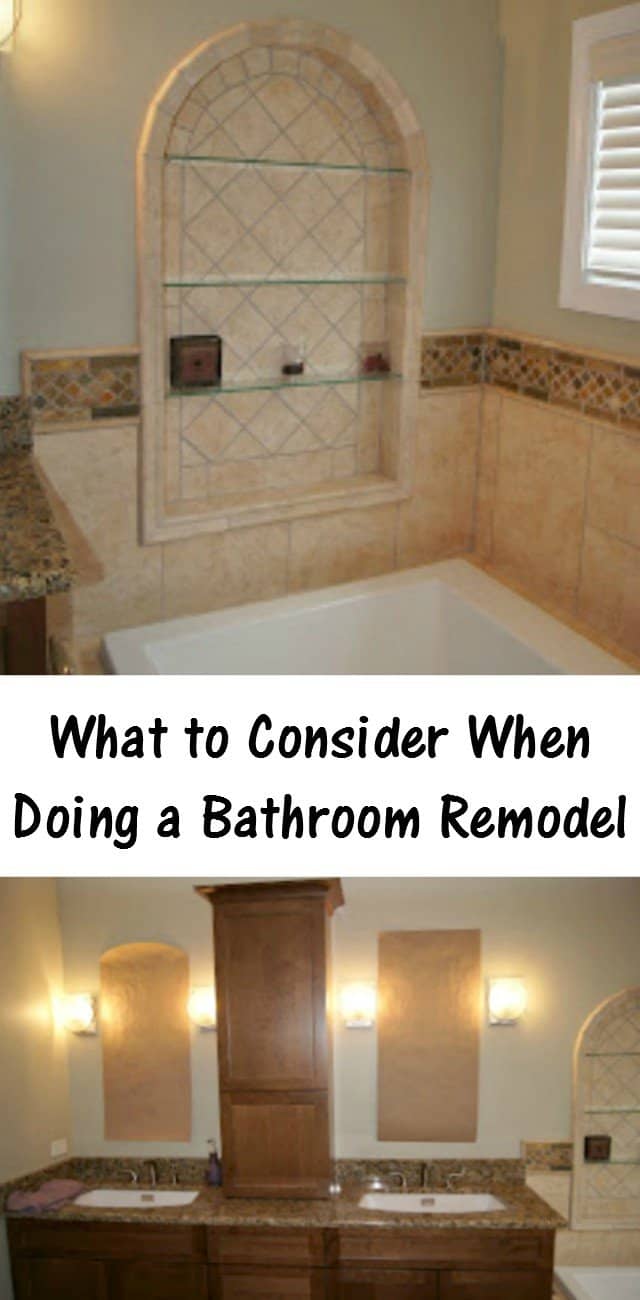
Fortunately, my contractor came up with a fantastic bathroom remodel idea. I knew I wanted a window from my shower to make it feel bigger since we couldn’t increase the size of the shower itself. We chose an arched design, and our contractor suggested a tiled arch shelf built into the wall to hold some knick knacks and bath oils, etc. It turned out gorgeous. A shelf like this may not be the best fit for every bathroom, but it created a great point of interest on an otherwise boring wall. How can you give personality to your bathroom?

Create an artistic feature <a href=bathroom remodel ideas" />

Make sure you have enough storage.

Our current second floor has no linen closet. In fact, there’s nowhere to really store towels and sheets and other items in general. There is some wasted space behind the bathroom door, and we purchased a wooden shelf that we painted white to act as a temporary closet. It isn’t the prettiest, but it’s functional. For now.

No linen closet

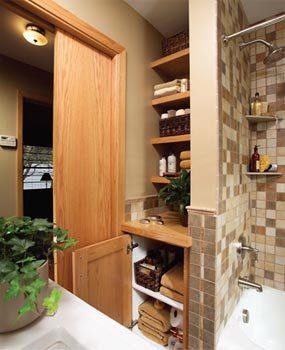
When thinking about bathroom remodel ideas, don’t forget about storage. Do you have enough with your current setup? In our last house, we added a storage tower between the two sinks. We had a large bathroom and a long sink area, so this worked well. It separated my husband’s stuff from mine, and all our “things” stayed out of sight.

Create a tower to add more storage in your bathroom

When we remodel our current bathroom, we won’t put a tower between the sinks because our bathroom is narrower. On the far edge of our vanity, we have wasted space there, and we’ll extend the cabinet up to create storage for towels and sheets and add some vertical interest with a change in heights.

And yes, we’ll build in a real linen closet where that space is currently wasted.

Choose the right sink.

Growing up, sinks were all the same. They were slightly oval and mounted into the counter. Now? Oh my word, the options! In so many bathrooms, a vessel sink looks amazing. It’s so sophisticated and so many have the personality many bathrooms lack.

They can be pretty expensive, however. A more traditional sink now comes in a variety of shapes. We chose a rectangular sink that gave me more room to presoak laundry in the “extra” sink since we had a second floor laundry and no laundry sink. It was large and gorgeous. An undermount sink worked great for us there because it minimized dirt that got stuck around the seal of the sink. In our current bathroom – because storage is at a premium – we know we’ll do a top mount sink that gives us more room in the vanity, but that doesn’t mean we won’t find one with the right look for our bathroom.

Choose the right fixtures.

Now that you have your sink, make sure your fixtures fit the aesthetic of your bathroom as much as you sink does. If you have a vessel sink or pedestal sink, make sure your faucets have enough room for you to wash your hands and more.

When it comes to the shower, it’s easy to find a showerhead in the same family as your sink faucet without it being identical. Do you want a showerhead you can move easily? Do you want an overhead shower for a more spa like experience? One of the bathroom remodel ideas I nixed last time was a steam shower. I didn’t think it was worth the money. Once we were done, I regretted it. Now there are smart showerheads that create that spa-like experience.

More and more fixtures provide great spray while still saving water. I miss the days in my old Chicago apartment where my shower beat on me. When I think of all the water wasted, I cringe. I can regain that experience with many showerheads now available without the need to hang my head in shame for the excess water.

Build a niche into your shower.

I am not a fan of the shower surrounds. When I do my bathroom, I want tile everywhere, which allows a ton of customization. My current bathroom? Yep, it’s a surround. And there’s nowhere to put shampoo or soap or anything. Shaving my legs? I’m balancing with a foot on the wall, and it isn’t pretty.

Generic bathroom shower

Another of those great bathroom remodel ideas? Build your shower to fit your needs. You can find a place to create a niche in a wall to hold your bath products. Make sure your contractor tilts it so water doesn’t stay in it. This is not only a functional addition, but it looks cool, too. We flipped the direction of the tiles we used elsewhere in the shower so they were diamonds instead of squares, and it looked fabulous. Major custom look without a major custom price. That inset? It’s a prefab option so my contractor didn’t have to build it by hand.

Bathroom shower and window to make it feel bigger and more custom

Create a bench, too, if you have room. We were able to have enough room for a bench so I could sit while shaving without feeling cramped in our last shower. Barely. Not every shower has that ability, but even in a standard size shower, you can build a foot rest into the tile so you have a secure place to rest your foot or booty while shaving. As with the inset for shampoo, just be sure your contractor angles it to avoid water pooling.

Don’t go too trendy.

Full bathroom remodels aren’t cheap. It isn’t the most expensive home renovation you can do, and it provides a great return on investment relatively, but you don’t want to go super trendy so that someone walks in and says, “Oh, yeah, this bathroom was done in 2016.”

That doesn’t mean you want to be blah or avoid any trends at all, but think about what has a longer term appeal. The pink tiles in my old master bathroom? I know they were from 1993. By 1996, I knew that. Avoid those traps.

If you plan to live in your house long term, create a bathroom that is your haven. You live there, not the person who’ll buy your house in 15 years. If it fits with the rest of your house design, go for it. What works in my 1925 more traditional home doesn’t work in an Italian villa style or in an ultra modern home. The overarching philosophy behind my bathroom remodel ideas is what matters.

Honestly, I can look even now at our bathroom remodel from five years ago and know that we chose too trendy a color wood that is too dark, especially with the granite countertop (which I do still love). This is where an expert designer comes in handy to help ensure you love your bathroom today and in 10 years. They have so many bathroom remodel ideas to make it fit you without being so trendy you’ll regret it.

Look for flooring with personality.

We chose rough stone tiles. Smooth is not your friend in the bathroom. The rough surface wasn’t uncomfortable to walk on, and we never had to worry about falls. Even better, the crags and such in the flooring meant we never had puddles when leaving the shower. We actually removed rugs from the bathroom entirely, which I loved. Why? The water that doesn’t evaporate quickly enough in a humid bathroom? Yuck.

While we love stone, that isn’t the choice for everyone. There are so many neat options out there today. Porcelain and ceramic tile come in so many neat patterns and textures now. Don’t do wood, as wood and moisture don’t get along. There are now wood looking porcelain tiles, however. Whatever you choose, find something that complements the entire style of your bathroom.

Update your counter surfaces.

We honestly may update our countertops in the master bathroom and in the guest bath on the main floor before we do a complete redo of the master bath because we have so many other major projects on our list with this house. Right now, they are a very cheap laminate countertop that doesn’t go with the aesthetic of the house. It bothers me every time I look at them.

Countertops aren’t as expensive as you might think, especially as bathroom counters tend to be a fairly limited area. Quartz is a great alternative because it requires no maintenance. You can find great designs with this. I love granite, personally. The uniqueness of granite and the personality it can bring to your bathroom make it worth the investment in my book.

Ready to Implement These Bathroom Remodel Ideas?

Just writing this, I’m excited to redo three of our bathrooms whether just a little countertop change or a full remodel. I’m not quite ready, but when I am, I know what I’ll do. Sears, of course, offers everything you need, whether you’re looking at a quick change like refacing your cabinets or a complete overhaul of your space.

Taking these bathroom remodel ideas and doing the whole thing? Sears has a savings of $500 on bathroom remodels of $1,500 or more through 11/30/2016.

Replacing or refacing your cabinets? Get $500 off a project of $1,500 or more through 11/30/2016, too.

Changing up your countertops? You can save $250 off a countertop purchase of $1,500 or more through 11/30/2016.

And of course, Sears offers free consultations on your projects so you can easily figure out what exactly you want to do and how much it will cost. Just know that if you’re anything like me, you’ll end up increasing the scope of the project as you go along, so make sure you budget for some changes!

What are your best bathroom remodel ideas?

Looking to renovate your bathroom? These 9 <a href=great bathroom remodel ideas will give you a good place to start. Some tips on how to stay happy with it long term and some ideas you may not have thought about." />s
Saturday, February 17, 2018

How to Take the Best Bath Possible

Read article : How to Take the Best Bath Possible

Taking a bath is not about getting clean—that’s what showers are for. Baths are about calming your troubled mind and soothing your aches and pains, both physical and emotional. As a highly sensitive person, I find baths to be necessary, and I’ve gotten very good at them.

This isn’t to say that baths can’t be cleansing in their own way, especially the steamier ones, but removing dirt is not your goal in the tub. (Plus, if you do remove a lot of dirt while in the tub, you’ll just end up sitting in a body of dirty water. If your goal is to sit in a body of dirty water, I suggest a lake.)

Advertisement

Anyway. Taking a good bath isn’t as easy as filling the tub and hopping in. Plans must be made. Moods must be set. Playlists must be curated. Learn from me, my children. Follow my bath-time plan and reap the most restorative benefits.

Step 1: Clean Your Bathroom

It’s hard to relax in disordered, dirty surroundings, so take a few minutes to straighten up, wipe everything down, and maybe shake out your bath mat and give the floor a quick sweep, as there is nothing worse than emerging from the tub, all blissed out, only to have your joy stolen by the feeling of grit and hair sticking to your feet.

Advertisement

I’m not saying you scrub every tile and little line of grout, but give the tub a quick spray of all-purpose cleaner, wipe up any grody spots, and rinse it well. If your bathroom is in need of a deep clean anyway, go ahead and do that, then reward yourself with a very nice bath. (Honestly, my love of baths and bathing is what motivates me to keep my bathroom pretty clean.)

Step #2: Decide What Kind of Bath You Want to Have

The baths I take can be divided into four categories: physically pain-relieving, beautifying, pre-date, and I’m-going-to-murder-the-world-if-don’t-chill-out. Each one requires slightly different strategies and supplies.

The Pain-Relieving Bath

This is the bath to take if you have aches and pains from working out or—in my case—picking up your dog weird, because I’m old now, and never work out my core. This bath requires Epsom salts, an adult beverage, a cold glass of water, maybe a cold compress, and the hottest water you can stand. I’m a big fan of Dr. Teal’s Epsom salts because they’re cheap (so you don’t feel like you have to ration them) and come in a wide range of excellent smells. I like the Ginger & Clay, but there’s even one for manly men, because sometimes masculinity is just too fragile.

If your pain is anywhere but your head, put on some Netflix or a good playlist (more on that in a moment), making sure it’s something that will keep you in the tub for a while, so that you may reap the maximum amount of restorative benefits. If your pain is in your head, dim the lights, and put a cold, damp rag on your forehead or over your eyes.

The Beautifying Bath

This bath is slightly less relaxing than the others, but still soothing in its own way. The treatments you use will vary, depending on your skin type, but I recommend choosing one for your body and one for your face. A face mask is an obvious choice, and I cannot recommend the TONYMOLY sheet masks enough. Not only do they have one for every single type of skin concern you can conceive of, but they’re easy to put on, cheap, and require no scrubbing afterwards. In fact, the serum they leave behind isn’t meant to be removed at all; just gently massage it into your skin.

For body treatments, epsom salts are once again a good option, but I’m a fan of a moisturizing bath bomb or melt, usually from Lush. If you wish to exfoliate, however, get yourself some viscose. I have a Baiden Mitten, but apparently Korean Italy Towels work just as well and are much much cheaper. To use either one of these scrubby miracles, just soak yourself in hot water for twenty minutes and then rub your whole body with your viscose of choice. Dead, dull, skin will roll off of you like magic, revealing a super smooth, new you underneath.

You’ll want to use your mitten or towel at the end of tub-time, and rinse off in the shower after. No one wants to walk around with rolls of dead skin on them.

The Date-Night Bath

The date-night bath is similar to the beautifying bath, only a little less aggressive, and a little more mood-enhancing. You could do a face mask, but I don’t like to do any intense or new facial treatments before a date, just in case my skin reacts poorly. Sensual, fragrant bubbles are must for the date-night bath, either by way of this bubble bar or (once again) a wonderfully scented Teal’s product. A playlist is also needed, preferably something a little sexy but still relaxing. Cigarettes After Sex is my current go-to for cultivating date-night bath vibes. Feel free to use it yourself.

Article preview thumbnail
Cigarettes After Sex: Complete Discography, a playlist by Cigarettes After Sex on Spotify

Explore more of Cigarettes After Sex in the playlist below, featuring EP’s, singles and the full…

Read more

It also doesn’t hurt to have a cocktail, because most good dates begin with cocktails.

The I’m-Going-to-Murder-the-World-If-I-Don’t-Chill-Out Bath

Also known as the “fuck-it-all bath,” this is the bath you take when you have ceased to be able to even, and must submerge yourself in hot water to replicate the soothing feeling of being in your mother’s womb, when things were simpler, less aggressive, and no one wanted anything from you. This bath is about indulging in whatever you need in that moment, and there’s no wrong way to take do it. For me, it usually involves a cocktail (shocking), and some sort of fragrant bath product, but it has also included ice cream and macaroni and cheese (with potato chips crumbled on top).

The one thing this bath does not include is beauty products or, like, shaving. This is your time to sulk, not make yourself more pleasing to look at by patriarchal standards.

You can of course create your own bath, taking elements from each of mine as needed to craft your best bathing experience. I sometimes combine the pain-reliever with the fuck-it-all; there are no rules.

Step #3: Gather Your Supplies

I am never more enraged than when I sink into the warm, caress of the my tubs embrace, only to realize that I left my drink or book in the other room. A little bit of prep work prevents such a disaster, and you will thank yourself for having such brilliant foresight. Before you even begin to fill the tub, gather the following:

  • A couple of hand towels: Place them within easy reach of the tub, so you can dry your hands as needed to prevent your books, magazines, or phone (tweet in the tub at your own risk) from getting damp.
  • Entertainment: Set your laptop on a chair near the tub so that you may watch your favorite show, grab some reading material, or cue up a podcast or playlist.
  • Beverages: Though a very concerned citizen warned me against it, I enjoy an alcoholic beverage in the bath; I even have a little cup holder for such imbibing. You should also take a big glass or bottle of water in there too, because dehydration is no fun.
  • Any beauty treatments: Gather your bath bombs, face masks, or anything else you plan to apply to your person. This applies to exfoliation devices as well.

Step #4: Shower, or at Least Wash Your Feet

If you haven’t showered recently, you probably will want to do it before your bath, lest you wish to stew in the filth you’ve accumulated that day. At the very least, make sure your feet are clean, otherwise all that grit and grime will float off of them and contaminate your otherwise perfect bath. Save yourself some rage and wash your damn feet.

Step #5: Unwindulax

Get in the tub, enjoy the blissful time in your tub, emerge renewed. Wrap yourself in a very absorbent towel, then put on pajamas. (Unless you just had a pre-date bath. Then you should put on your sexiest little number, or just stay nekkid, depending on how you conduct your dates.)

Thursday, November 9, 2017

How to Get Rid of Mold And Mildew

Read article : How to Get Rid of Mold And Mildew

(Like what you're reading? Sign up for our newsletter to get health insights, clever kitchen tricks, gardening secrets, and more—delivered straight to your inbox. And follow along on Facebook and Instagram.)

How to get rid of mold and mildew

I started by tossing the mats and fabric shower curtains and cotton shower curtain liner in the washing machine and hanging them out on the line, where the sunshine emerged to do its mold-killing magic. If your curtain is a bit musty, you may want to give it a presoak for a few hours, or even overnight, in a bucket of water with a cup of white vinegar added before tossing it into the washer.

Then, I tackled the grout. No matter how diligent you are at giving your bathroom its weekly once-over (and I am very not diligent), the joints where one material meets another are prone to dirt buildup and mildew. A number of natural cleaners are equal to the challenge, but the type and condition of your grout, tile, and other surfaces need to be taken into consideration when you select one so you don’t damage them. Also, steer clear of scrubby pads if you have materials that could be scratched (my surfaces are tough and were marred long before I owned them, so I don’t sweat a little more scrubbing once in a while to get rid of mold. If yours can also take the abuse, you can even use epsom salt to scrub grout).

(Here are two easy ways to clean a cast iron pan!)

A good basic cleaner to start with is baking soda dissolved in water for spraying or sponging (1/8 cup per quart of water), sprinkled dry on a damp sponge, or made into a paste with a little water for tough areas. Baking soda has been found to kill certain types of mildew, and for the types it can't kill, its mild abrasiveness allows you to scrub the stuff away. It's safe for most surfaces, but you might want to test a small area first if you have any doubts. Apply the baking soda, either in spray or paste form, leave it alone for an hour or so, and then scrub with a soft brush (a retired toothbrush is my favorite). Wipe and rinse well when finished. (Here are 9 more surprising uses for baking soda.)

White vinegar or lemon juice (full strength or mixed with half water) are also good for cleaning mildew-stained grout, but they are acidic and can start to eat away at grout as well as certain hard-surface finishes, so be sure to rinse completely; neither is a good choice for natural marble. To use, sponge on, scrub with a soft brush, and rinse. If you can’t get your grout clean with either of these cleaners, you may want to consider looking for a company that offers professional steam cleaning, which is nontoxic and very effective. Just make sure the company is clear that you don’t want toxic chemicals used.

Related: What's The Better Mold Cleaner—Lemon Juice Or Bleach?

In areas where mildew is a chronic problem, you can keep it from growing by applying citrus or tee-tree oil regularly. Put 10 drops of lemon, orange, grapefruit, or tea tree oil and a few drops of dish soap into an empty quart spray bottle, add warm water almost to the top, and slosh to mix. Spray down areas that are prone to mildew once a week or so. (Here are more essential ingredients for making all of your own cleaning products.)

Related: 6 Times You Should Never Use Essential Oils

How to get rid of hard water stains

Depending on the dissolved minerals in your water, you too may get white, gray, or even rusty stains on bathroom surfaces. If I had a magic bullet that would get rid of hard water stains with no effort, I’d be a millionaire, but I don't. However, with a little trial and error and even more elbow grease, you can take care of soap scum and mineral deposits as effectively with natural products as you could with the latest toxic panacea being pushed on TV (which probably isn’t nearly as effective as they want you to believe it is anyway).

Related: The Only 10 Things You Need To Buy To Make All Your Own Natural Cleaning Products

As with grout, baking soda is a good basic cleaner to start with: Use it dissolved in water for spraying or sponging, sprinkled as is on a damp sponge, or as a paste for tough areas. Apply baking soda to your surface, let it sit for an hour or so, and then remove it with a soft cloth or brush.

Related: How To Wash Your Car Without Nasty Chemicals Or Wasting Water

If baking soda isn’t up to your challenges, vinegar is quite effective at dissolving soap scum and removing hard water stains. Sponge it on full strength (or mixed half and half with water), wipe with a sponge or soft cloth, and then rinse well. To remove hard-water buildup from showerheads, remove the showerhead and let it soak in undiluted vinegar for a few hours while you're cleaning. Vinegar works because it is acidic, but for the same reason it can also eat into grout or damage the finish of marble, tile, and other surfaces. Check with the manufacturer for advice or test it in an inconspicuous area. (Here are 9 times you should never use vinegar around the house.)

Should both of those fail, a good next step is a product called Bar Keepers Friend (the dry, powdered type). Its active ingredient is oxalic acid, a natural chemical found in rhubarb leaves and various other plants. It is very good at dissolving mineral deposits, even rust stains, without a lot of scrubbing. Just remember that even though it is natural, it can still hurt you if you ingest it, or get in on your skin or in your eyes, so be sure to follow the simple label cautions. (Here are 12 more household toxins you should banish from your home.)

A few other alternatives are Bon Ami cleanser,powdered pumice or a pumice stone, or even very fine wet/dry sandpaper. But as with any other cleaning method, test a small area first to make sure they won't damage surfaces. 

Tuesday, August 15, 2017

How to Get Rid of Mold And Mildew

Read article : How to Get Rid of Mold And Mildew

(Like what you're reading? Sign up for our newsletter to get health insights, clever kitchen tricks, gardening secrets, and more—delivered straight to your inbox. And follow along on Facebook and Instagram.)

How to get rid of mold and mildew

I started by tossing the mats and fabric shower curtains and cotton shower curtain liner in the washing machine and hanging them out on the line, where the sunshine emerged to do its mold-killing magic. If your curtain is a bit musty, you may want to give it a presoak for a few hours, or even overnight, in a bucket of water with a cup of white vinegar added before tossing it into the washer.

Then, I tackled the grout. No matter how diligent you are at giving your bathroom its weekly once-over (and I am very not diligent), the joints where one material meets another are prone to dirt buildup and mildew. A number of natural cleaners are equal to the challenge, but the type and condition of your grout, tile, and other surfaces need to be taken into consideration when you select one so you don’t damage them. Also, steer clear of scrubby pads if you have materials that could be scratched (my surfaces are tough and were marred long before I owned them, so I don’t sweat a little more scrubbing once in a while to get rid of mold. If yours can also take the abuse, you can even use epsom salt to scrub grout).

(Here are two easy ways to clean a cast iron pan!)

A good basic cleaner to start with is baking soda dissolved in water for spraying or sponging (1/8 cup per quart of water), sprinkled dry on a damp sponge, or made into a paste with a little water for tough areas. Baking soda has been found to kill certain types of mildew, and for the types it can't kill, its mild abrasiveness allows you to scrub the stuff away. It's safe for most surfaces, but you might want to test a small area first if you have any doubts. Apply the baking soda, either in spray or paste form, leave it alone for an hour or so, and then scrub with a soft brush (a retired toothbrush is my favorite). Wipe and rinse well when finished. (Here are 9 more surprising uses for baking soda.)

White vinegar or lemon juice (full strength or mixed with half water) are also good for cleaning mildew-stained grout, but they are acidic and can start to eat away at grout as well as certain hard-surface finishes, so be sure to rinse completely; neither is a good choice for natural marble. To use, sponge on, scrub with a soft brush, and rinse. If you can’t get your grout clean with either of these cleaners, you may want to consider looking for a company that offers professional steam cleaning, which is nontoxic and very effective. Just make sure the company is clear that you don’t want toxic chemicals used.

Related: What's The Better Mold Cleaner—Lemon Juice Or Bleach?

In areas where mildew is a chronic problem, you can keep it from growing by applying citrus or tee-tree oil regularly. Put 10 drops of lemon, orange, grapefruit, or tea tree oil and a few drops of dish soap into an empty quart spray bottle, add warm water almost to the top, and slosh to mix. Spray down areas that are prone to mildew once a week or so. (Here are more essential ingredients for making all of your own cleaning products.)

Related: 6 Times You Should Never Use Essential Oils

How to get rid of hard water stains

Depending on the dissolved minerals in your water, you too may get white, gray, or even rusty stains on bathroom surfaces. If I had a magic bullet that would get rid of hard water stains with no effort, I’d be a millionaire, but I don't. However, with a little trial and error and even more elbow grease, you can take care of soap scum and mineral deposits as effectively with natural products as you could with the latest toxic panacea being pushed on TV (which probably isn’t nearly as effective as they want you to believe it is anyway).

Related: The Only 10 Things You Need To Buy To Make All Your Own Natural Cleaning Products

As with grout, baking soda is a good basic cleaner to start with: Use it dissolved in water for spraying or sponging, sprinkled as is on a damp sponge, or as a paste for tough areas. Apply baking soda to your surface, let it sit for an hour or so, and then remove it with a soft cloth or brush.

Related: How To Wash Your Car Without Nasty Chemicals Or Wasting Water

If baking soda isn’t up to your challenges, vinegar is quite effective at dissolving soap scum and removing hard water stains. Sponge it on full strength (or mixed half and half with water), wipe with a sponge or soft cloth, and then rinse well. To remove hard-water buildup from showerheads, remove the showerhead and let it soak in undiluted vinegar for a few hours while you're cleaning. Vinegar works because it is acidic, but for the same reason it can also eat into grout or damage the finish of marble, tile, and other surfaces. Check with the manufacturer for advice or test it in an inconspicuous area. (Here are 9 times you should never use vinegar around the house.)

Should both of those fail, a good next step is a product called Bar Keepers Friend (the dry, powdered type). Its active ingredient is oxalic acid, a natural chemical found in rhubarb leaves and various other plants. It is very good at dissolving mineral deposits, even rust stains, without a lot of scrubbing. Just remember that even though it is natural, it can still hurt you if you ingest it, or get in on your skin or in your eyes, so be sure to follow the simple label cautions. (Here are 12 more household toxins you should banish from your home.)

A few other alternatives are Bon Ami cleanser,powdered pumice or a pumice stone, or even very fine wet/dry sandpaper. But as with any other cleaning method, test a small area first to make sure they won't damage surfaces. 

Tuesday, May 16, 2017

11 Shower Heads For Your Master Bathroom

Read article : 11 Shower Heads For Your Master Bathroom
11 Perfect Shower Heads For Your Master Bathroom

Get up to 4 Free Quotes!

There is no better feeling in the world than coming home to a warm shower and having the water run along your face. Showers are supposed to be soothing. They are meant to make you forget work, soccer practice or reality TV. As such, given that the shower can do all the above, you better have the best shower head on the market.

Shower heads come in all shapes and sizes. Whether it’s a handheld, rainfall, dual or double shower head, it better take you to a place you can’t experience anywhere else in the home. The designs have greatly changed over the years and that is why I gathered 11 of the best shower head designs on the market.

If you're thinking about installing a new shower head, let us help you find reliable shower contractors near you!

Hand Held Shower Heads

Basic Shower Head

As you will see with the other shower heads mentioned in this article, many are made of chrome that give your shower the shiny and bright design all of us desire. This hand held shower head is part of a casual and comfortable shower surrounded by different sized tile. The shower head may have a small diameter, but homeowners can adjust the height while you wash your hair.

Thinking about upgrading or converting your tub into a more luxurious shower? See some of the costs involved with our shower installation cost estimator.

White Bathroom & Shower Head

As you can see in our next handheld shower head, they are many updates you can implement to make sure your shower experience is up there with the best. The silver shower fixtures are part of a traditional bathroom that is covered in white wall coverings. The shower head comes with an adjustable height feature, as well as multiple shower panels below. With this shower head system, you surely won’t miss a spot.

Bathroom

Dual Shower Heads

Dual Shower Head

This is one of my favorite shower heads as the traditional beauty features dual shower heads, slate tile all around, extra panels below the shower heads and a frameless shower door. Clearly, this shower was designed for two people, but I doubt anyone would complain about the extra space if they go at it alone.

If you are thinking of installing a glass shower door like you see here, see what it costs with our glass shower door cost estimator.

Rainfall Showers

Square Rainfall Shower Head

If there is one dominant theme in new shower design, it’s the idea of the rainfall shower. No matter where you look, more and more homeowners are asking for rainfall showers in their master bathrooms. After all, they are easy, relaxing and fast.

This contemporary shower features a walk-in shower with a square, silver rainfall shower head. The simple shower handle matches the design of the gray and white bathroom. The shower head is not as flashy as some of the rainfall shower heads below, but it enhances a shower experience like no other.

Outdoor Shower Head

Who said all great shower heads belong indoors? This courtyard shower added teak floors, tile backsplashes, a soap dish and of course, a large rainfall shower head.

Outdoor showers are often used to remove dirt or sand, but even so, that doesn’t mean you have to sacrifice your design creativity. As you can see, if weather permits, your outdoor shower can look as good as any in America.

Outdoor Bathroom Shower Head

Get up to 4 Free Quotes!

Now we are really stepping up our outdoor shower. These homeowners decided to go all out with an entire indoor-outdoor bathroom, complete with a luxurious inground tub, mosaic wall tile, glass doors, an outdoor shower with a stone floor and of course, a chrome, rainfall shower head.

No need to worry about privacy, as this outdoor shower is completely surrounded by a tall, stone wall and greenery. If you want to add an outdoor shower, make sure you know what plumbing costs come with it.

Multiple Shower Heads

As you have read, there is no one shower head fits all. Many showers and bathrooms demand more and therefore, installed multiple shower heads in their newly remodeled bathroom.

Multiple Shower Heads

Shower heads and bathrooms do not get more contemporary than this masterpiece with the massive rainfall shower head above and a smooth, thin handheld shower head below. The bathroom also highlights smooth, gray wall tile, stainless steel all around, a floating sink and tile flooring.

No matter your design preference, when you turn this amazing shower on, you’re in for an unforgettable shower experience.

Big Shower Head

I understand the size of this massive shower will not fit for most of our fans, but the shower head system is one that can go in any master bathroom. Two rainfall shower heads, a handheld option and multiple panels right in front highlight this frameless shower.

This brighter, international shower design also incorporated a built-in shower seat, recessed lights and a marble soaking tub.

Multiple Shower Heads and Bench

Many Americans don’t like to hold the shower head, but still want the experience of multiple water outlets. That is why this shower head combo is perfect with the wide rainfall shower above, dual shower heads on the side and a small shower head next to the corner seat. Despite the size of the smaller shower head, it would be hard to turn down those shower jets.

Front and Back Shower Heads

Dual, detachable shower heads made their way into this gorgeous shower remodel with marble shower walls, a rock shower floor and bronze fixtures all around. They added a small bench for comfort as well as multiple shower shelves for storage.

Modern and Industrial Bathroom

This simple modern shower design implemented both a small ceiling shower head, in addition to a handheld shower head near the shower bench. Overall, they did a great job of implementing a mix of modern and industrial design with the white tile and cement wall in front.

Conclusion

Shower heads come in all shapes and sizes. If you want to enhance your shower experience and establish that relaxing and soothing aroma every night, then you may want to install one of these 11 shower heads as part of your next bathroom remodel.

As always, make sure you talk to local bathroom remodeling pros before you take out your checkbook.

Saturday, April 15, 2017

A Small Bathroom That Feels Big

Read article : A Small Bathroom That Feels Big

The small bath problem and proposed solutions

A Small Bathroom That Feels Big

Lead photo

Bathroom after remodeling

The kitchen may be the heart of the home, but over the past 20 years, the bathroom has morphed into the home's soul—a savored refuge from our busy world. Once little more than utilitarian space, the bath has expanded, both in size and in role, to serve as a pleasing retreat.

How to create such a retreat in an ordinary, compact 5 x 9-ft. bathroom could easily leave the owner feeling like a, well, lost soul. Remodeling a bath built to accommodate a standard 5-ft. tub, a toilet and a vanity without adding footage can be a challenge.

Just ask Pam Peterson, who wanted to mine more space from her small 1954 bathroom. She turned to designer Matthew Rain of Abode Drafting, who, along with the remodelers at Mike Otto Construction, “grew” her limited space without changing the room's footprint and added modern elegance to a dated room.

Their solution relied on several fixes: reconfiguring the linen closet; brightening up the fixtures; updating the wall, tile and floor surfaces; and radically changing the vanity.

The Bathroom, Before and After

An oversized vanity and solid-color harvest gold tile visually shrank this already small bathroom.

With the installation of bright fixtures and right-sized pieces, this bathroom gains a big-time feel.

Black and white beforeBathroom before remodeling

Fewer doors, more space

A Small Bathroom That Feels Big

More storage, fewer swinging doors

This corner is now functional storage with an open look and feel. Eliminating most of the cabinet doors and adding a pocket door created a greater sense of space.

Rain cleaned up the structural clutter by rethinking the original linen closet. It had four cabinet doors in the bathroom and another access door from the hallway. “With all those cabinet doors and the big bathroom door, I felt I was always dodging and weaving anytime I needed to get something,” says Peterson of the old layout. “Some door was always in the way.”

The new design turned a bad closet into a great one by shedding all but one of the bathroom cabinet doors and removing the hallway cabinetry entirely. “The new wall space in the hall allowed us to turn the old bathroom door into a pocket door. Eliminating a door 'in-swing' immediately gives a room a bigger feel,” says Rain.

The new bathroom storage area has five custom open shelves made of red oak (to match the room's new light-toned trim), perfect for stacks of towels (photo). “By leaving these shelves open, it also adds to the room's feeling of spaciousness,” says Rain, “and because you can quickly grab a towel, it's functional as well.”

Tiled for a big feel

A Small Bathroom That Feels Big

Mixed tile colors

The rough edges and rich colors of the tile create the illusion of natural stone, but in reality, it's low-maintenance porcelain. Because the mosaic style breaks up the color pattern, the eye perceives that the room is larger.

Despite the recent interest in retro fashion, there is little nostalgia for the old harvest gold look. In this bathroom, the wall and floor surfaces were replaced with an easy-to-clean porcelain tile in a palette of warm colors—including gold.

While the mosaic tile is beautiful, it also serves a design purpose. “Both the scale of the 2-inch tile and the random arrangement give the feeling of being in a larger room,” says Rain. He found 2-in. tile that could be ordered in a random mix, which took the guesswork out of how much of each tile color to purchase for a mosaic (photo). “The dark floor tiles in a larger format, here a 6-by-6, also add to the spaciousness,” Rain says.

Bright, clean and open for small spaces

A Small Bathroom That Feels Big

Photo 1: Open sink console

To accent the open space underneath the console vanity, a polished chrome finish P-trap was used.

A Small Bathroom That Feels Big

Photo 2: New faucet and a refinished tub

The brushed nickel finish was selected for its long wear and because “it simply doesn't show dirt as much,” says designer Matthew Rain. The bathtub was refinished so it would match the clean white color of the new fixtures.

Peterson wanted a crisp look that wasn't overly modern. “I didn't want anything too elaborate in this little bath. It's hard to appreciate things in such a small room because there is no place to stand back and take it in,” she says. “I wanted a look with simple lines.”

Rain selected nearly all of the fixtures and accessories from Kohler's Memoirs collection. “The style matched up well with my client's tastes and the products were 'right-sized' for the scale of the room,” says Rain, adding that shopping online saved him and his client hours of legwork.

After 50 years of use, the tub was beginning to show its age. Replacement wasn't feasible without either special ordering an expensive custom bathtub to fit the constraints of the room or undertaking a more extensive remodel. “Because it's a high-quality cast-iron tub, I decided to spend $500 to refinish it,” says Peterson (Photo 2). “It looks good and saved money in demolition and installation costs.”

Warranties on tub refinishing vary but usually hover around the five-year mark. “I've found that a refinished tub will last about seven years when it's used every day or around 10 with low use,” says remodeler Mike Otto.

The old vanity was dated and with its clunky style took up too much space in the small bath. A contemporary console sink with square legs was used as a replacement with eye-popping results (Photo 1). The console style offers enough space to place toiletries by the basin but without the chunkiness of a traditional vanity.

“This is probably one of the biggest changes in the room when it comes to opening things up,” says Peterson. “I had wanted some unique pieces in the room and this is definitely one of them.”

Wednesday, March 7, 2018

A Small Bathroom That Feels Big

Read article : A Small Bathroom That Feels Big

The small bath problem and proposed solutions

A Small Bathroom That Feels Big

Lead photo

Bathroom after remodeling

The kitchen may be the heart of the home, but over the past 20 years, the bathroom has morphed into the home's soul—a savored refuge from our busy world. Once little more than utilitarian space, the bath has expanded, both in size and in role, to serve as a pleasing retreat.

How to create such a retreat in an ordinary, compact 5 x 9-ft. bathroom could easily leave the owner feeling like a, well, lost soul. Remodeling a bath built to accommodate a standard 5-ft. tub, a toilet and a vanity without adding footage can be a challenge.

Just ask Pam Peterson, who wanted to mine more space from her small 1954 bathroom. She turned to designer Matthew Rain of Abode Drafting, who, along with the remodelers at Mike Otto Construction, “grew” her limited space without changing the room's footprint and added modern elegance to a dated room.

Their solution relied on several fixes: reconfiguring the linen closet; brightening up the fixtures; updating the wall, tile and floor surfaces; and radically changing the vanity.

The Bathroom, Before and After

An oversized vanity and solid-color harvest gold tile visually shrank this already small bathroom.

With the installation of bright fixtures and right-sized pieces, this bathroom gains a big-time feel.

Black and white beforeBathroom before remodeling

Fewer doors, more space

A Small Bathroom That Feels Big

More storage, fewer swinging doors

This corner is now functional storage with an open look and feel. Eliminating most of the cabinet doors and adding a pocket door created a greater sense of space.

Rain cleaned up the structural clutter by rethinking the original linen closet. It had four cabinet doors in the bathroom and another access door from the hallway. “With all those cabinet doors and the big bathroom door, I felt I was always dodging and weaving anytime I needed to get something,” says Peterson of the old layout. “Some door was always in the way.”

The new design turned a bad closet into a great one by shedding all but one of the bathroom cabinet doors and removing the hallway cabinetry entirely. “The new wall space in the hall allowed us to turn the old bathroom door into a pocket door. Eliminating a door 'in-swing' immediately gives a room a bigger feel,” says Rain.

The new bathroom storage area has five custom open shelves made of red oak (to match the room's new light-toned trim), perfect for stacks of towels (photo). “By leaving these shelves open, it also adds to the room's feeling of spaciousness,” says Rain, “and because you can quickly grab a towel, it's functional as well.”

Tiled for a big feel

A Small Bathroom That Feels Big

Mixed tile colors

The rough edges and rich colors of the tile create the illusion of natural stone, but in reality, it's low-maintenance porcelain. Because the mosaic style breaks up the color pattern, the eye perceives that the room is larger.

Despite the recent interest in retro fashion, there is little nostalgia for the old harvest gold look. In this bathroom, the wall and floor surfaces were replaced with an easy-to-clean porcelain tile in a palette of warm colors—including gold.

While the mosaic tile is beautiful, it also serves a design purpose. “Both the scale of the 2-inch tile and the random arrangement give the feeling of being in a larger room,” says Rain. He found 2-in. tile that could be ordered in a random mix, which took the guesswork out of how much of each tile color to purchase for a mosaic (photo). “The dark floor tiles in a larger format, here a 6-by-6, also add to the spaciousness,” Rain says.

Bright, clean and open for small spaces

A Small Bathroom That Feels Big

Photo 1: Open sink console

To accent the open space underneath the console vanity, a polished chrome finish P-trap was used.

A Small Bathroom That Feels Big

Photo 2: New faucet and a refinished tub

The brushed nickel finish was selected for its long wear and because “it simply doesn't show dirt as much,” says designer Matthew Rain. The bathtub was refinished so it would match the clean white color of the new fixtures.

Peterson wanted a crisp look that wasn't overly modern. “I didn't want anything too elaborate in this little bath. It's hard to appreciate things in such a small room because there is no place to stand back and take it in,” she says. “I wanted a look with simple lines.”

Rain selected nearly all of the fixtures and accessories from Kohler's Memoirs collection. “The style matched up well with my client's tastes and the products were 'right-sized' for the scale of the room,” says Rain, adding that shopping online saved him and his client hours of legwork.

After 50 years of use, the tub was beginning to show its age. Replacement wasn't feasible without either special ordering an expensive custom bathtub to fit the constraints of the room or undertaking a more extensive remodel. “Because it's a high-quality cast-iron tub, I decided to spend $500 to refinish it,” says Peterson (Photo 2). “It looks good and saved money in demolition and installation costs.”

Warranties on tub refinishing vary but usually hover around the five-year mark. “I've found that a refinished tub will last about seven years when it's used every day or around 10 with low use,” says remodeler Mike Otto.

The old vanity was dated and with its clunky style took up too much space in the small bath. A contemporary console sink with square legs was used as a replacement with eye-popping results (Photo 1). The console style offers enough space to place toiletries by the basin but without the chunkiness of a traditional vanity.

“This is probably one of the biggest changes in the room when it comes to opening things up,” says Peterson. “I had wanted some unique pieces in the room and this is definitely one of them.”

Thursday, March 22, 2018

Preparing structural steel surfaces for painting, coating standards

Read article : Preparing structural steel surfaces for painting, coating standards

Mill scale, dirt, laser scale, rust, heat-treat scale, grease, and dust interfere with paint and coatings’ adhesion to structural steel and must be removed before steel members can be coated. What are structural steel fabricators doing about surface preparation, and what options are available? Surface preparation can run from simple chemical cleaning to abrasion methods such as grinding and abrasive blasting. Many fabricators’ projects come with surface specifications prescribed by The Society for Protective Coatings (SSPC) standardsMill scale. Dirt. Laser scale. Rust. Heat-treat scale. Grease. Dust. And did we mention heavy mill scale? When these come between your structural steel and your paint or coating, bad things happen. And when the steel you fabricate holds up bridges, overpasses, buildings, and stadiums, bad things are big bad things.So what are structural steel fabricators doing about surface preparation, and what options are available? Surface preparation can run from simple chemical cleaning to abrasion methods such as grinding and abrasive blasting. How to know which methods to use?Many fabricators’ projects come with surface specifications prescribed by The Society for Protective Coatings (SSPC) standards (see Figure 1). The methods used are specified in the contract or project documents, according to SSPC Certification Program Manager Joe Berish, PCS, MCI, who administers the program. The primary documents are the specification and product data sheets, he said. The data sheets provide the surface preparation that the coatings manufacturer used when it tested its materials and demonstrated the performance applicable to the intended use and service life, according to Berish. “The coating systems manufacturers test for adhesion and performance. When they do that, they do it with a specified profile range. For example, if you were using a certain brand’s product on a bridge, the data sheet might tell you that it was tested in a laboratory at a 2- to 4-ml profile, and this would mean you might need 3 to 5 ml of paint. It’s going to give you the profile range, the thickness of the coating that you can apply, how much thinner you can and cannot use … whether you can put it over a pickled surface or a chemical-treated surface or an abrasive-blasted surface. It’s going to tell you all of that information.“What that means is that the coating manufacturer, in the laboratory, has taken a piece of metal that met that description and they have actually tested it and here are the test results,” Berish continued. “And to get the paint manufacturer to provide a warrantee, it has to be known that it was applied under those same conditions.” The surface preparation’s standard name indicates the method used, and all surface preparation standards use the prefix SP, he said. “For example [SSPC] SP 5, SP 6, and SP 10 are all defined as abrasive blast cleaning standards. SSPC SP 8 is the standard for pickling as a means of surface preparation. The differences in all of these standards are the cleaning methods, cleanliness levels, and surface profile. Different methods may produce a similar level of cleanliness, but each will still result in differences such as surface profile or flash rusting.”Why would a customer choose abrasive or blast cleaning over pickling or solvent cleaning—or vice versa? “The contract or specification and coating product data sheet may require a surface profile which cannot be achieved by pickling, chemical stripping, or solvent cleaning,” Berish said. “Also, the coating being applied may not be compatible with all methods of surface preparation. In addition, some choices may be made dependent on the availability of equipment that the fabricator may have.”  Cost is also a consideration, which depends on the amount of surface area to be prepared, Berish continued. “For example, if it is just a few square feet and does not require a surface profile, chemical stripping may be cost-effective; conversely, if there are several thousand square feet of surface to be prepared, pickling or abrasive blasting would be more cost-effective.”Whether or not the waste produced would need to be disposed of as hazardous has an effect on the methods used as well.“The customer will give the fabricator a build sheet, if you will,” Berish said. “’We want it to be fabricated like this: the bolts located here, with this diameter.’ It’s the same with the surface condition. Just by the material they’re going to use, they’re going to go to that material data sheet that will tell what surface standard is compatible with that material—SP 1, SP 2 or 3, SP 6 or SP 10.” Figure 1
The SSPC’s surface preparation’s standard name indicates the method used, and all surface preparation standards use the prefix SP.SSPC-SP 1: Solvent CleaningThe first line of defense is simply cleaning the structural member with acetone, a thinner, or another type of solvent. “Cleaning with a solvent and a cloth is a precursor to every other surface preparation standard out there. It’s a given,” Berish said.Cortec® Technical Service Engineer John Wulterkens said that fabricators can remove mill scale, oxides, and corrosion from the metal surface using either VpCI®-422 or VpCI-426 water-based liquids (see Figure 2). “VpCI-422 is more ‘ecofriendly’ (biodegradable); VpCI-426 is stronger and works faster. Depending on the application, the gel versions of both products can be used on vertical or overhead surfaces, or on parts that cannot be treated in a dip bath.”After the scale is removed, cleaning and neutralization should be performed with a water-based alkaline cleaner, he added. “This will leave behind a cleaner surface for painting, coating, and welding. The cleaners (and rust/oxide/scale removers) contain flash corrosion inhibitors, so after the neutralization and cleaning stage, the surface will remain flash rust-free for up to a week, depending on conditions.”SSPC 2, SSPC 3: Hand Tool, Power Tool CleaningBass Mechanical, a structural steel fabricator in Elizabethtown, Pa., has 40- by 80-foot drive-through bays that handle both medium- and large-scale structural steel fabrication. The company fabricates and welds carbon steel, aluminum, stainless, and nickel aluminum into trusses, box girders, plate girders, beams, columns, mezzanines, stairways, and railings.Before sending its products out for coating, the company performs some minimal surface prep, according to Jerry Miller, chief operations officer. “We usually go to an SSPC-SP 2 or SP 3, which requires the steel to be free of grease, moisture, contaminants, heavy mill scale, and rust.” Miller said the company uses a thinner and a power tool to remove the contaminants. Then it uses high-pressure air to blow the dirt or dust and rust away,” Miller said. Standards SP 2 and SP 3 require the use of a hand or power tool to satisfy the requirement, Berish said. “By standard, SP 2 means that the surface is clean of all oils and loosely inherent material. So SP 2 is hand cleaning with the use of hand tools—a wire brush or a scraper. The use of a chemical treatment alone cannot make it an SP 2 because you cannot remove inherent materials with chemicals alone.” SP 3 is the standard for cleaning and removing loosely inherent material using a power tool, such as a grinder (see Figure 3).SSPC-SP 6, Blast CleaningTo achieve an SSPC-SP 6 grade surface cleanliness, fabricators use a shotblast cleaning machine (see Figure 4). An SSPC-SP 6 finish is the most common for structural steel, according to Alex Berghouse, product manager for blast equipment at Peddinghaus, Bradley, Ill. “That will get all the difficult residue off the steel—mill scale, rust, dirt, and so forth.”Berghouse explained how the blast machines work: The raw structural steel enters the shotblast machine, and as the material passes through the zero point, the operation is initiated. The turbines engage when the machine senses the material’s presence. The turbines throw the shot or abrasive onto the material to clean the steel. With an adjustable brush mechanism, the machine cleans off the excess abrasive and returns it to the hopper to be recycled and used again and again. The process continues until the full piece passes through the entire turbine orientation. “The speed can vary, but it is normally set about 3 to 5 feet per minute, depending on the structural profiles that are being processed. So the steel goes in laden with rust, dirt, and scale and comes out clean and ready for the next fabrication process,” Berghouse said. “The primary application for the blast determines the number of turbines you need to achieve the proper clean surface requirements,” Berghouse said.Figure 2
At left is a metal surface with corrosion removed using VpCI®-422; at right, a metal surface before the corrosion was removed. Photos courtesy of Cortec Corp., St. Paul, Minn.“There are all different types of classifications for blast cleaning, depending not only on the postprocess, such as painting or welding, but also on which application, such as for bridge construction or building construction,” he said.Before entering the blast machine, a structural steel member must be cleaned of oil and grease, Berghouse cautioned. “If a structural member goes into the blast system with any kind of excessive moisture, oil, or liquids, a filtering problem can arise. The filter cartridges will become gummed up with contaminants and won’t filter properly.”Peddinghaus designs its filtration system with inverted, conical-type filtering units intended to keep the particles loose and allow them to flow freely into the collection system. The blast system can be a stand-alone system or it can be an integrated part of the structural steel fabrication line. This includes material handling technology for moving profiles via roller conveyor and cross transfer systems, according to Peddinghaus Chief Sales Officer Lyle Menke. “Conveying systems bring the beams into the machines, which minimizes overhead crane handling.” The operator loads the structural member onto the cross transfer, which moves it to the infeed roller conveyor that delivers it to the blast machine, he continued. After it has been cleaned, the member is rolled to an outfeed transfer which can deliver into a band sawing machine; then to a structural drilling machine; and finally (if required) into a thermal cutting machine for cutting of copes, blocks, and similar design shapes. An arc writing machine uses plasma technology to write the layout, welding, and fitting information for each beam. “The welding personnel then can locate the marking and weld identification and weld each piece to finalize the structural section.”SSPC-SP 8, P&ODave Hansen, co-owner and production manager of Hansen Steel Services, Santa Fe Springs, Calif., said that the company mostly just grinds the scale to remove it from spot areas that call for only minimal joining, such as welding a base plate. Otherwise, many of the components they fabricate undergo pickling and oiling (P&O) to chemically (acid) remove the scale before fabrication and then apply an oily rust inhibitor afterward while it’s being stored before downstream processes. “One of the concerns facing beam fabricators is that base plates must have drilled holes. When a hole is drilled, it requires cooling oil for the cut. All of that oil that has now stained the base plate needs to be cleaned free of residue before a paint primer can be applied. So not only is sanding and grinding needed for prep, but the removal of all oil.  It’s not just ‘blow and go,’ unfortunately,” Hansen said. SSPC-SP 10, Near-whiteSP 10 is an abrasive blast cleaning standard. “We call that near-white metal,” SSPC’s Berish said. “By the nature of the definition of the standard, it’s gone through abrasive blasting, would completely remove all old paint, mill scale, and rust, leaving no more than 5 percent of staining—discoloration with no volume.”The surface profile that results depends on the type of abrasive used. “Abrasives can leave anywhere from a 0.5 profile to a 5- or 6-mm profile,” Berish said. “You’ll have the best paint adhesion with that finish, because it’s run at a slower speed through the machine,” Berghouse said.“SP 10 is the standard for bridge builders, because bridges are exposed to the elements and support transportation,” Menke added. “For bridge components, special types of paint are applied in addition to the primers to avoid rust and so that when the original coat starts to peel, paint can be reapplied in the field years afterward.” How to Know If Achieved?How do fabricators know and verify that they have achieved the desired surface condition? A trained and certified inspector evaluates the surface to the standards in the contract. Visual guides and written industry standards provide the evaluation criteria, Berish said. “Without proper training, they would not be qualified to provide the evaluation with a clear understanding of the standards.”Figure 3
SSPC-SP 3 is the standard for cleaning and removing loosely inherent material using a power tool, such as a grinder. Photo courtesy of Bass Mechanical, Elizabethtown, Pa.The SSPC is an ANSI-accredited organization, and the consensus standards have been developed through an ANSI process. Bass Mechanical, 717-367-0890, www.bassmechanical.comCortec® Corp., 651-429-1100, www.cortecvci.comHansen Steel Services,  562-692-6900, www.hansensteel.comPeddinghaus Corp., 815-937-3800, ext. 1145, www.peddinghaus.comThe Society for Protective Coatings, 412-281-2331, ext. 2235, berish@sspc.org, www.sspc.orgFigure 4
To achieve an SSPC-SP 6 grade surface cleanliness, fabricators use a shotblast cleaning machine. Photo courtesy of Peddinghaus, Bradley, Il